A HOT PEPPER IN THE EDITORIAL OFFICE OF HOSTENI
A memory from my youth
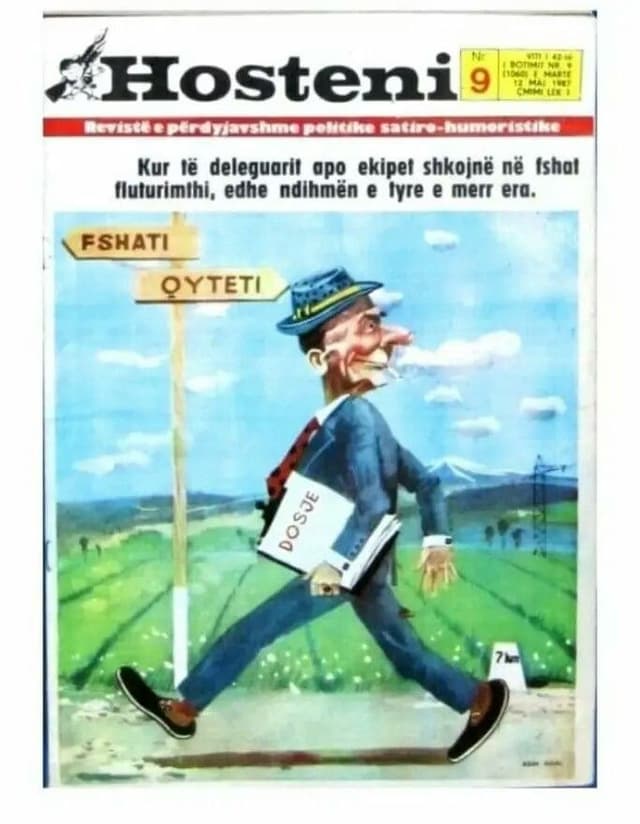
I was still in high school and living in Laç. I wrote fables, epigrams and the occasional humorous poem, because I believed these were the pieces that best suited Hosteni magazine.
My schoolmates considered me a talented boy. Perhaps their enthusiasm gave me more confidence too. I was young, I wanted to write, and whenever a piece of mine was published in the magazine, I experienced it as a major event.
So, one day I decided to go to the Hosteni editorial office myself.
It was no ordinary visit for me. I was going to a place where people worked whom I knew from their writing, but whom until then I had only seen as names on the pages of the magazine. The editorial office was located where part of the library is today, near the 1 Maji park.
I reached the door and stopped. Should I go in or not? I do not know how long I stood there, but I remember that feeling perfectly. My heart was pounding. Today, when I think back on it, I believe I must have been covered in sweat and my face must have been bright red. I had prepared many words in my mind, but the closer I got to the door, the more it seemed as if they had all vanished from my memory.
Finally, I made my decision. I climbed the stairs.
On the right were two editors’ offices. On the left was the office of the editor-in-chief, Niko Nikolla, and another office that handled general topics, cartoons and other materials.
As I walked past the first office, I saw the door open. Inside was Dionis Bubani, who was discussing something with someone. I knew that Dionis handled fables and humorous poetry. In other words, exactly the kind of writing that had brought me there too.
I continued to the next office and knocked.
“Come in!”
I opened the door and went in. I stepped forward, held out my hand and tried to look as calm as possible.
Gaqo stood up and held out his right hand, which was noticeably shorter than the other.
“I am Pilo Zyba,” I told him. “You have published some of my modest pieces a few times, and I came to meet you in person.”
He looked at me for a moment. He did not spend much time examining my physical appearance, because the physical map of my body was small, as I am short, but he immediately noticed the state I was in.
“You have turned into a hot pepper! Bright red!”
I lowered my head. I did not know whether I should laugh or find an answer. My shyness, it seems, was so obvious that Gaqo understood it at once.
And, as only he knew how, he turned the situation into humor.
“We do not want you to turn red as a pepper,” he continued. “We want the pieces you send us to have some pepper in them! We have discussed it with Dionis too. Your writings, fables and epigrams have a high amount of hot pepper!”
Then he laughed.
At that moment I felt a little better. It seemed as if I had passed the first test, although I did not know what awaited me next.
Gaqo called out to Dionis, who came over from the other office. Now there were two of them, and the jokes continued. Their presence set me at ease. I was no longer standing in front of two famous names of Albanian humor, but in front of two people who knew how to make a shy boy feel right at home.
“Come here,” Dionis told me. “Because you have some fees to collect!”
I was surprised.
Fees? I had come to meet them, to shake their hands, perhaps to get some advice. I had not thought that my writings came with a reward too.
We went to the secretary’s office. I signed and took the money.
I cannot easily describe that feeling. It was the first time I was receiving a reward for something I had written. It was not just some money. For me, it was proof that what I did with such passion, what I wrote at a young age and sent to the editors, had value.
For the time, it was not a small amount. And I, with that money in my pocket, felt as if I had achieved something great.
Afterwards, we went out for a coffee.
Here comes one of those details that time does not erase, no matter how many years go by.
After we drank our coffee, I stood up quite naturally to pay. I was happy, I felt lucky to have met them in person, and with the fees I had just received, I considered myself not only rich, but also capable of showing my respect to others.
They looked at each other and laughed.
“Where are you going?” they said almost in unison.
“To pay,” I replied. “I am lucky to have met you and to drink this coffee with you in person.”
They looked each other in the eye again.
“It turns out he is not just a pepper in his fables and epigrams,” Gaqo said.
“Even worse!” Dionis added.
And they laughed.
They did not let me pay. They got up themselves, paid for the coffee, and then, by the entrance door, they wished me well wholeheartedly.
I left.
I do not know how long I kept walking with that joy inside me. I only know that, as I headed back, it felt as if I had won the whole world. I had entered the Hosteni editorial office as a shy boy from Laç, and I was leaving with the feeling that all of Tirana belonged to me.
Today, after so many years, when I remember that day, I do not just remember the stairs, the offices, the fees or the coffee. Two people appear before me: Gaqo Veshi and Dionis Bubani.
I remember the way they welcomed me, how they understood my shyness and how, with two or three jokes, they lifted all that weight I had carried right up to the moment I knocked on the door.
Back then I was a boy who dreamed of writing. They were masters of the word and of humor, but they did not welcome me like a stranger who had come asking for something. They welcomed me like a young man who had set out on his path.
And, perhaps, this is exactly why that meeting never faded from my memory.
Some doors, when we open them for the first time, do not just lead us into an office. They open up a path for us that can last a lifetime.