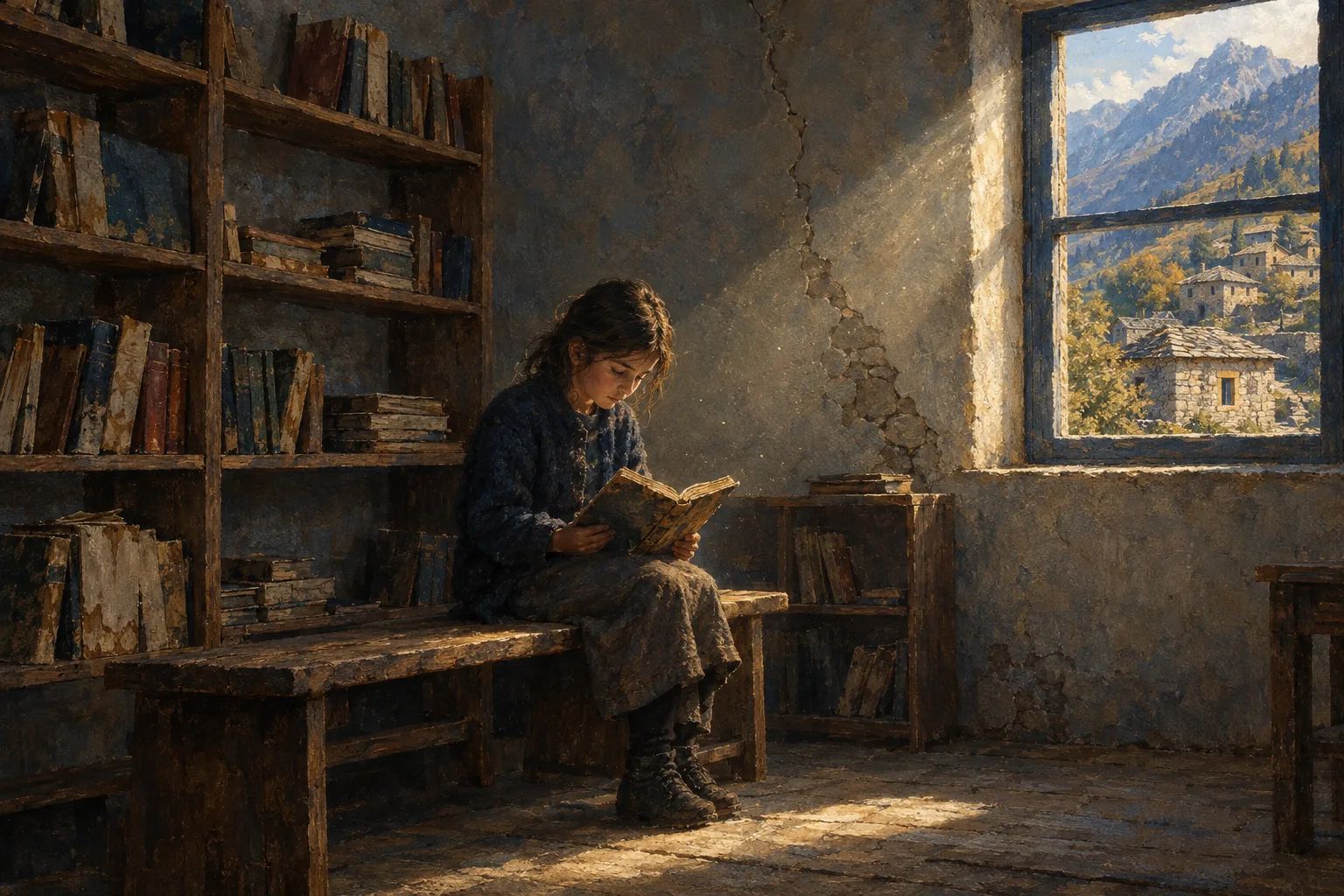
In Albania the National Library is often discussed, but the small shelves in the villages very rarely are, and the very lack of data about them is part of their story.
A network without a map
Anyone looking today for a complete, up-to-date list of Albania’s village libraries will not find one easily. What exists are fragments. Ramazan Vozga, of the Training Centre at the National Library, in a strategy for public libraries republished in 2010 in the Journal of Documentation, described the network as relatively extensive, with libraries answering both to the Ministry of Culture and to local government, and with children often served in separate rooms. But he added that these libraries had worked without a clear national policy framework and that no study or project existed concerning their future.
The legal framework was set by Law no. 8576, adopted on 3 February 2000, on the funding and management of public libraries. Meanwhile the administrative map changed radically. With the territorial reform that took effect at the 2015 local elections, municipalities were reduced to 61 and the former rural communes became administrative units within them. According to Albania’s cultural policy profile, in 2019 Tirana municipality ran 8 libraries, but not all of its administrative units had one. What happened to the shelves of the former communes, across the country, is a question that has not yet received a full public answer.
Examples that speak
A few examples give an idea. In 2018 an article on the Porta Vendore portal described the “Mitrush Kuteli” library in Pogradec: for eight years no new title had been bought, and part of the collection had been damaged by water. If this happens in a town library with thousands of members, it is easy to imagine the state of a shelf in a mountain village with neither a budget nor a permanent librarian.
The scholar Behar Gjoka, in May 2020, when the National Library had been closed to readers since March of that year, summed up the last three decades this way:
“In 30 years it wiped bookshops and libraries out of existence.” (our translation)
— Behar Gjoka, Shqiptarja.com, 26 May 2020
Kosovo’s experience, though for entirely different reasons, shows how fragile this link is. According to a joint UNESCO, Council of Europe and IFLA mission in 2000, Kosovo had about 180 public libraries before 1990, while after the war at least 118 were estimated to remain, most with one or two staff. Library buildings in the rural areas of central and western Kosovo had been badly damaged, while those in towns had fared better.
A village without readers, or readers without a village?
In Albania, the greatest threat to the village library is not war but emptying. The municipality of Përmet, for example, has lost nearly half its inhabitants since 2001, and the administrative unit of Frashër counted just 144 residents in the 2023 census. A library without readers is only a room with books; but a village without a library also loses one of the few places where children and the elderly met around the written word.
There have been efforts to link books with schools. The “Albania Reads” campaign, launched in 2006 by UNICEF and the Mjaft Foundation, aimed to set up a library in every public school. Perhaps the future of the village library lies precisely there: in a shelf shared with the school, a mobile library circulating between villages, or a digital collection that can also be read by those who left.
The map that needs to be drawn
Before any solution, however, something simpler is needed: a map. How many village libraries exist today, where are they, how many books do they hold and who looks after them? Without these data, every debate about reading in Albania stays focused on the big cities, while the small shelves disappear without leaving a trace in any statistic. A country that forgets to count its libraries risks, in time, forgetting why it built them.
Sources
- Renewing Albania's libraries (reproducing Ramazan Vozga, “New national strategy for Albanian public library development in information society”), Journal of Documentation 66(5) / City Research Online (2010)
- Albania: Archives and libraries, Compendium of Cultural Policies & Trends (accessed 2026-10-16)
- Municipalities of Albania, Wikipedia (accessed 2026-10-16)
- Bibliotekat në Shqipërinë e gjeneratës tjetër, Porta Vendore (2018-06-12)
- Bibliotekat mbyllur, studiuesi: Të pengosh lexuesin të shkojë tek libri, kudo do të ishte kriminale. Në Shqipëri është luks!, Shqiptarja.com (2020-05-26)
- Misioni i Bibliotekës së Kosovës: Raporti i IFLA-s/FAIFE-së, prill 2000, IFLA/FAIFE, UNESCO, Këshilli i Evropës (2000-04)
- Përmet (Municipality, Albania) – Population Statistics, City Population (census data, INSTAT) (accessed 2026-10-16)
- Library for every school, Tirana Times (2006)