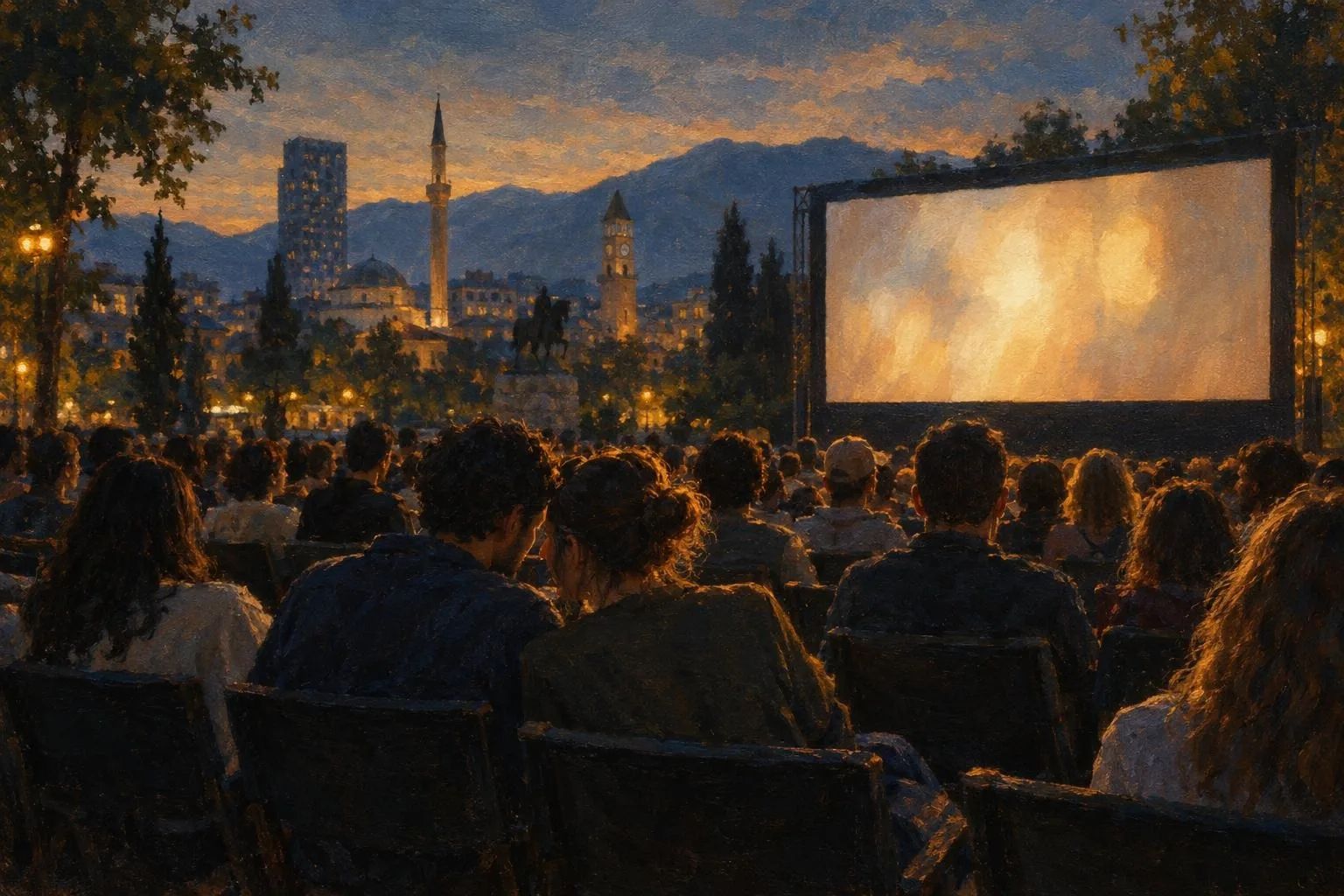
At a time when screens fill us with faceless images, a festival that asks cinema to return to the human being is not indulging in nostalgia but making a choice.
The 24th Tirana International Film Festival (TIFF) took place from 21 to 27 September 2026 under the theme “Bring It Back! Humanography”. The organisers presented it as an invitation to reflect on human stories, emotions and experiences through the language of cinema. According to the festival, the programme screened 229 films from 71 countries, 27 features and 202 shorts, all of them world, international, regional or national premieres.
Founded in 2003, TIFF holds Oscar-qualifying status for the short film category and for the Student Academy Award, and is recognised by the European Film Academy as a festival that can put films forward for the European Film Awards. Screenings were spread across several venues in the city: Millennium Cinema, Agimi Art Center, Kino Piramida, the “Maks Velo” cinema, Vila 31 x Art Explora and Tunèl Terrace.
From myths to people
The choice of opening film explains the theme better than any statement. After the 21 September ceremony, the festival opened with the national premiere of “Mother” by North Macedonian director Teona Strugar Mitevska, first shown at the Venice Film Festival in 2025. The film is a fictionalised account of how a nun became a religious icon, an attempt to see the real person behind the myth of Mother Teresa. For Albanian audiences this angle carries particular weight: her figure is often present in public rhetoric, but rarely as a woman with doubts and choices of her own.
In the same spirit, the programme included “Shame and Money” by Kosovar director Visar Morina, winner of the Grand Jury Prize in the World Cinema Dramatic Competition at the Sundance Film Festival in January 2026. The film, a co-production between Germany, Kosovo and several other countries, follows a family who, after losing their livelihood in the village, are forced to move to the capital. The Sundance jury praised its portrayal of human dignity in contemporary Kosovo. It is a theme that speaks directly to a region where emigration and displacement are not abstractions but family biographies.
Albanian cinema and the archive
The “Made In ALBANIAn” section presented national premieres of the latest films produced in Albania and Kosovo in the Albanian language, while the festival's juries included many Albanian names, from producer Dritan Huqi to actor Nik Xhelilaj. But the most meaningful gesture of the edition came at the close. The closing film was Xhanfise Keko's “Mimoza Llastica” from 1973, presented as a world premiere in a restored 4K version, in collaboration with the Central State Film Archive.
This choice gives the “Humanography” theme a deeper meaning. Albanian cinema from the dictatorship years is a difficult legacy, produced within the ideological limits of its time. Yet the films of that era often preserve faces, streets, gestures and ways of speaking found nowhere else. Restoring them is not an act of nostalgia but of memory: a way of giving new generations the chance to see these images with fresh eyes, in the quality they deserve.
Beyond the screen
The festival accompanied its screenings with a broad professional programme: the fifth edition of its screenplay contest, masterclasses with Teona Strugar Mitevska and producer Labina Mitevska, an animation workshop for children and teenagers in collaboration with the TUMO centre, and a retrospective devoted to Luchino Visconti, with films such as “Ossessione”, “Rocco and His Brothers” and “L'innocente”. According to the organisers, TIFF welcomes more than 30,000 visitors a year, in person and online.
A film festival in a country with few cinemas has a function beyond the screening itself. For a week, Tirana becomes a city where films from 71 countries are seen alongside works by Albanian authors, and where a film from 1973 is shown with the same respect as a Sundance winner. That, in the end, is “Humanography” in practice: putting people from different times and places on the same screen and letting them speak.
Sources
- Welcome to the 24th edition of Tirana International Film Festival 2026, Tirana International Film Festival (2026-09-10)
- 2026 Sundance Film Festival Announces Award Winners, Sundance Institute (2026-01-30)
- Shame and Money, Wikipedia