Writer and poet Alma Mehmeti “goes mad”!
In London, all the television channels are broadcasting this “sad” news
BY PILO ZYBA
Here is what the BBC writes:
Alma Mehmeti, a writer and poet from Albania with roots in Çamëria, has shocked the English public and everyone living and working in the United Kingdom.
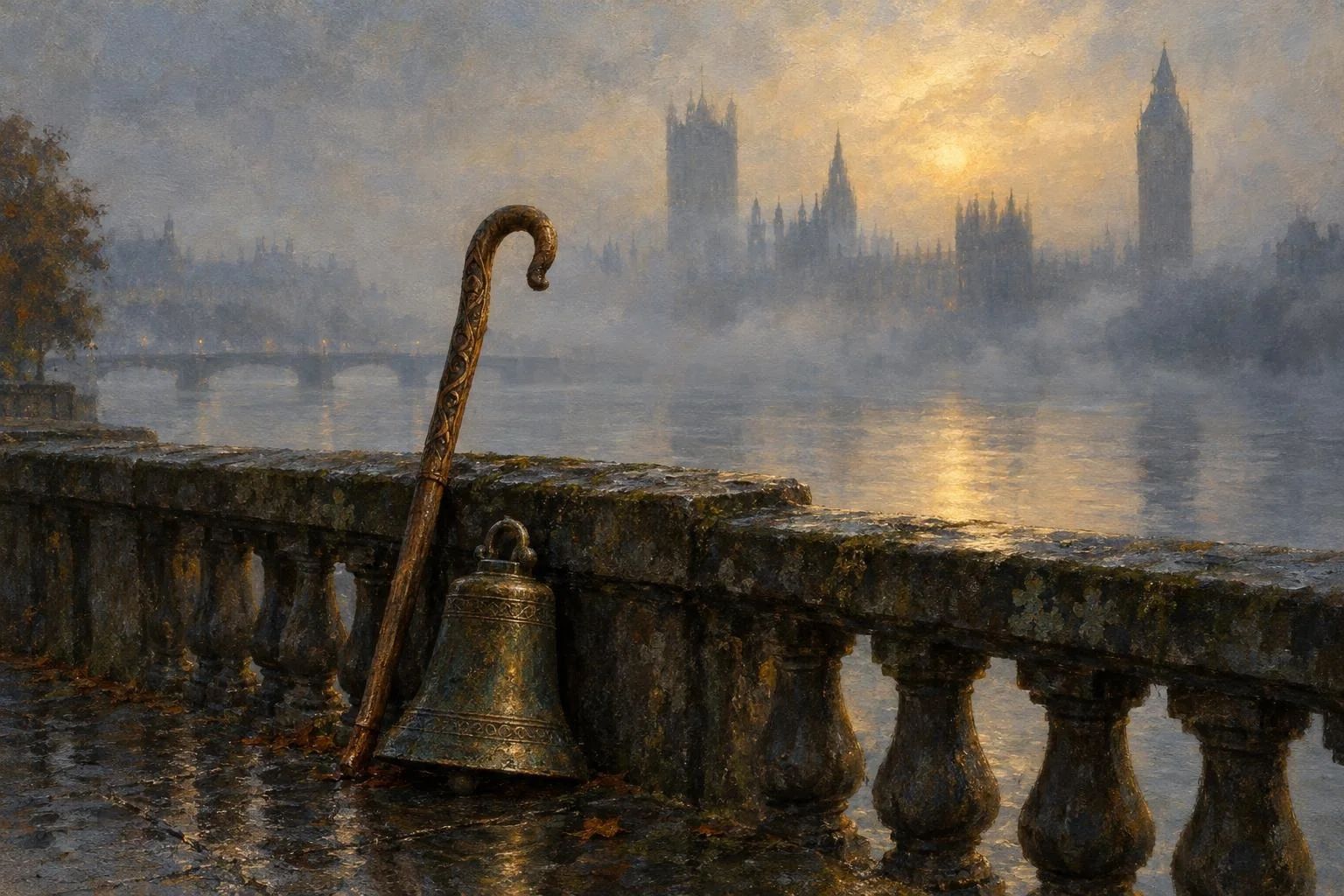
Dressed in a pair of tumane left to her as a keepsake by her grandmother, she has taken up a shepherd’s crook from Labëria, gathered a herd of animals, and is standing in front of the English parliament.
To everyone’s surprise, her herd includes cows and donkeys, birds, hens and roosters, dogs and cats. She has given each animal a name, for example: the bellwether ram is called Edi, the donkey Sali, and an ox Ilir, although, as she says, he is no longer free, because they have put him in handcuffs and he is in prison.
She is protesting in front of the parliament with her animals because our own parliamentarians do not protest for Çamëria and Albania, which were carved up like baklava in this very parliament. The whole herd shouts and brays to demand their rights. From inside the English parliament, barking can be heard; in fact, it is unclear whether it is the parliamentarians barking or the hounds guarding the English parliament.
A little further away, Churchill watches them from his monument and, after tapping out his pipe, shakes his head and whispers, “Evil times have come.”
In the chorus of the herd, Alma notices that the bellwether ram is neither bleating nor shaking his bell. She strikes him right between the horns with her crook and yells at him:
“Edi, open your mouth and ring that bell, because otherwise, the time has come for me to take it off you completely, as election days are coming.”
Sali the donkey shakes his head and looks at the bell, thinking that by taking the bell, they will also take off the packsaddle of crimes he has committed.
Ilir the plow ox stays silent, waiting for the chance to step out and snatch a piece for himself.
Afterwards, the entourage of the herd, led by the shepherdess, passes in front of all the ministries and takes the high road to Oxford Circus and Piccadilly. There, the animals bump into immigrant voters waiting with applause for Adriatik Llapaj. Adriatik babbles up and down that, when he becomes Prime Minister, the people will eat with golden spoons and spend their time basking in the sun. A cordial and cheering meeting. Among them, the donkey raises his head high and brays to catch everyone’s eye. The herd takes the long road to Rainham, since the shepherdess and poet Alma has bought a large house there and, apparently, has thought of having a stable for the animals too.
I approach her to ask a question, but carefully, because her crook is no joking matter:
“Alma, have you put down the pen for good and decided to take up livestock?”
She bursts out laughing:
“No, I took up the crook because I was forced to. Just look at how the cow Albania has ended up, she can barely stand on her feet. They have been milking her for 36 years of democracy, leaving her unfed, poisoning her with pesticides and salmonella. Do you see Edi, with his horns and his bell of leadership, he has reduced the homeland to an empty sheepfold.”
“Alright, alright, but where are you going to put this whole herd?”
She reached deep into her tumane and pulled out the covers of a book. I was astonished; “Are you teaching the animals to read and write?”
“No, but I am going to put all the animals in here!”
“But how can the book hold all these animals, Alma!”
“It holds them, it holds them, because my animals are ideas, they are not stable cows, nor are they neighborhood thieves. They are neither like Sali who ground Albania down... nor like Edi the Ram, who made Albania burst.”
I took her book in my hand and what did I see. The animals spoke like humans and, by braying and shouting at the top of their lungs, they struck out with humor at every wrongdoer and traitor. And while the herd took the road to her sheepfold, I sat down in a park, among trees and grass, and began to read and understand the story of the herd. From time to time I laughed with hope, knowing our humor will never die. Thus, the author Alma Mehmeti, with waves of irony like the sea, shows how the earthquake is approaching.
There I saw that she has not thrown away her sharpened pen, but with its tip in this book she manages to pierce someone in the mind and someone else in the mouth, so that next time they do not make a mistake.
She makes it clear that, with the language of animals, one can strike at the flaws of people, in the Ministry, at home, and in society. The author turns the barking of a dog or the braying of a donkey into a sword against long tongues. And the horned ram pierces you for your own good, so you can become more renewed for society.
For me, knowing Alma, her eye looks deep when a thought is not well planted. She turns her pen into a double-barreled shotgun and runs through the thickets of society, to flush out the flaws from there and hand them to the readers like shelled walnuts. The author has an uncanny ability to spot wrongdoing from afar, be it night or day; the gods have given her this gift. In fact, she does not wear glasses yet, as she is young, but mind you, she does not yield an inch when it comes to flaws in her art. To make what we are saying more believable, let us illustrate it with the fables the author has created. Let us take one of them:
THE DOCTOR...
The car doctor got up one day and said,
“From this day on, I’ll start a new trade,”
And so the ironworker left his screwdrivers behind,
White apron on, a scalpel in his hand.
He was used to using alcohol for the brakes,
Sometimes to brake himself, he’d wet his tongue.
Surprisingly, his feelings were quite numb,
With a tongue like a shovel, he babbled against women too.
He chose his patients, perhaps by their breed,
Or else by how heavy their wallets were.
How much he rejoiced at empty praise,
The bogeyman dragged his patients to their doom.
“I will learn, just as I learned the other trade,
And if someone dies, it’s no disaster.
A doctorate for me is an old profession,”
The old man was making grand plans.
Do you think that your day has come today?
We are not scrap metal, to loosen and tighten screws.
Democracy arrived and, along with its "abundance," instead of doctors and specialists, it also brought us people who change professions and exert pressure for profit. They do not care about the health of the people, but about profit. Many became doctors, and people are dying from their "advice" and their medicines. Others became merchants and are poisoning the masses with products full of microbes. Others grow fruits and vegetables with pesticides. For these and other things, the author has sharpened her pen well and strikes them without mercy. She has the ability to build a little comedy with the medicine of healing, to place it in the mouth of an animal, to make the vice the epicenter of her lashing.
It is worth mentioning here that the author has the ability to beautifully construct a fable artistically. The fable in artistic language is the very artistic invention that the fabulist makes. Because of this, I can say that, even with her first book, Alma joins the ranks of our fabulists like Dritëro, Nonda Bulka, Gjikë Kurtiqi, Jani Duri, etc. As for the female gender, she is the first woman to present readers with a complete literary work:
VELO'S BELLWETHER
In Velo’s sheepfold, a bellwether ram,
With a bell as big as a church bell.
He leads the herd as if he’s been to school,
From one side of the hill, he takes them across.
When he’s full himself, he cares not for the rest,
He lifts his head and returns to the fold.
The whole herd, poor things, with empty bellies,
Keeps the bellwether ram at their head.
This happens every day, the herd is skin and bones,
The ram has five fingers of fat on his back.
From the back, a wise sheep stands up,
But two rams approach her as fast as a spear.
“What did you have to say to me, madam?”
The ram asks her at the front of the fold.
“I wanted to ask, do you have anything to give us?
If only you would share the fat you have with us.”
The poor guy’s horns stood straight up,
Velo the shepherd whispered something in his ear.
“When you need meat to eat,
You should catch that sheep at the back.”
And so the herd learned its lesson,
He continued to remain the bellwether.
He held punishment and reward in his hands,
Velo’s ram with two or three sets of bells.
For all those who read this fable, they will understand that all our bellwethers—that is, those who lead this country on the path of democracy—have as their sole purpose their personal and family gain, not social and national benefit. This is shown better than anything by these 36 years of struggle just to stay in place, or rather, in many cases, we have gone backward. The author, with her artistic scalpel and her ironic manner of expression, brings to light their thoughts, intentions, and wicked deeds. With her elastic, laconic style and the force with which she expresses it, she becomes delightful to read, but also savory in the message taken from her.
Besides what we said above, Alma has another form that unfolds her creativity to the reader in a different way. Drawing from our tradition and humor poets and writers like Qamil Buxheli, Dionis Bubani, Gaqo Veshi, etc., Alma uses satirical poetry. Her satirical poetry is direct and very pleasant to read, in its fluency, rhyme, and rhythm, but also in its message, which at the end resembles a humorous "bomb" that wakes the reader up to the themes the author brings to the book.
The book contains many fables of a high standard in terms of artistic invention, structure, and message. We can mention The Fox and the Wolf, Some Comedian's Tears, The Hiccup, or Foals with Diplomas.
But at the same time, we must also mention satirical poems like Uncle at the Café, Oh If Only I Were a Man, Just Wait Till I Get My Pension, etc.
To deeply analyze the book, we understand that this book of fables consists of three beautiful braids as distinct methods: the fable, satirical poetry, and the method of construction. These three, braided together, create the backbone of the book. These are the three dimensions where her creativity is sustained and moves forward.
Not to prolong our analysis any further, while congratulating the author on her work, I think we should leave the further evaluation to the reader.