BY PILO ZYBA, LONDON
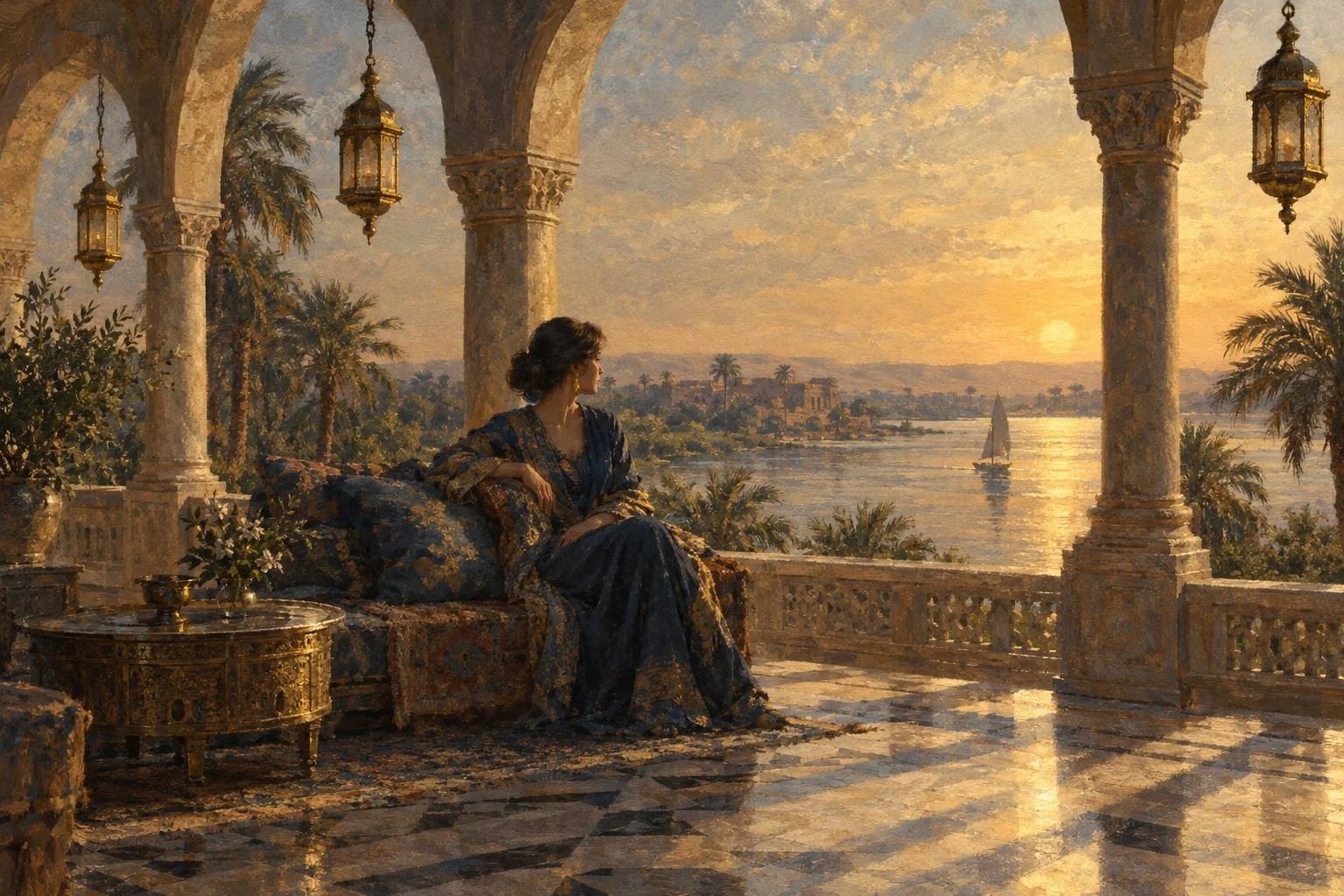
The four-horse carriage stopped in front of the Solynor Naama Bay hotel, in the city of Sharm El Sheikh along the course of the Nile in Egypt. The staff, dressed in red vests and round hats, wore light white shirts and trousers. They took our suitcases and bags, and we suddenly found ourselves inside the grand lobby, its architecture carved as if in ancient times. They greeted us at the reception and asked in English, “What language do you speak?” This happens in Egypt because in that country they have five foreign languages in their school curriculum. It is the only country in the world that asks tourists this way and communicates with them in the language they can speak best.
“Albanian,” I told the receptionist, a dark-haired but very elegant girl under thirty.
She smiled, casting her gaze over us and the staff standing by to serve us.
“Who is the young lady?” she asked me, as everyone turned their heads toward Ardita, who was accompanying me and standing by my side.
“This is the granddaughter of Mehmet Ali Pasha, the founder of the culture and the modern state of Egypt,” I said. In an instant, as if an atomic bomb had dropped, the entire staff bowed forward with their hands on their hearts. I bowed slightly too, and after straightening up, I addressed the girl. “We are in room 444 on the fourth floor, overlooking the great Nile.”
The girl took the key, and I reached out my hand. So that I would not feel offended, she took two chocolates and placed them in my hand, while she gave the key to a tall young man with some hair falling over his forehead and a beard as soft as fine wool from his age. In fact, although they were communicating with me, their eyes remained fixed on Ardita by my side. She stood silent, as sweet as she always is in her posture and her words.
“Would you like to sit down for a coffee?”
“We are somewhat tired from the journey,” I said, “and it would be good to rest a little. Later, when we come down, we can stay for coffee and talk longer.” As we headed for the elevator, I saw that everyone was following us with a sweet gaze, and a smile fluttered on their lips like a breeze coming from a rose garden.
This evening and this sunset were a true marvel. From the room where we were staying, like a reddish brushstroke on a vast canvas of space, the sun rested half in the water and half out of it, like an innocent child bathing in a great natural tub. The purpose of this piece is not our stay in Egypt, so I will skip past this page of my writing.
****
Around eleven o’clock the following day, I saw a middle-aged man of about forty-five walk past us.
After greeting us with a calm and melodious voice, he spoke to me in Albanian:
“May I borrow Ardita for an hour or so and bring her back to you?”
I was surprised, but at the same time delighted.
“Are you from Albania too?”
“No, miss!”
“But you speak Albanian!”
“I was the ambassador in Tirana for eight years, and I like the Albanian language. As well as its history.”
“At which embassy?”
“At the Spanish embassy. My name is Alehandro, and I am here on holiday just like you...”
I cast my eyes toward Ardita as if to get her opinion or see if she wanted to go. She was, as always, silent, calm, and sweet.
“You may take her, and bring her back whenever you think you should,” I told him. “We are in room 444.”
He took Ardita and left, leaving me alone with my thoughts. In fact, I had brought Ardita with me to stave off my boredom at certain hours... but it seems others want Ardita too, I said to myself.
After a long time had passed, I kept my eyes on the road, the way they had gone. It was hot. Lunchtime passed too. The shade of the umbrella had rotated with the sun, and meanwhile, I saw Mr. Alehandro from afar together with Ardita. He came over, and the first thing he said to me was:
“Forgive me, Mrs. Denada, for the delay. Our conversation was pleasant, we had lunch together, and we didn’t realize how the time flew by!”
“You ate, but I went without lunch waiting for you to return.” A scolding tone could be heard in my voice. I was completely covered in sweat.
“It is hot,” he added!
In fact, I was covered in sweat from embarrassment.
He shook my hand, thanking me, and then added:
“I believe we will find the opportunity to have a cocktail together in the evening.”
We nodded, and he walked away, leaving several written pages in my hand.
I glanced at them and saw they were thoughts on Ardita’s poetic art. How wonderful, I thought, this is good for her and gives her creative work one more piece of appreciation.
Alehandro Munioz
A BEAUTIFUL POETIC OASIS
During the time we spent together, whether over coffee or eating lunch, I understood and read from our conversation that we are dealing with a talented and very modest young woman. Her art seems to me more like a beautiful oasis in the middle of the desert, where dozens of seagulls peck at metaphors with their beaks and lift them high. In places, it seems to me that her poetry is entirely one beautiful metaphor, from beginning to end. Dressed with taste, but also embroidered with a filigree verse. Her poems remind me of those embroidered vests worn by the girls and women of the highlands in Kosovo.
I could mention several of her poems here, but I want to speak more about the ones that spoke to me the loudest and most convincingly.
IF YOU WERE A BOOK
In the palm of my hand I would have held you.
With my fingertips,
softly turning you over the cover.
How I would have loved,
to enter you gently between the lines.
To take the virginity of your soul
in every letter, in every word.
To rest after every comma.
To send your exclamation marks to another world,
until they moan amidst an exhausted voice,
and my breath stops at that point.
Instead of a signature,
A kiss upon your brow!
This poem, its verse, its beautiful metaphor and structure, make every reader drink the poetry like a glass of water in the middle of July. In her imagination, which Ardita often has perfected, she sees love as a book. Holding it in her hands, she reads with her pen the feeling, the fragility, and the infinity she seeks within it. Every word is a metaphor, and the whole poem an endless love, which anyone drinks in with their eyes, or rather, swallows whole without waiting to take a breath between the commas and punctuation marks. The poem has a light start, and during the reading, it increases its tempo and poetic rhythm along with its literary figures, just like a marathon runner who knows his strength well and his goal to arrive victorious at the end of the race. And the author has chosen this method in her artistic marathon, closing the poem with a beautiful and successful finale.
After every comma, she says, with finesse and care, to send you to another world... that is, to that world of feelings we all dream of, love, and touch, but with one difference: Ardita also turns it into an impressive poetic art.
In her art, the poet possesses the distinctiveness of poetic art. She cooks up her art in a unique way. She is direct and sparing with words. She selects both her themes and the way she constructs them and expresses her thoughts. This shows an individuality that even many experienced poets lack.
Here is how she expresses herself in the poem below.
RETURN JUST ONE MORE TIME
In the brazier of a soul burned by longing,
your shadow above the embers appears to me as an illusion!
I drink a glass of wine and pray for you!
I know, you do not hear me,
You have migrated to other paths!
I furiously strike the strings of the soul,
beyond the rhythms of the heart my voice cries out,
singing a serenade for you.
From the vortex of pain,
I draw the desire for the sun to fulfill it for me,
And crash like a ray upon your eyes.
Return just one more time,
The shadow of your hand still rocks me
in the cradle of my dreams.
Her literary figures are unheard of and unrepeatable in poetic art. She paints or embroiders her art with the colors she thinks best. She dresses it metaphorically in her unique costume to then give it to the reader as beautifully as possible, poetically, aesthetically, and thematically. In the now vast flower garden of artists, her flower of thought occupies a special place. It has varied coloring, fragrance, and physical beauty; it has a sweet sound on the poetic pentagram of art. Although she is a poet with little experience, she masters the word with certainty, knows how to carve it and give it the shape of an enduring monument in the orchestra of poets.
Ardita, with her imagination, is one of those poets who, with her gaze, finds her theme from an object, a sound, a color, and by working and reworking it in her artistic factory, gives it life, vitality, and deep thought, and through them a message that stays in your mind even after you have closed the pages of the book.
We read below and understand that Ardita, with her artistic microscope, looks so deeply that the imagination of an ordinary reader cannot understand, see, or perceive it.
THE CORN
I imagine...
As if the sickle of the moon were to cut your stem,
the Autumn wind plays with your hair,
the kernels pressed to your chest, it caresses them with passion.
With the softness of its fingers,
it strips off your dress fold by fold, clinging to your body.
In the mill of my mind, I grind you into crumbs of hope.
On the empty table, the only miracle,
Whenever you sweat in my hands,
I pray to God, who blessed me!
Imagine, dear reader, how the autumn wind plays with the (corn hair) — a wonderful metaphor this — while it passionately caresses the kernels of the chest. Further down, anyone who reads it is left speechless by the fragility, by the beautiful dress that is stripped away, and from which emerges the ear of corn of a virgin girl's body. I have read and commented a lot in my artistic life, but these figures have surprised me and make me realize that we are dealing with a talent that time has brought to our artistic and poetic table.
In the poem “Wine,” I only want to take its last four lines, without denying the poem above, but I want to quote them for the beautiful and rare metaphor they hold. Simply by reading these verses, anyone easily creates the poetic image in their imagination, which makes you adore her art and her pen.
WINE
Through my hands,
many tender bunches of grapes,
passed into fermentation.
The same fate awaited them all: “Hermetic sealing”
in the cellar of my adventures,
where I passionately store old loves.
Bloods heated up in the demijohn,
the sweetness left the yeast dead at the bottom.
The foaming must at the brim,
I squeezed through the cheesecloth.
The droplets, drop by drop,
into the small glass I held in my hand.
And with impatience,
I waited to taste its sweetness.
With her beautiful art, the author also delves into the dark corners of society. Into that spiritual and sensory world of women that still remains taboo, but which the author finds with her scalpel-like pen, to strike at this wound that comes from the past, and with art she gives it a new direction and solution, as beautiful as it is original and wise.
NEVER
I could never show myself,
as I wanted to be.
I suppressed it inside myself,
I altered it,
I gave it a completely different look.
In this cursed world,
where for the sake of face
you have to swallow so much.
To close your eyes to the bad,
to laugh even when you feel like crying,
in front of those who want to kill your dreams.
In general, all her art is characterized by a concise form, style, and thought, and a thematic breadth, thanks to the talent Ardita possesses. I could mention many of her poems here, which I read while eating lunch, while drinking coffee, and even after I stayed alone in my hotel room to do the analysis.
Nothing remains for me but to see her poems in the light of publication in the Spanish language as well, if I am given the permission and the opportunity. Wishing you success!
When I read the careful analysis of our poet Ardita, I forgave the wait in the sun for more than five hours. His pen had gone deep, had read and analyzed her beautiful art down to the details.
***
The days flew by and we had to fly again, but this time in another direction toward the continent we had set off from to come to Egypt.
A week later we unloaded our suitcases in the middle of Athens at the English hotel “Grande Bretagne”. On the exact same floor, in the exact same number... room 444, fourth floor.
I don't know why Ardita's dress and beauty caught the eye wherever I went. One of the hotel managers asked me:
“Where does this beauty come from?”
“From Kosovo,” I told him sharply. “From that Kosovo that you have not yet recognized as a state.”
“Not me,” he said, as if caught in guilt. “I am ready to recognize it this very moment, this beauty of Aphrodite.”
“This is Aphrodite's sister,” I told him, not without irony.
“Aphrodite is Greek,” he addressed me, full of indignation.
“That is what you have been told, but just look, do Greek women look like this? If you gather them all together, they don't even amount to half of her.”
He saw that the discussion was pointless, put his tail between his legs, and left.
Afterward, we went out onto the balcony and ordered a coffee to relax a little. Before us stretched the Greek Parliament on one side, and the Academy of Greece on the other.
“And these men,” Ardita said to me, “are wearing our fustanella.”
“Yes, we have this as a gift from the King of Bavaria, the German Otto. He turned our costume into a Greek designation. While this building you see across from us is the Greek Academy, which was built by the Albanian Simon Sina.”
The days were busy, seeing and explaining Athens to Ardita, its origins and its name.
The next day I went out to drink coffee with an old friend who publishes an Albanian-language newspaper in Athens. When I returned, I did not find Ardita in the room. I looked for her on my floor, in the lobby, in the dining room where we ate breakfast and dinner, but she was nowhere to be seen. I grew tense, and also frightened. She does not know the language, she does not know the outside environment. I thought she might have gone out and lost her way.
I went down to the reception and asked:
“Excuse me, but my friend who is staying with me is not upstairs!”
“I don't know, madam, but I see that the room key is here. Perhaps she has gone out somewhere around here.”
But Ardita did not appear in the afternoon, nor in the evening. I called one of the hotel managers and told him:
“I need to report this to the police, because this seems like an extraordinary event to me.”
“Do not worry, madam,” he cut me short. “We are a serious business, we are monitored by cameras.”
“Then find Ardita for me,” I told him in a raised voice.
Ardita did not appear the next day either, and I checked the news and the newspapers first thing in the morning for any possible scandal.
On the third day, I was lying down and thinking about what I should do, when the phone from reception rang.
“Yes, has she arrived!?”
“Who?” spoke the voice on the phone.
“Ardita, who else? I have no use for anyone else!”
“No, someone else is asking for you down here, a gentleman in his sixties.”
I got up hastily. Something has happened, I thought. Now comes the bad news, earth swallow me whole, how will I answer Ardita's people to whom I gave such assurances when I took her with me.
When I went downstairs, I saw my friend Durim Haberi in front of me!
“What are you doing here?”
“They told me you were here and I thought I'd pay you a visit. We haven't seen each other in a long time, since you left Greece for London.”
“Haber,” I told him, “I am worried, I have lost Ardita Lajçi!”
“Who?” he said. “That girl from Kosovo?” “Yes, yes, how do you know, do you have any news, because you journalists get in everywhere!”
“One night she slept with my daughter!”
“What!”
“Another night with my wife!”
“Where did she find your daughter, and your wife?”
“My daughter works here as a manager and as part of the hotel's advertising in Greece and abroad.”
“We talked with her for a long time, a talented and quiet girl. I have written a review of her work for the upcoming Friday newspaper.”
“Leave the reviews, Durim, because I have lost my patience, where is Ardita!”
“I left her at my house, with my wife and daughter. It seems they might come here together.”
“Please call her quickly on the phone to come now... now!” My tone of voice was so loud that all the staff in the hall and lobby turned their heads, as they are not used to such behavior.
Haberi made the call. The answer from the other end was: “We will be a little late because we are at the hair salon, we want our guest to become even more beautiful than she is.”
I was understanding nothing.
Durim left a stack of papers in my hands and told me, “Here you have an analysis of her work that will be published on Friday. Goodbye.” Just as he had come like lightning, he left, giving me a cold shower of rain.
DURIM HABERI
I do not know what name to baptize my friend with, who by chance stayed at our house. Her name is Ardita, but with what I saw and read I could call her Art-dita. Because by reading her art, my day became beautiful, and not only that. I have lived in Greece for about 30 years, and I have seen very few Kosovar poets in this country, and at the time of their arrival, much noise and fuss was made about their work. Whereas Ardita came in silence, giving us the pleasure of her company, but also of her quiet, yet beautiful and impressive art.
Whoever enters her artistic world of poetry understands that we are dealing with a doctor who, with the scalpel of her pencil, analyzes an entire spiritual world regarding feeling, and especially regarding love.
Her publications are few, the flower garden of her work today is small, but the artistic colors and above all the depth of thought reach down to the very last cell.
Without dragging things out, we will try to discuss and analyze what she conveys to the reader.
HOW MANY TIMES
How many times I have wanted
to run far from the truth
To fulfill my dreams.
In a world filled with sins,
where souls tremble
beneath the waltz of love,
and the body submits to the madness of the mind.
Ardita is a woman of few words and much work. She squeezes her thought to the last drop to turn it into must. So that the reader receives value and quality, rather than volume. Her thought and her work are such that from the great creative lake, from the turbines of the hydroelectric plant of thought and creation, she brings an idea to light, into a message, in the highest possible quality...
DO YOU SEE IT
How sweet
love comes to me,
Even though it often stops my breath.
Tell me, for God's sake;
Are you feeling the heart
Are you seeing
How pleasantly it beats for you?
That even my glow has changed,
Revealing all the chaos I hold inside!
Often I want to step out of myself,
Just to love you
the way I know how to love.
At first glance, the above poem seems simple, but in the depth of its thought we see something special and a spiritual contradiction of the author. She seeks in her art not the superficial appearance, but that of the inner world. She fights for a person to be open, free, and themselves in their feelings, because only in this way will the world itself see and understand, but also appreciate human feelings. And that is why her ending is striking and shocking to society, which most of the time dreams and desires one way, and appears another. All of this stemming from thoughts and prejudices.
Besides this, Ardita has the ability to play beautifully with the dough of the creative word, and through a small artistic invention to convey a message that is as sarcastic as it is serious.
I CANNOT HELP BUT LOVE YOU
How pleasantly you laugh,
Giving grace to your appearance.
How sweetly you speak,
sweetening my day as well.
I cannot help but love you,
Even though from all that sweetness
I risk getting diabetes!
She cultivates all the lines of the pentagram even though they change sound, but whether they are minor or bass, they always sound beautiful in the orchestra of her creation.
Her perspective, or the window from which she harvests her creative themes, is delving deep into the human soul, into that world for which little is done today, and the fight for women, the social and family aspect, etc., is poor and leaves much to be desired.
“I Killed Love with My Own Hands!”
Loving it more than I should,
I suffocated its free breathing,
I killed it without premeditation.
Yet I served the sentence,
in the cell of pain.
I am afraid to love again.
Perhaps I am sick and,
will turn into a serial killer.
It often happens that we give everything to love, because that is how we feel better and more fulfilled. But not everyone understands this kindness, and we are often disappointed and wounded in our feelings. This theme, too, has not escaped Ardita's pen. She is an experienced and careful hunter of everything that surrounds her. She puts a bullet in disappointment, but also prays to find a new feeling, so as not to be disappointed.
Finally, one more poem that I think should have the closing word of my modest analysis, but which, for Ardita's work, I think will not be the last.
THE LAST FIRE
I blow on the last embers,
That are about to go out,
Just so this love catches fire one more time.
Let it ignite all the strings of my soul
And let me turn to ash in its memory.
Her artistic and creative broad-heartedness, even in the most difficult moments, lends a hand to love once more so as not to extinguish that warm hearth, from which pure feelings are born, and life becomes more beautiful.
Not wanting to close my analysis here, I leave it to the reader to correct me or prove me right regarding her artistic creation. Wishing her success in her crystal-clear poetic spring, which flows from the mountains of her thought and goes to the reader as spiritual and intellectual nourishment.
***
As soon as I finished this analysis, I heard a knock at the door. I got up hastily and opened it. In the doorway, I saw a grown girl, who with a smile on her lips told me:
“I came to bring you Ardita,” she said, handing me the typewritten book I had been waiting for for three days, and walked away, swaying like a rose shoot in the evening breeze.
I passed it through my hands, caressed it like a small child, and was thinking;
Ardita had given it to me to edit and proofread, but also for a short foreword before publication. But now there was nothing left for me to do in this regard. Friends and comrades had done the analysis, and their thoughts had perfectly fulfilled the purpose of my work.
Nothing remained for me but to wish it a good journey to the publisher and the reader.