A Satire
Things happen in Albania that happen nowhere else in the world.
For example, someone wakes up one morning and says,
“We must re-bind the Lidhja e Shkrimtarëve!”
And immediately you get the impression that Albanian literature had been untied like a mountain goat through the sheepfolds of the transition, and now must be caught again with an institutional rope.
The word “Lidhje”, in itself, sounds very romantic. It reminds you of a bond in love, friendship, and spiritual closeness. But in Albania it has always had a more practical meaning: to be tied to the party line.
Once, when Enver Hoxha created the Lidhja e Shkrimtarëve dhe Artistëve, writers were not tied to each other, but to the ideology. It was a kind of collective marriage to socialist realism, where artistic divorce was punished more severely than marital infidelity.
That Lidhje had everything: buildings, offices, secretaries, drivers, funds, per diems, meetings, congresses, reports, and above all, fear.
A writer went in a poet and came out a set of meeting minutes.
Today, after thirty-some years of democracy, a few veterans of the pen decided to “re-bind” it again.
But what exactly will be re-bound?
The building is gone.
The funds are gone.
The state does not pay.
The readers have fled to TikTok.
The poets fight on Facebook.
And the novelists publish their books with the money of their emigrant brothers-in-law.
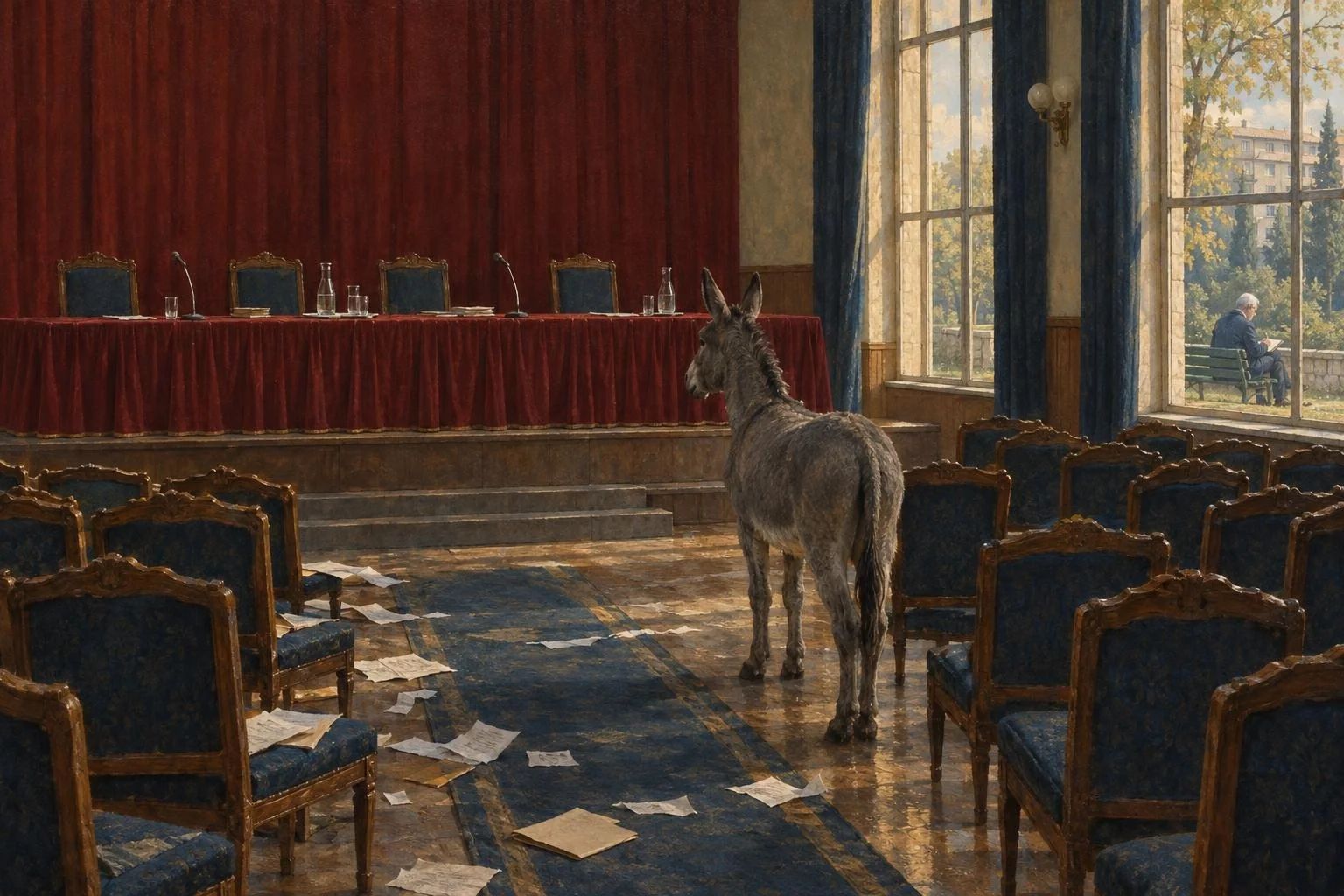
Nevertheless, the assembly took place.
With great solemnity, in fact, as if the new Constitution of Albanian literature were being proclaimed.
There was so much ego in the hall that if the lights went out, the illumination would continue solely from the participants’ self-esteem.
They spoke there of the “unity of creators”, while before the assembly had even finished, a literary civil war broke out on social media.
One wrote,
“The elections were rigged!”
Another,
“The statute was not respected!”
Yet another,
“No one asked the poets of the south!”
Someone else,
“Why was there no representation for the metaphysical poets?!”
“Why weren’t the emigrants represented?”
In the end, only one statement was missing:
“This assembly does not represent traditional Albanian rhyme.”
But the climax was the issue of women.
According to some of the assembly’s patriarchal minds, women can write poetry, novels, plays, elegies, and even 500-page books… but to lead the Lidhja, you need a man.
So, according to them, a woman can create characters, philosophical worlds, and an emotional universe, but she cannot lead the meeting where the agenda and the coffee-break byrek are discussed.
And so the assembly took on a somewhat medieval air.
It seemed as if Lekë Dukagjini had risen from the grave and taken charge of the voting commission:
“Let the women write. The men decide!”
In fact, this was no longer a Lidhja e Shkrimtarëve.
It was a mix of the Kanun, nostalgia, and the 1972 statute.
Meanwhile, outside the hall, true literature continued its life without a statute, without a stamp, and without meeting minutes.
A young girl was writing poetry on her phone.
An emigrant was publishing his memoirs on the internet.
An old man was writing stories in a squared notebook.
A boy in the provinces was reading Hemingway, hidden from the noise of TikTok.
So, literature lived on.
Only the Lidhja needed an institutional respirator.
And thus the Great Assembly of the Re-binding came to a close.
Some came out happy.
Some angry.
Some with posts.
Some with the statute in their pockets.
While Albanian literature…
continued on its way alone, as always—without asking anyone.
*
London…..May 2026