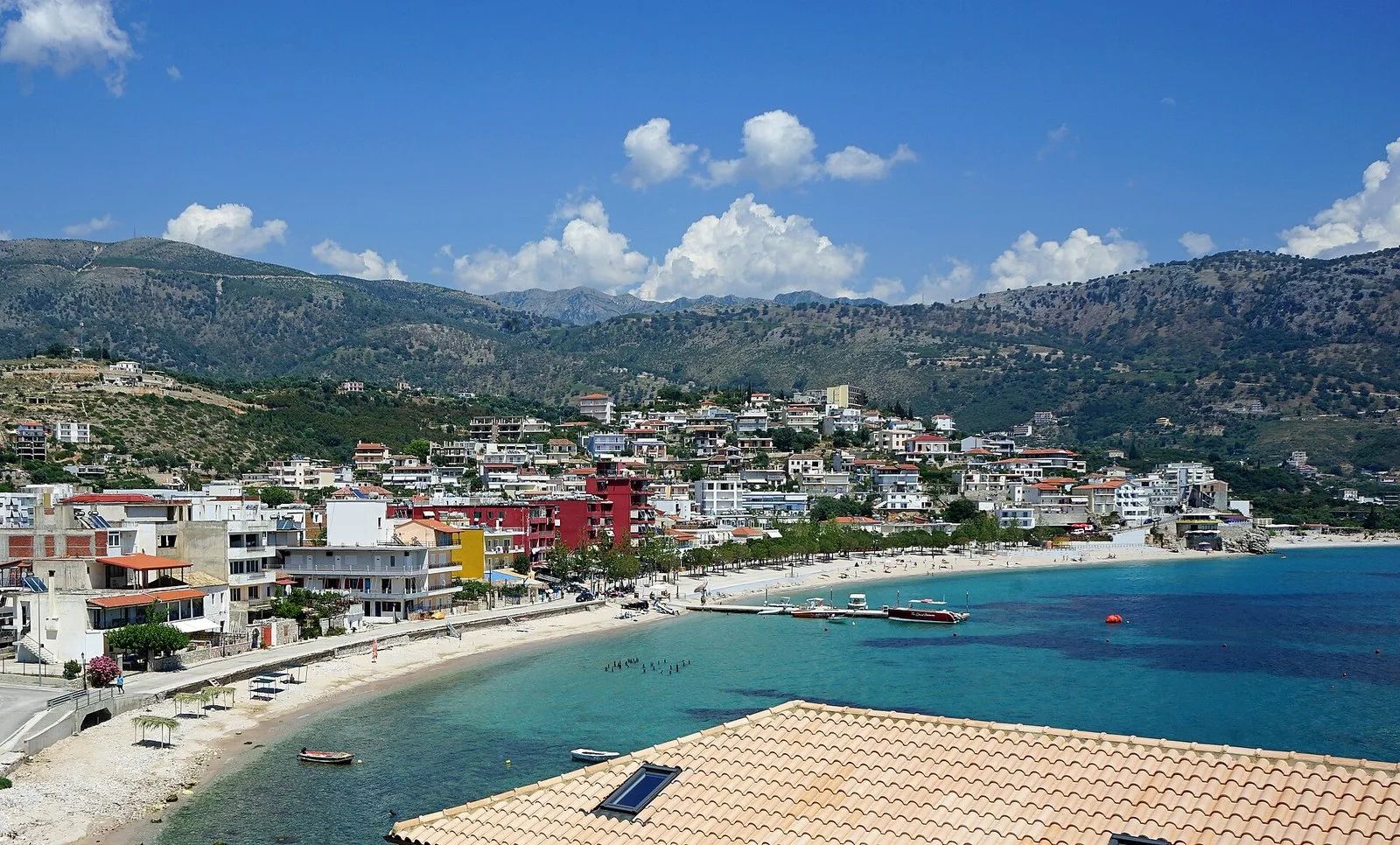
Few places in Albania come up as often in relations between two states as Himara, and few are heard so rarely in their own voice. This spring, Prime Minister Edi Rama and the Greek defence minister, Nikos Dendias, spoke about it once again. I believe the debate needs to return to what makes Himara distinctive: its languages, its property and the people who live there, or who have left.
Two languages on one coast
On the Himara coast, Albanian and Greek are both spoken, often by the same people. Rama himself, in an interview with the Greek newspaper Kathimerini reported by Euronews Albania on 20 April 2026, acknowledged this reality: he said that in some villages of the area there are people who speak Greek, though not in Vuno, his mother’s village. In the same interview he noted that Himara’s tourism material is published in Albanian, Greek and English, and presented the current mayor, who has one Greek and one Albanian parent, as a model for both communities.
This bilingualism is neither new nor simple. In a report for Osservatorio Balcani Caucaso in April 2025, the journalist Petra Dvořáková met people in southern Albania who feel both Greek and Albanian, and who remembered that under the dictatorship they were not allowed to speak Greek. That shared memory of prohibition, of a language that had to be kept inside the house, seems to me a more honest starting point than any ethnic map drawn in the capitals.
What each side says
Athens has made the question of the Greek minority, property included, a permanent theme of bilateral relations. After meeting Rama on 25 May, Dendias said he had spoken about Himara, the town he believes he originates from, and reiterated his position that “the Greek ethnic minority is a bridge of friendship between the two states and the two peoples”. In earlier years, according to BIRN, Greece had threatened to obstruct Albania’s EU accession process, accusing Tirana of flouting the rule of law and violating the rights of the Greek minority in Himara.
The Albanian state frames the question differently. Rama has argued that property is not a minority problem but a national one, the result of five decades of expropriation and a turbulent transition in which documents were destroyed or assigned to the wrong people. In his words, “Greeks and Albanians living in the same village face the same challenges”, while the government is unifying the cadastre and issuing Himara’s residents ownership titles for their old houses.
Voices also differ within Albania. When Greek Prime Minister Kyriakos Mitsotakis visited Himara in December 2022, the leader of the Democratic Party, Sali Berisha, declared that Himara had never been Greek and that its people had shed blood for their Albanian identity. That position expresses the feeling of the many Himariots who see themselves as Albanian, just as Dendias’s words express the feeling of those who see themselves as Greek. No one has the right to deny either group that self-understanding.
Property, courts and a mayor in prison
The case that turned Himara into a diplomatic issue was that of Fredi Beleri, the Greek minority’s candidate, arrested in May 2023, two days before the local elections, on charges of vote-buying. He won the election, but the Special Court sentenced him in March 2024 to two years in prison, and the Court of Appeal upheld the ruling in June that year. Meanwhile Beleri was elected to the European Parliament for New Democracy and was conditionally released in September 2024. The Albanian government has said it had no role in his arrest; Beleri himself, after his release, announced that he would complain to the European Court of Human Rights about what, in his view, he had been denied. In his April interview, Rama described what happened as unfortunate.
The courts have also spoken about the other side of the problem. In March 2026 the Special Court of Appeal upheld the conviction of Himara’s former Socialist mayor, Jorgo Goro, and his deputy for abuse of office linked to irregularities in issuing agricultural land ownership deeds. It was Goro’s second conviction, after an earlier case concerning the transfer of state land into private ownership with falsified documents, in which he had pleaded guilty.
For residents, these are not chapters in a national clash but everyday questions. In 2024 a 64-year-old trader told BIRN that Himara had chosen Beleri because it believed he would defend its properties and rights. Another resident, aged 50, said that neither he nor his 84-year-old father was registered as a resident of Himara, and that all he wanted was for the problems with his land and house to be resolved.
A municipality with more voters than residents
According to the 2023 census, 8,328 people lived in Himara, while according to media reports cited by BIRN, 23,130 voters were on the municipality’s rolls. The gap shows how many Himariots live elsewhere while remaining tied to their birthplace through property, the vote and memory. Nationwide, according to census data reported by Novinite, 23,485 people declared Greek ethnicity, in a questionnaire where the ethnicity question was optional. The results were contested: in an analysis for the New Lines Institute in May 2025, Rudina Hajdari wrote that the census had caused disputes with Greece and North Macedonia, and that the absence of secondary legislation had left the 2017 law on minorities largely unimplemented.
I think the real question is not “whose is Himara”. It is whether a resident who speaks Greek, Albanian or both can hold a title to their grandfather’s house, teach their child the family’s language and vote without feeling hostage to a dispute between two capitals. This review has written before about the literature of Albanian emigrants in Greece, where two languages live on the same page. Himara is the place where that coexistence has existed for centuries, long before it became a conference topic. It deserves to be given back to its residents.
Sources
- Himara, EU negotiations and his origin, Rama interview for Greek media, Euronews Albania (2026-04-20)
- ‘I consider Himara my place of origin,’ Dendias after meeting Rama: The Greek ethnic minority is a bridge of friendship, Euronews Albania (2026-05-25)
- In Albania’s Himara, Property Rights More Important Than Greek Diplomatic Row, Balkan Insight (BIRN) (2024-08-05)
- Ethnic Greek Politician Fredi Beleri Released from Albanian Prison, Balkan Insight (BIRN) (2024-09-02)
- Albanian Ex-Mayor Convicted in Second Abuse of Office Case, Balkan Insight (BIRN) (2026-03-25)
- Being Greek and Albanian at the same time, Osservatorio Balcani Caucaso Transeuropa (2025-04-03)
- Mitsotakis në Himarë, Berisha: Kurrë minoritet grek, kanë derdhur gjak për shqiptarinë, Shqiptarja.com (2022-12-23)
- Bulgarians are the Fourth Largest Minority in Albania, Novinite (2024-06-29)
- Why the Issue of Minority Rights in Albania Could Become a Roadblock to EU Accession, New Lines Institute (2025-05-12)