Five years after Albania created a poet laureate title of its own, the question that follows it is no longer who deserves it, but what it means for a state institution to appoint poetry.
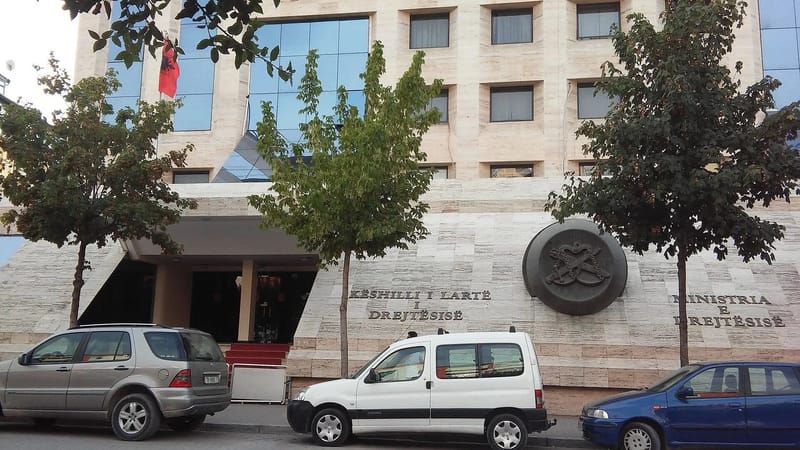
The title was born in the autumn of 2020. On 31 October, at the Ministry of Culture, the National Centre for Books and Reading (QKLL) named the poet and translator Rudolf Marku as its first holder. The appointment ran for two years, came with a prize of 200,000 lek and carried a concrete task: within four months the laureate was to present a project for spreading Albanian poetry. The jury, chaired by the writer Besnik Mustafaj, described Marku's work as rich and coherent, able to stand beyond its historical and political circumstances, and cited his work as a translator of world poetry classics.
It did not take long to see that a new title does not land on clean ground. The scholar Lisandër Kola called the decision a disgrace and reminded the public of the poet's role during the dictatorship. From its first day, then, the institution ran into the question that Albanian literature since 1990 has still not settled: how to read work written under a regime, and how far an author can be separated from his time.
A title in search of rules
The second edition, in 2023, moved the debate from biography to procedure. In February, Visar Zhiti sent the QKLL an open letter asking for his name to be removed from the list of nominees. He mentioned distance, since he was writing from Chicago, far from home, and uncertainty about the title's purpose, but his main argument was one of principle:
"Nuk konkurrojnë autorët, sipas meje, por konkurojnë veprat." ("In my view, it is not authors who compete, but works.") — Visar Zhiti, open letter to the QKLL, February 2023
In September that year, the QKLL's director, Alda Bardhyli, made the criteria public: the quality and impact of the work, its critical reception, a modern spirit, translation into at least one foreign language, participation in international events and a clean public record. In October, Marku left the jury, saying that most members did not know the work of the candidates they themselves had proposed; Bardhyli replied that she had replaced him because of a smear campaign against the jury. On 31 October 2023 the title went to Luljeta Lleshanaku, with a citation that placed her modern verse, far from automatic metaphor, and her influence on a new generation of poets at its centre.
When a jury speaks the language of sociology
In December 2025, the QKLL named Rita Petro poet laureate for the 2025–2027 term. The most closely argued response came from the poet and scholar Mujë Buçpapaj, who, in a piece published on 27 December, did not deny the author's right to write as she pleases but objected to the jury's language. The citation spoke of bold themes, of overcoming moralistic taboos and of an energy that drives individual and social emancipation. For Buçpapaj, these are ideological formulas, not aesthetic categories. He added a concern tied to the public nature of the title: when the laureate is expected to visit schools, the choice is no longer only literary but also pedagogical.
One may or may not agree with his reading of Petro's work. But his remark about the jury's language touches something wider than this appointment. When a public institution judges poetry in the vocabulary of social impact, it risks repeating, with the sign reversed, the logic of a time when verse was measured by its political usefulness.
What poetry asks of the state
In countries where the title has a tradition, the poet laureate is not mainly a prize but a public duty: to carry poetry to places it does not reach on its own. In Albania, where state literary prizes have changed names and rules so often that, as Preç Zogaj has pointed out, they have lost part of their authority, the danger is that this title too becomes one more medal to argue over rather than a programme.
Three appointments in five years have shown that the problem does not lie with the poets chosen, each with their own readers and detractors. The problem is that the title's rules have not yet entered public debate with the same clarity as the names: who nominates, who judges, how decisions are recorded and what exactly is expected of the laureate once the ceremony is over. Without these, every announcement will reopen the same wound, while poetry, to which the title is dedicated, will again be left in the background.
Perhaps this is the question worth putting to the QKLL before the next edition: not who, but how. A title meant to awaken the reading of poetry would gain more from transparency than from any name.
Sources
- Rudolf Marku zgjidhet Poet Laureat; studiuesi: shamia e Musine Kokalarit sot më e zezë se kurrë, Shqiptarja.com (2020-10-31)
- I nominuar për Poetin Laureat, Visar Zhiti letër të hapur QKLL: Ju lutem hiqni emrin tim, BalkanWeb (2023-02-16)
- Nga promovimi i mendimit të lirë te pastërtia e figurës, kriteret për Poetin Laureat, BalkanWeb (2023-09-18)
- Poeti Laureat 2023: Alda Bardhyli dhe Rudolf Marku përplasen për jurinë, Shqiptarja.com (2023-10-06)
- Krijoi një brez të ri poetësh: Luljeta Lleshanaku, kurora e Poetit Laureat, Shqiptarja.com (2023-10-31)
- Skepticizmi im mbi titullin “Poet Laureat” (Mujë Buçpapaj), Telegrafi / Gazeta Panorama (2025-12-27)
- Për poetin laureat dhe çmimet letrare (Preç Zogaj), Telegrafi / Panorama
- Rita Petro, Wikipedia