The author of the article, with Ricos’s daughter and his granddaughter
MY MEETING WITH THE POET JANI RICO’S DAUGHTER ... the writer...Eri Rico
Part Three and the Last
A GUEST IN RICOS’S HOUSE
By Pilo Zyba
A long time passed without my seeing her after that parting. She spent her summer holidays in Karlovac on the island of Samos, where her mother’s house was. On a clear evening at the beginning of September, Panajoti, the owner of the café, let me know that Eri would be expecting me at her house in the castle the next morning.
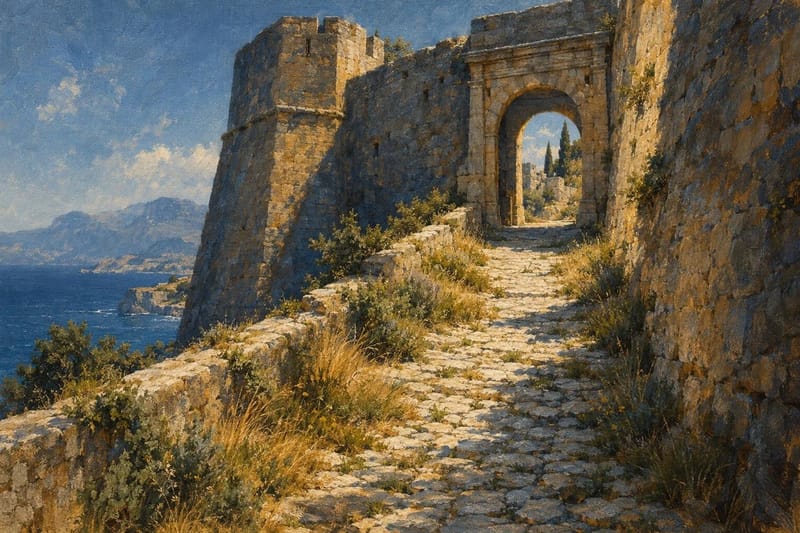
It was a clear morning, and I set off on foot to enjoy it as a gentle stroll along the seashore up to the castle. Ricos’s house, surprisingly enough, sits right above the castle’s entrance gate. It looks like a great welcoming door; it feels as if all the tourists and visitors entering the castle must first knock on his door to get their entrance ticket to visit the history that unfolds inside the castle, where every house, every stone, every church, every ruin is an event, a history. His bust is placed on the outer veranda of the house, and from sunrise to sunset, this bust takes dozens, if not hundreds, of photographs. If you open many websites around the world today, you will see this view of the house on many blogs, videos, and so on. From this veranda, Ricos saw the wide world, with its good and its bad; sometimes he performed an autopsy on it, and sometimes he stamped its beauties into his verses.
I checked my appearance once more and knocked carefully on the door, carefully, feeling as though if I knocked any louder I would frighten away his memories.
“It’s open, come in!”
I opened the door and stood in the frame. A plump, blonde-haired lady came to receive me. She hugged me and welcomed me.
“Eri is coming right now,” she said. “I am her first cousin, my name is Dhespina, I am the daughter of Ricos’s sister, Lula.”
I cast my eyes around; it was a house furnished in an old tradition. In the background there was a piano, the fireplace, and a rich bookcase made of old but beautifully carved wood. The curtains were hand-embroidered just like ours, made of lace. A large table, and on it open old books, a pair of glasses, ink and a quill pen, fountain pens. A silence that spoke, an environment that took you back in time and feeling. The living room and the bedroom together were a bit dark. Strangely enough, a beautiful ray of light came in through the window and rested on the writing desk. Later they explained to me that this ray of light was combined with mirrors so that it would strike the desk at all hours of the day. I took the books and objects in my hands, I touched them, I looked at them, and I felt as if I were in another world. They had their own way of speaking; they spoke with their presence, with that color the years had cast upon their backs. Half-torn pages with his signature and handwriting, a passport from 1930, a box of paints and brushes, and further on the walls his paintings, done in oils, watercolors, and water-based paints. On the old piano with its lid open, rested a musical score
with Vivaldi’s movements; it had been left open at “Spring”. I cast an eye over the notes; I like music, and their melodic line echoed in my ear. I have played it many times, though not on the piano.
It seemed to me that this piano held Ricos’s joys inside it, and if you placed your fingers on it, it would begin to tell of his life, his joys, and his sufferings with its voice. Its language is just as beautiful as poetry. I was completely alone in this house at those moments, just me and Ricos. I could not hear his voice, but I saw his face in these dozens of objects. Sometimes it came to me from the paintings, sometimes from the lines of text, and sometimes from the sounds of this piano. I was in another world; I do not know if I was in a dream or in reality, but I liked what I was experiencing and did not want it to end. I was brought back to my senses by Eri’s voice standing behind me with a tray in her hand.
“Good morning, here we are seeing each other again. Shall we sit inside or go out on the veranda?”
“Wherever you wish!”
“We’d better go outside, I’ll tell you why later.”
We went out onto the large veranda from where the endless depth of the sea could be seen; the first clouds had begun to appear like torn curtains in the depths of the sky at the far end of the sea’s horizon where it meets the sky. They looked like large sailing ships bringing the first news of the change in the weather.
She left the front door open. It was not long before visitors filled the rooms, the veranda, and the corridors of the house.
“That’s why I told you we should sit outside, otherwise they wouldn’t even let us drink our coffee,” she said. “Out here no one knows I am Ricos’s daughter; they come, take photographs, leave their impressions, and go. When we are not here, the house stays closed.”
Many years have passed since then, but these conversations have stayed in my mind. Later, Dhespina, Eri’s aunt’s daughter, came over too. For as long as she stayed, she did not stop talking about her mother and about Ricos; she was haughty, she wanted to show off. She worked as a composer of modern music, acted modern, and aimed high. She had nothing in common with Eri, yet Eri respected her with her silence and her quiet nature. It was a good thing she only stayed a little while and left to go shopping. I waited a bit and, to spur the conversation, I said to her:
“This view is wonderful,” I said, and pointed to the sea. “From here your father waited for the motifs of his poems to come to him.”
She smiled, two little dimples forming on her cheeks, filled a glass with water, and said to me:
“My father was a very quiet, patient sort of person. He spoke little and worked a lot. He read a great deal; you never saw him sitting idle. He read everything he could get his hands on. Among his favorite writers were Pallamas (1859–1943) and Sikelianos (1884–1951); he kept up to date with all the publications that came out. Of the foreigners, he really liked Majakovski, Neruda, Aragon, Elyar, Eliot, Hikmet, and so on. I don’t know who he preferred the most, to tell you the truth; I was young at the time and didn’t pay close attention to what he did.”
“Inside,” I told her, “I saw paintings, poetry, music!”
“My father worked a lot, he worked every day. This can be seen from the works he left behind, it can be seen in his notes; every poem, long poem, and painting has its place and date of creation. He worked from morning until evening. Many times he wrote until dawn. Many times he did two or three jobs in parallel; he reworked every piece two, three, sometimes even four times.”
“He would start work with a coffee, and only took a break when he ate. Even when he went to the sea, he took his notepad with him; he would jot down ideas or specific figures of speech, and later he would make the ideological and figurative connection between them. He loved the sea and swimming very much. At the same time, he worked for the ‘Govoci’ publishing house, and he was very careful in publishing other people’s books. He took an interest in the covers, the fonts, the illustrations, and so on. He looked for ways to present them to the reader. Every foreword he wrote for others was a work in itself; he approached it with great professionalism. This earned him respect and love from others.”
“Did your father stay in Monevasia all the time, except for the time he was interned?”
“No! In Karlovac on the island of Samos in the 1960s, he and my mother built a house where my father had his own separate studio. The house is large; it looks out over both the sea and the mountain. Although my father, to tell you the truth, never seemed to me like a man with pretensions. He wrote however and wherever he could. In Athens, where his house was small and filled with books, he would sit on a sofa and write on a board where he rested his elbows; I think this had stayed with him from the time of his internments.”
“He liked classical music very much, especially Bach and Vivaldi, and Bergman from cinema; perhaps he found himself in their creations. Perhaps the quality and quantity of their works was for him the guiding light of success and hard work.”
“I didn’t know,” I said to her gently, looking at her face flushed under the rays of sunlight, “that your father was also a painter?”
She smiled, looked deep into my eyes, and then explained to me as sweetly as only she knew how:
“My father had a love affair with painting. He showed this desire of his ever since he was a child. When he was 10 or 12 years old, in the letter his mother sent to her brother in London, whose name was Leonidha, he sent a little note and asked for a box of paints and brushes as a gift. The box is on the desk and the letter is in the museum; it bears the date and the year 1920. Many times at school he was punished because, instead of paying attention to the lesson, he would draw in his notebook. According to the experts, my father would have been successful as a painter too, but not as successful as he was as a poet. It is said that in his poems and long poems too, painting in verse is a talent he crafted with mastery.”
“My father had a special love for old furniture; in many of his works, descriptions intertwined with ideological values are plentiful. Although, being interned from one place to another, he did not get to enjoy them much. My mother, as a sign of love for his talent, carved him a large, deep armchair out of stone in Samos, and a table, both made of stone. They are still there today.”
“He liked football very much, and English football in particular. He wasn’t a fanatic; he liked the sporting battle. When he was young at the high school in Githio (the place Helen of Troy fled from), he played football, and likewise in Athens he was a player for Atalanta Thimarakion.”
“As a father, what was Ricos like? You lived with him until you were grown up.”
“My father and I had a simple relationship, the kind a father might have with his daughter. We had a few clashes during my teenage years. Both my mother and my father were, how shall I say, people of dialogue. So many times when we had clashes, we would discuss them and resolve them. The only thing my father didn’t like about me was the way I dressed—I was indifferent to clothes—and the mess he would find in my room. My father himself was always tidy, very tidy everywhere, on the move, at home, and outside it. At the time when I was 14 or 15 years old and my father was living with us, he was under house arrest; I got to know him better then, but I knew neither the name nor the value of his work. Many times on the veranda facing the sea he would read me his poems and ask me:”
“‘What did you think?’ Sometimes I would say ‘I like it,’ sometimes ‘beautiful,’ sometimes ‘I don’t know,’ and the conversation would end there. Of course he wasn’t expecting my opinion; he was simply mocking his loneliness and internment.”
Meanwhile, without realizing it, lunchtime had arrived. We heard Dhespina speak next to us:
“They are waiting for us at the restaurant, it’s already 1:30, are we going to eat today or are we full from the conversation?”
We laughed; we had not noticed how the time had passed.
After these meetings I have written about, we continue to meet often. Now, after 20 years of knowing each other, we have become friends. Eri also has a daughter in high school whose name is Lito; during the summer holidays, she grew up with my children, who are slightly older in age. We have much more to say about her father and her family, but they no longer belong to these conversations that began in the first year of our acquaintance in 1991. The rest belongs to the monograph I have in manuscript, which I say must be published in the future. So that you too, dear readers, may get to know more closely the life and work of this colossus of world literature.