The author of the article with the poet’s daughter
PILO ZYBA
MY MEETING WITH THE POET JANI RICO’S DAUGHTER... the writer ...ERI RICO. - continued -
WAITING
As soon as we parted, I went back to the bar. I slept on a chair for about two hours, just enough to chase the sleep away. I didn’t even see the sunrise, which in this part of the world has a rare distinctiveness. Work started early. People didn’t look as if they had spent the night out. Coffees followed one another. The hours passed, and I cast my gaze far down the road leading to the castle, where Eri had her father’s house. A river of movement: tourists, locals, people from the surrounding area. It seemed to me that all the languages of the world were spoken in this small place, which nature had endowed with a special beauty.
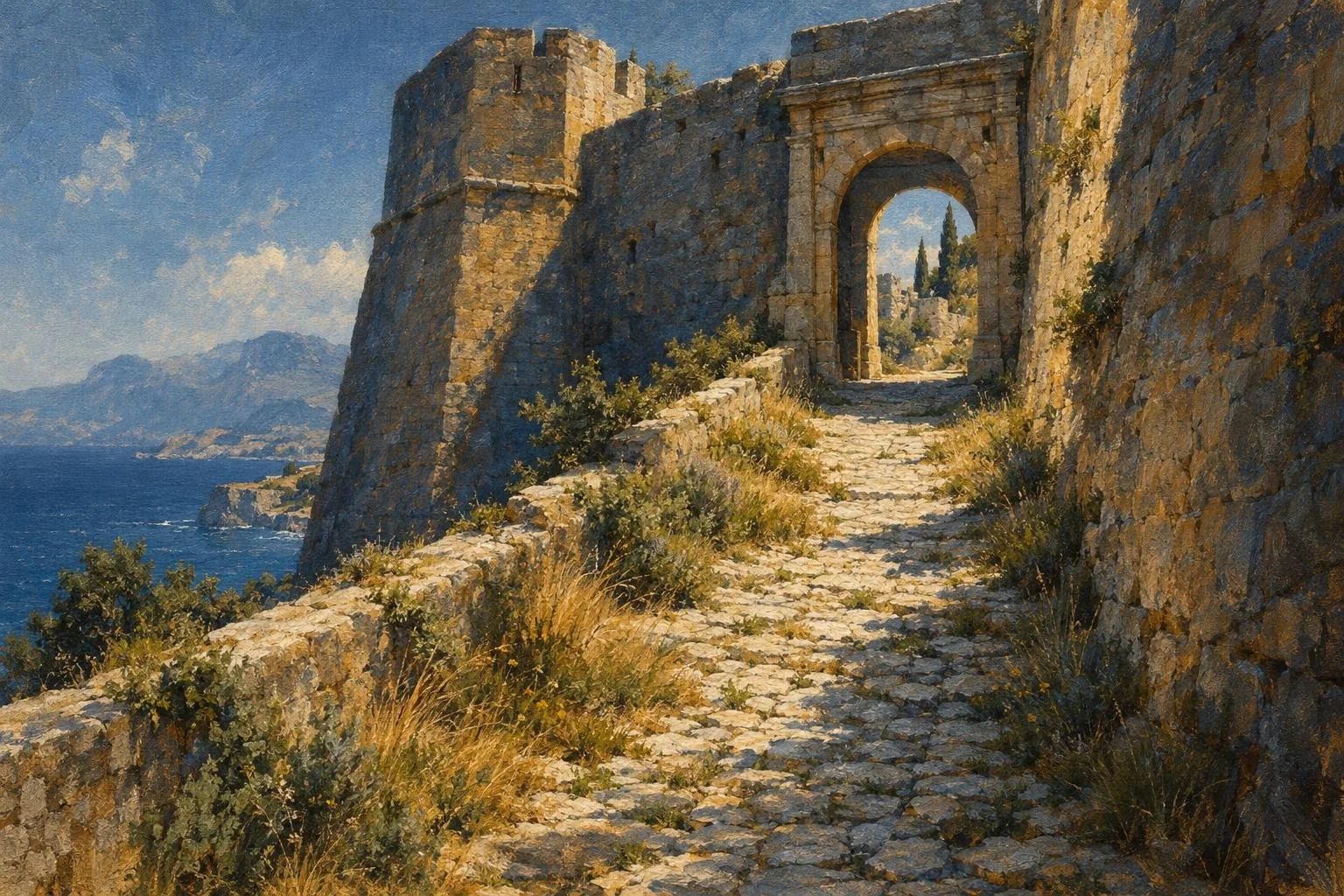
The thousands-of-years-old castle draws many visitors; I can tell you that it is one of the seven castles of its kind in the world that is still inhabited today. Its name, Monevasia, means mono—only,
and vasi—entrance. So, a castle that has only one entrance! It is no wonder at all that when I first went to its museum, I read: “The upper part of the castle is called ‘Gurlash,’ from the Arvanitika language (the Greeks separate the Arvanites from the Albanians on purpose and not out of ignorance), which means ‘stones I left behind.’” I asked the guide, and these were her words: “Arvanites lived here; when they first liberated it from the Turks in 1432, they abandoned it and left. When asked why they left, their captain,
Jorgo Shkaku, said: “We left; I only left stones behind there,” meaning it was a desolate, dry place. Jorgo had taken the surname Shkaku, to always remember that fleeing from Larissa to the Peloponnese was the cause of a blood feud.
The author of the article with the poet Jani Rico’s granddaughter... Lito
Exhausted by sleeplessness, the heat, and the waiting, I was losing my patience. When I finished work at three o’clock, I quickly went to sleep; I slept in the house above the bar on the second floor. Panajoti, the owner of the bar, had come from Australia after his father died, and worked in his bar.
I don’t know how long I slept! When I got up, evening had fallen. From outside came the roar of the waves crashing lightly on the shore. The waves murmured something in their own language and retreated, only to return to the shore again. A game this was, repeating endlessly since the world was created. “Eri must have left,” I thought, and went in to take a bath. In this place, the evening is something out of a fairy tale, which is why tourists go out after ten at night. The climate is both mountainous and coastal; thanks to this nature and beauty, it has always been under occupation—Venetian, Roman,
Gaulish, and finally by the Turks, who also used it as a strategic point for all navigation taking place in the Aegean. I usually went out on the balcony in the evenings, enjoying all the movement and the beautiful nature deep into the bay of Milos.
There was a knock on the door. I hadn’t even managed to open it when I heard the voice of Dhimitra, a local girl who worked with me during the summer holidays: “Open up, someone is looking for you!” “Who is it?” I called from inside. We were talking without seeing each other.
“Eri Rico, Jani’s daughter.” Her call seemed uncultured to me, but today I understand that they used the phrase
“Jani’s daughter” with no ill intent, just as we speak in our own villages.
I got flustered; dressed as I was, I splashed a little lavender water on my hair and rushed out down the stairs. “We’ll go out for ouzo,” I thought, “and I’ll pay for the ouzos.” When I think about it today, it makes me laugh, but this was the Albanian mentality. Eri was in the car; standing by her window was my employer, Panajoti:
“This,” he said to me, “is neither fair nor normal, for you to come from Albania and take our Eri right from our doorstep! I don’t understand where you met so quickly, or did you catch the honey scent of poetry?” and he laughed out loud.
I went over to Panajoti’s side, but Eri motioned for me to get into the car. I got in. It was just the two of us inside!
“Come back quickly, I lock the house door at midnight! I have orders from my wife not to go out alone at night.” Panajoti had a humorous nature!
Eri laughed and stepped on the gas. Everyone’s gazes had lingered on me; in their eyes, one could read both curiosity and astonishment.
When Panajoti hired me, he told me I would work the whole tourist season until October. I ate at their table, I slept in their house. During mealtimes, when the table was always full, I would first eat the salads and cheeses, and in the end, the meat would be left uneaten. An old habit of eating the meat last to leave a good taste in my mouth. He had noticed this, and after the second week, he said to me while we were eating at the table:
“Pilo, you should look for another job!”
I was dumbfounded.
“You told me you had work until the end of October, Mr. Panajot.”
“There is work, but I don’t see you being able to do it.” In fact, he had never complained before. I saw his wife sitting there looking serious, and I got worried.
“I can do it, Mr. Panajot! You have never complained about my work; on the contrary, you have thanked me.”
“No, no,” he said sharply, “I don’t want to keep people in my bar who can’t eat the food put in front of them.”
“I have eaten it,” I answered him in all sincerity; I was truly worried.
“You ate the bread and the salads, and you left the meat.”
“I will eat the meat too, just don’t fire me!”
They both laughed. It seemed to me they were making fun of me. Maria, his wife, joined the conversation:
“We’ll see this week; if you don’t eat it, find work somewhere else. We don’t want hungry people in our bar.”
By the time I realized they were joking, I had lost three kilos. After that day, I would eat the meat first, drink the first bottle of beer, and then start on the salads. At the end of October, when I went to see my children, I was unrecognizable; I had rounded out, and my neck had grown fat.
My father, who was a joker by nature, hugged me and then said to my mother and my wife:
“Don’t expect him to have brought anything; he ate it all himself. Look at him, he’s become like the Selal family’s piglet.”
I saw that the car was leaving the village, but I didn’t ask her.
“Aren’t you going to ask me where we’re going?”
“Why should I ask you?” I replied. “It’s not like I know my way around this area!”
“We’re going to Jeraka!”
“Is it far?”
“Not very, a 20-minute drive!”
Those minutes felt like an hour to me. I didn’t know how to talk to her, I didn’t know what to ask her, I didn’t know where to begin.
Jeraka was a fairy-tale place, a lagoon where the sea entered between two mountains, and deep inside, an open lake surrounded by beautiful houses with courtyards. We left the car and sat down at a bar right on the seashore. In front of you, you could only see boats, tourist ships with a tall mast and a lit lamp at the top. I was thrilled. Eri noticed and invited me to sit next to her.
“What shall we drink, or are you thinking of eating?”
“Whatever you wish!”
“Today you are my chosen one,” she joked.
“No,” I told her, “you have come as a guest; I am already a local.”
“You from Albania and I from Athens—just think about who the guest should be. Let’s sit here in the corner,” she told me in Albanian a moment later.
I was taken aback.
“You know Albanian?” I asked her in her language.
“No,” she replied, “they stuck in my mind from my parents; they used to speak a few words of Arvanitika, but not Albanian.”
“It’s the same thing, it’s the same language.” To tell the truth, my tongue was untied to speak, too.
The conversation did not go on much longer. We ordered ouzo and grilled octopus. I really like the aroma of ouzo, so I drank it with great pleasure. The ice in our glasses was replaced from time to time, and the ice that stood between Eri and me began to melt. We broke down the fences of our boundaries and leaped into each other’s gardens. I would ask her and she would answer me; then she would ask and I would tell her about my parents, my wife, my children, and mostly about my country, Albania.
“My father,” she told me, “loved your country very much. He had a great desire to go there one day, but things never worked out for him. While he was alive, two of his books were published in Albania; we have them in my father’s library in Athens.”
“I know, I have them in Monevasia too.” I talked to her about “The Man with the Carnation” and “Neighborhoods of the World.” One was translated by Aleks Çaçi and the other by Spiro Çomora; I told her about their lives and the books they had published in Albanian. “Spiro Çomora,” I told her, “finished high school in Corfu. After the war, the borders were closed, and he never returned to Corfu again.”
“Ah, those paths,” she said, “those paths of political convictions separated brothers and half the world from the rest. My father felt devastated by this; he expressed it in conversations too. His view was that a conviction, by its very definition, is personal, and there is no reason for it to become a violent force for others to embrace.”
I started asking her questions, as if I were prospecting a mine and wanted to grow rich from her words.
“Slow down,” she told me, “this is our first meeting. We will have time to talk over the summer, step by step. If we say everything tonight, what will we talk about later?”
I fell silent! But I couldn’t sit still; I wanted to read at least the book of her life, I wanted to read something.
“At least something about yourself?”
“About myself, yes!” She raised her glass and said to me, “Stin jasas” (to your health).
This was the beginning of the story about herself.
“I am Jani Rico’s only daughter.” She said the words with a laugh, but as if she were confessing. I laughed. She continued, “My mother was named Filio (Kiss, or friend); she was a doctor. I graduated in English philology and have published four books. I am a sincere person and affectionate with people. I try not to live in my father’s shadow. I work at the National Bank of Greece.”
She had a fragile voice like a high school girl; she expressed exactly who she was. “I have a boyfriend,” she told me, “and many friends and companions.” When she finished, I saw that she was relieved from the interrogation of well-meaning questions. We clinked our glasses; deep in the lagoon, a small boat with a lamp like a firefly’s light was approaching us. The closer it got, the clearer its contours became. It was just like our conversation: by telling each other our stories, we were willingly gifting each other the life that was unknown to the other.
The moon had descended from the arch of the sky and hung on the branch of the willow, which had let down its long, uncombed hair, covering the entire body of the tree. The willow looked like a girl with her hair let down, standing with her feet in the water. The evening, jealous, waited in anticipation to snatch a word from our intimate, brotherly conversation, like between two friends who had known each other for centuries.
- To be continued -