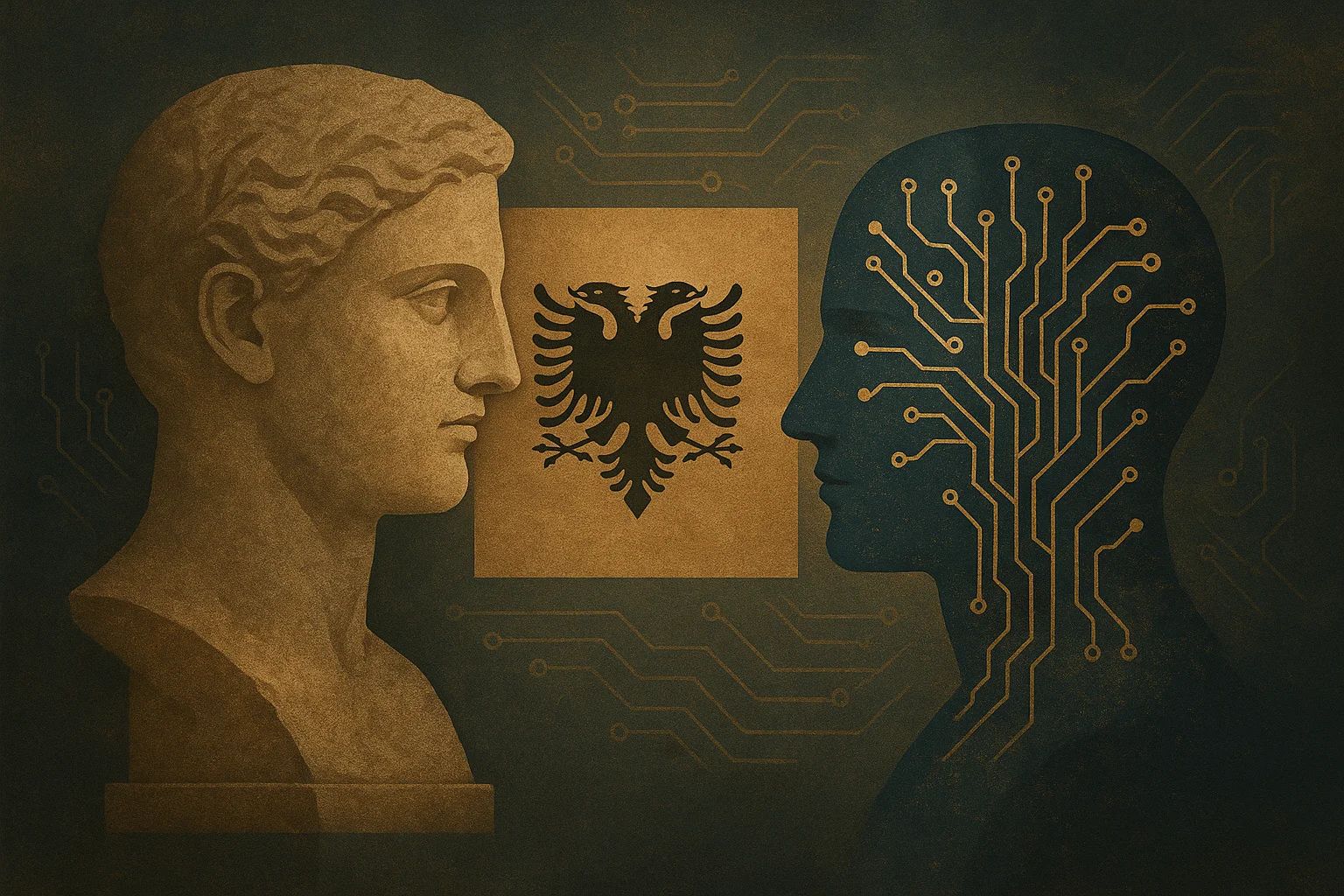
On TikTok, language is not silent — but what you hear is no longer necessarily Albanian.
On a phone screen, a teenager in London asks Siri: “What’s the weather like in Tirana?” The device answers at once. Albanian is mentioned nowhere. Elsewhere, in a café in Tirana, a student uses ChatGPT to write an essay — in English, because in Albanian, he says, “it doesn’t understand well.”
Meanwhile, on TikTok, thousands of new videos are uploaded every day, full of voices speaking a blend of simplified Albanian, mangled Italian and the English of social media. Languages mix, simplify, vanish. Albanian fades.
Language is not merely a means of communication. It is how we think, how we imagine the world, how we bind ourselves to the past. And when it no longer exists in the spaces where the global conversation happens – screens, networks, algorithms – it does not die all at once. It simply ceases to exist as part of the future.
For years we have treated Albanian as a literary, educational, even sentimental matter. Today, its preservation is a technological challenge.
The systems that are learning to speak — ChatGPT, Google Translate, Alexa, YouTube captions — do not learn Albanian because they have nothing to learn it from. Albanian is not there. There are no large text corpora. There is not enough formal use online. There is no state investment in bringing it into the age of algorithms.
And while young Albanians create, play, share and spread content every day, that creativity happens more and more often in a hybrid language that is no longer our Albanian. It is a digital version of it — shorter, shrunken, more foreign.
But there is still hope. Not in nostalgia. Not in moralizing complaints about “the way young people talk.” But in building real tools that make Albanian workable for technology and desirable for the new generation.
At the University of Tirana, work has begun on building a large corpus of the Albanian language — a database that can “feed” artificial intelligence systems. Applications have been created for spelling, translation and grammatical analysis. They are few, but they exist. They are seedlings in soil that needs tending.
On TikTok, Albanian is not dying. But it is changing fast. The question is not whether we will stop this change. We cannot. The question is: will we be there to steer it? Will we have the courage to carry Albanian into the algorithm, into audio, into text, into code?
Because if it does not appear on the screen, that does not mean it is gone. But it does mean it no longer has any influence.
And in a world that hears only what has been optimized to be seen… silence is extinction.