A song sung only once every five years, on a floodlit stage before thousands of spectators, is no longer a song of life but a song of the festival.
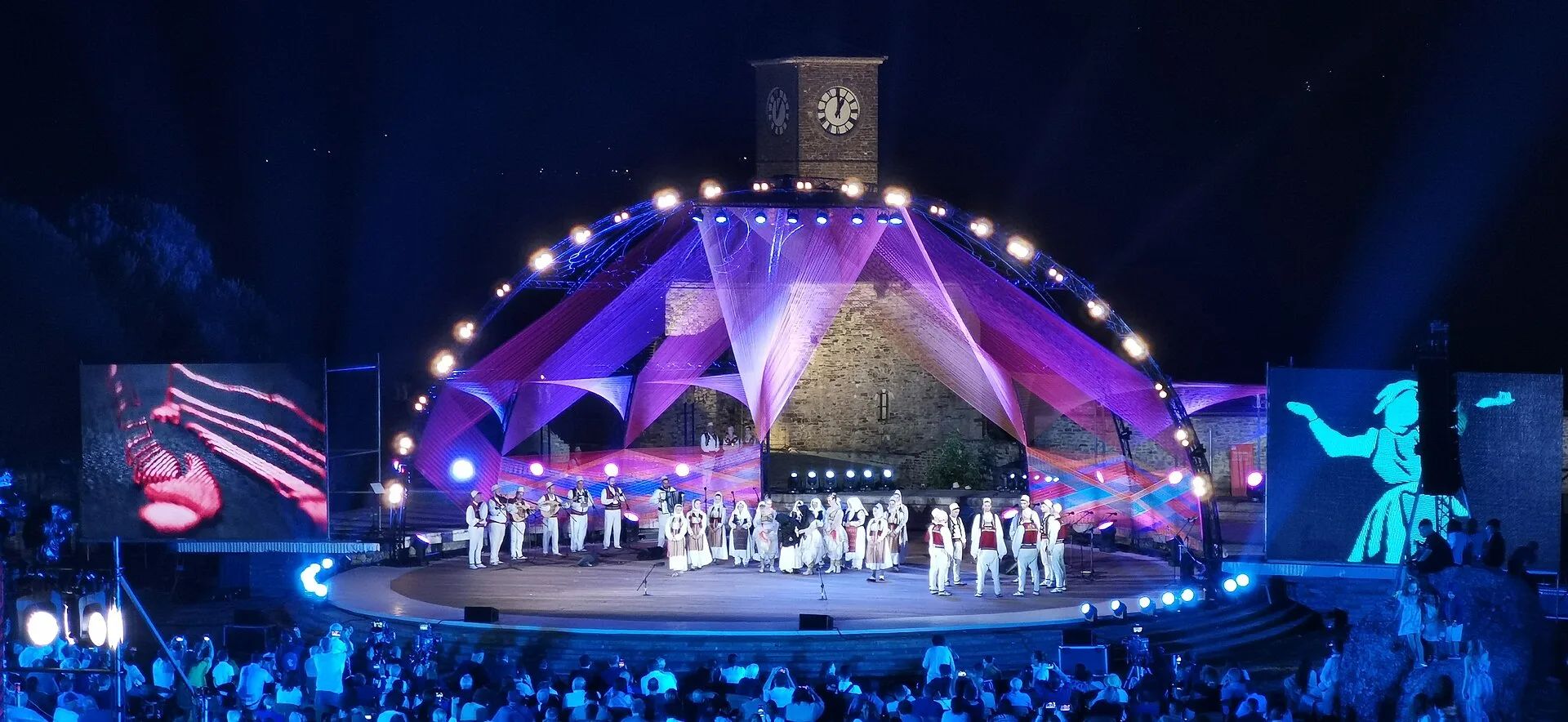
From 24 June to 1 July 2023, Gjirokastër Castle once again became the stage of the National Folk Festival. It was the festival's return after eight years: for eight nights, on an open stage with free admission, some 1,200 performers took part, not only from Albania. For a week, the stone city became the capital of Albanian culture, with costumes, dances and songs from every region.
Then the stage was dismantled. And this is where the question that interests us begins: what happens to the traditions the festival displays in the years when no one is photographing them?
A festival with a broken rhythm
The festival was first held in Gjirokastër in October 1968, following on from the folk festivals organised in Tirana in 1949 and 1959. Its date was tied to the birthday of Enver Hoxha, a native of the city, a fact that recalls how folklore, at the time, also had an ideological function. It was repeated every five years, in 1973, 1978, 1983 and 1988. After the fall of the regime, the rhythm broke: in 1995 the festival took place in Berat Castle, in 2000 it returned to Gjirokastër, and there were later editions in 2009 and in May 2015, before the long pause that ended only in 2023.
If the five-year rhythm holds, the next edition would fall in 2028. But the festival's history shows that this rhythm is not guaranteed. And that matters, because for many folk groups the festival is not just a performance but the reason to gather, to rehearse and to learn the songs from the oldest singers.
What UNESCO says, and what the festival does not
Albanian iso-polyphony was proclaimed a masterpiece of the oral and intangible heritage of humanity in 2005 and inscribed on UNESCO's Representative List in 2008. UNESCO's description presents it as a tradition of songs with two solo parts, a melody and a countermelody, over a choral drone, which accompanied weddings, funerals, harvest feasts, religious celebrations and festivals such as Gjirokastër's.
But the same document also lists the threats: the exodus of young people from villages to the big cities and abroad in search of work, poverty, the absence of legal protection and financial support for practitioners, and the advanced age of the singers. More telling still is another remark: according to UNESCO, the transmission of this tradition is now maintained by professional folk artists rather than within the family.
This simple sentence sums up a great change. The iso-polyphonic song was born as a way of giving voice to a community's everyday life: joy, lament, work, memory. When it moves from the courtyard to the stage, from grandfather to professional ensemble, it is saved as a form but risks losing its function. The festival preserves its appearance; it cannot, on its own, preserve its life.
This does not mean the festival is unnecessary. On the contrary: for many elderly singers it is perhaps the only occasion when their voices are heard beyond the village, and for many young people the only moment when they hear this song live, not through a screen.
The years of silence
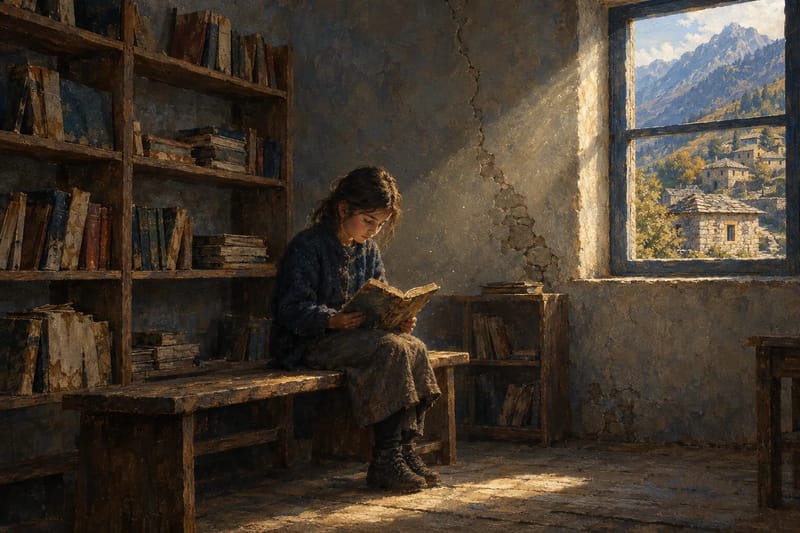
In our earlier essay on iso-polyphony as collective memory, we saw this tradition as a form of thinking together, in which no voice stands alone. In the years between festivals, this principle is tested in the most direct way. An iso needs several people to gather; in an emptied village where only the elderly remain, even this simple thing becomes difficult.
That is why the true measure of a cultural policy for iso-polyphony is not the size of the stage in the castle, but what happens in the other four years: whether there are schools where children learn the song from its bearers, whether local groups have support to keep rehearsing, whether recordings of elderly singers are preserved and made accessible. The festival is the great day. But the tradition survives, or fades, in the small days.
Sources
- Albanian folk iso-polyphony, UNESCO Intangible Cultural Heritage
- Gjirokastër National Folk Festival, Wikipedia
- Gjirokastra për një javë kryeqytet i kulturës, nis sot Festivali Folklorik Kombëtar, Shqiptarja.com (2023-06-24)