Reportage
Twenty years in Greece, and for the first time I decided to build my family nest for the four of us in Athens.
I left the tourist spot of Monemvasia and decided to move to the capital. Where the life of a state is said to boil. Where the ministries and ministers are. Where the superstructure is visible in the countless buildings, the lights, the massive movement of vehicles and people. I will not deal with these movements, but with the movements of their souls, which they carry wherever they go.
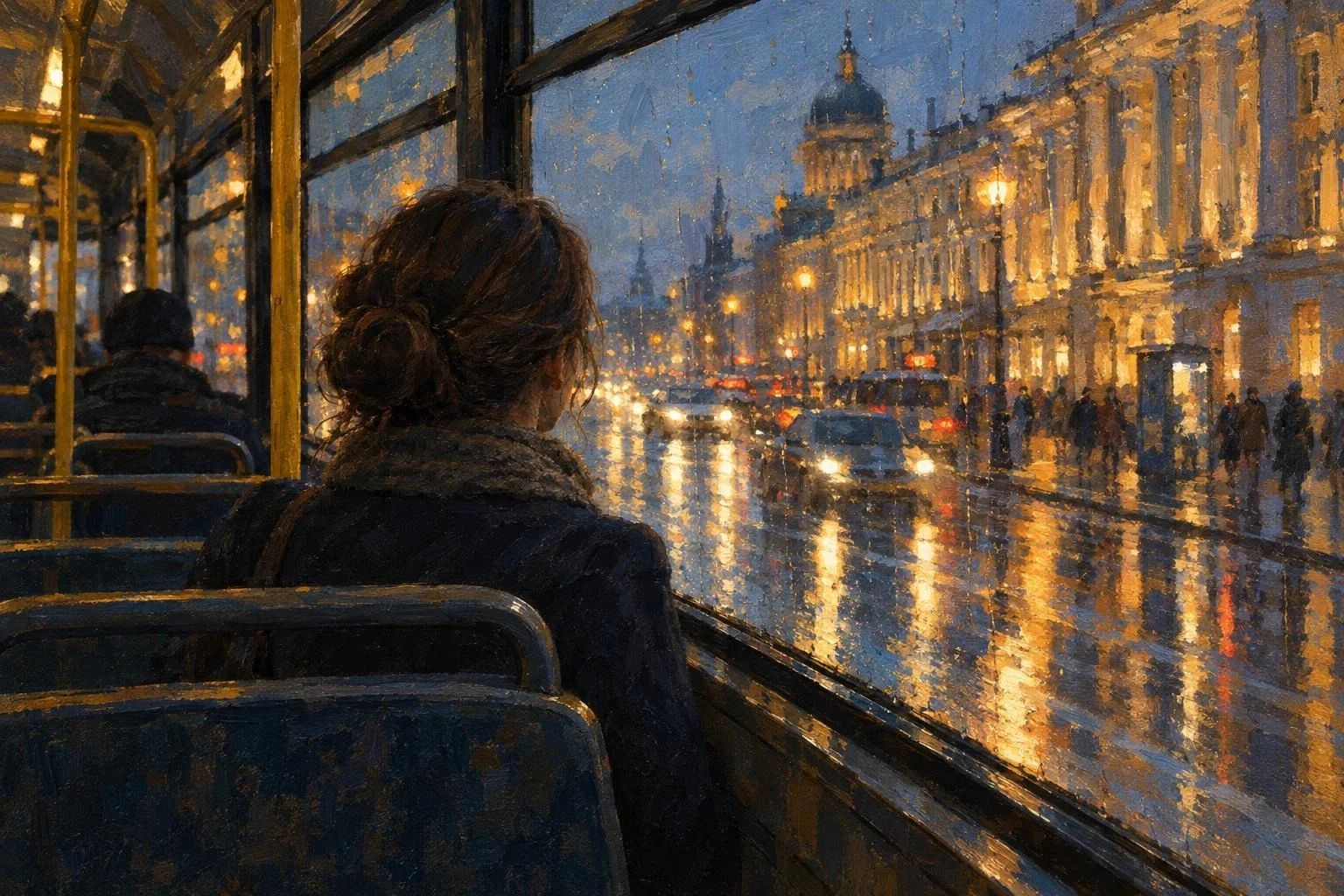
Riding trolleybus number 13, which takes you to “University” Street, I cast my gaze everywhere so that nothing would escape me.
Movie-like snippets of life outside the bus appeared in the window. Apartment blocks approached and vanished, giving way to others.
Opposite me sat a girl of about twenty. With a string of earrings in her right ear and a tattoo above her prominent, well-proportioned chest. Drowsy, with two earphones in her ears. Sometimes she smiled, and sometimes she looked serious. Someone on the radio waves was capable of changing her mood. For a moment, one of the earphones slipped from her shoulders. As if something extraordinary had happened, her face fell. She snatched the earphone, shoved it back into her ear, and returned to her previous state.
Strange, for a moment she clashed with reality, with the people surrounding her, and she put the earphones back in to escape their problems.
Nothing interested her except the drums and jazz that were far removed from the rhythm of the times. Not even the sweet, caressing gaze of a boy sitting nearby caught her attention. Around me were silent people, as if someone with an electronic remote had switched off their souls and left them as empty as nests whose chirping birds have flown away.
On “Vasilis Sofias” Avenue stood a large statue of a glass man, lifeless, with stamped-on eyes, who resembled everyone I had around me on the bus. As if the same sculptor had carved them—that merciless, savage one.
Somewhere the bus stopped; the red traffic light gave an order like a dictator, and... The bus groaned, shuddered, and halted like a man exhausted by the road.
Outside, crowds of people were running, running to catch something they had lost. Something they would never find... peace. The rushing current of life pushed them mercilessly toward... toward what?
“What are these people waiting for?” I asked a woman, who looked at me angrily. It seemed I had broken her train of thought.
“It’s the police station,” she answered coldly, with the same coldness her face held. “Can’t you see?”
“I see it,” I replied, “but what are they waiting for? I didn’t know they did trade at the police station.”
“Stamps and certificates for immigrants are bought and sold,” she said with irony. “They are buying their identification and residence permits.”
This was a slap in the face for me. A slap that for a long time will stay
in my mind.
“Where do you come from? From your language, you don’t seem Greek.”
“You’re right,” I told her, “I’m lucky,” and I continued to watch the long line of
people.
The sights I saw, despite my nineteen years in Greece, seemed alien, inhuman
and medieval. Where I had lived all these years, I had never encountered such problems. Strange,
the laws are the same and the way of life changes, even though we live in the same country.
For the first time after so many years, I felt more like a stranger than ever. At that moment in the center of Athens, I felt like a double immigrant. Either I didn’t know how to look at Athens properly and was inadvertently blackening reality, or Athens had brutally entered my life and shattered the dreams for which I had come.
The verses of the singer Melas came to mind:
“The way you keep your cards all closed,
And the lights of your heart turned off,
How am I to read you like this, tell me how,
How am I to catch your pulse, tell me how.
Gray light and your lips on fire,
You are a riddle, are you truth or a lie.”
The bus stopped. I still hadn't gathered myself.
“My wallet, my wallet was stolen!” a woman shouted from the back of the bus. People fled and backed away from her cries, as if not wanting to end up as witnesses to the theft. Was I in a dream or in reality?
The bus emptied out; only the driver remained. But even before, the bus was
just as empty as it was now. Their souls were so crushed and so disillusioned that they meant nothing of importance to the driver. He was smiling, as if to say: “I transport corpses from morning till night. Corpses that have eyes but do not see, have ears and do not hear, breathe and move like robots.” I could read his thoughts perfectly.
These robots say they are working to build a new world, for a united
and powerful Europe. But to me, this setup looks like a game. A game where the losers will be the ones building Athens and all of Greece day and night: the immigrants.
I walked dizzily and talked to myself. Passersby didn't look at me with curiosity; it seemed this was a completely ordinary thing to them.
“Good afternoon, Speridhon, has Athens made you dizzy!?”
I snapped out of it; it was Andon, one of my acquaintances from the tourist village.
“Andon,” I said, and hugged him as if I hadn't seen him in years. In these moments I needed a human being, a voice in this human and inhuman desert.
For nineteen years in Monemvasia, from morning until evening, we carried well-wishes and greetings with us. We knew everyone and everyone knew us. The streets buzzed with conversations and laughter.
“So you've come to Athens as a visitor,” he asked me.
“For a few days,” I answered him, “I had some business.” It was obvious I was lying to him. We had known each other for years, and he knew how to read my thoughts clearly.
My body had frozen, and my legs had turned into crutches, even though it was early August.
“Come, let's have a coffee,” he said with the generosity of a simple man.
I closed the door on my thoughts of Athens, and we went into the first café we found across the street.
THE WELCOMING STATION
Continuing my travels through Greece, I am buying a ticket to go to a station that is nothing like the first. Although it is far from Athens, it is closer to the people.
There, the winds play sonatas through the branches, and the birds give ticketless concerts for the passersby. The spring waters flow fiercely from the bosom of the earth, plunging into waterfalls of joy and rustling over the pebbles of the Nedhondos river. The value of its springs is greater than beer, whetting your appetite and freeing you from the fever of anxiety and exhaustion.
I know, you are waiting for me to tell you the place, the region. It is not unfamiliar to you, dear readers.
On the road crossing Lakonia–Messenia, Sparta–Kalamata, the pine breeze refreshes and rests the passersby like a caressing hand. Mount Taigetos, with its snow-white skullcap, watches carefully over the visitors.
But I will speak of these parts that remind me of Llogara, Razma, and Qafë-Shtama, of a welcoming station amid these mountains. This station is called Artemisia. A village known since antiquity and linked to the name of the Spartan Leonidas.
On the way out of the village, near a small waterfall between two red cherry trees like two shy girls, the former immigrants Leonidha and Dhimitra Strumbo returned to their birthplace after years in America. Their beehive was very fruitful, and as such, it became beloved by everyone. The honey of their hospitality reached everyone and took root.
Anyone who passes through this remote area cannot help but stop at the waterfalls of their laughter and...
Seeing the ellipses, you will ask: “Whose else's laughter?”
With the opening of the shop, they ended up with four children. Two daughters, a son, and... and Ana, the girl from Lushnjë, with thick chestnut hair and highly expressive eyes that harmonize perfectly with her smile. That is how one of the many passersby described her when he saw her for the first time. Petite in stature, a brunette, with a beauty that can be read in her soul, her speech, and her demeanor.
“She is our only daughter,” Dhimitra says. “Our two girls got their education and left; we have Ana here,” and she strokes the wavy hair cascading over her shoulders. “Fate gave her to us as a gift along with the shop.” She knows her fate very well, so she tries to ease their pain. Her husband was killed, leaving her a widow in the bloom of youth, only twenty-one years old, with her little son, Alban. His death deeply shook her sensitive soul, and to raise her son, she was forced to take the path of emigration. Every day the boy takes a taxi to school in Kalamata, thirty kilometers away, a care gladly provided by Mr. Leonidha and Mrs. Dhimitra, the former immigrants.
But let us return to the other side.
Ana, too, treats them like two parents, about whom she speaks the highest praise. She has worked there for nearly ten years. Hundreds of people, served by her, leave satisfied and eager to return again. This transit route is heavily traveled by Albanian immigrants; it is a connecting bridge for the two large cities of Kalamata and Sparta. If you ask the immigrants about this place, they will say: “That is our Ana’s place.” Such words hold love and the weight of respect within them.
Hundreds of immigrants who pass by and stop at this place draw strength and courage from her sweet words, from this sister and mother who makes the pain of the immigrants lighter.
One of these is the author himself, who, struck by a random misfortune, experienced her helping hand up close, a help that accompanies him even in this piece of writing.
Many immigrants “confess” before this charming sister and hardworking mother, who is always sincere.
They receive advice from her that acts as medicine to soothe, even a little, the longing they have for their children and relatives.
“So many good words for one girl?” someone might say. “Thousands of mothers and sisters work in Greece.” I say the same thing, dear readers. But I cannot encompass them all in a single piece of writing.
I know Ana, and I spoke to you about her. About her and the dozens of immigrants at this station, where conversations hash out the problems of life and emigration.
The girl in question also received many marriage proposals in this village, but she refuses.
“I want a man,” she says, “who speaks my language, who reads my soul, and who lives with my troubles and worries. I am working to save some money and open a place like this in Albania, near my people, who love me and whom I love.”
“But how long will this go on?” I ask her.
She falls silent; she doesn't even know what to say herself. She smiles and turns her head away... as if praying that this time will be as short as possible.
I snatch her smile and her hope, and I place them as a signature at the end of this piece, telling the reader:
“Make the comparison and draw your own conclusions about both pieces.”