The fable is one of the oldest forms of storytelling, and in Albanian it has a richer history than is often assumed: from oral tales and nineteenth-century manuscripts to today’s children’s books.
Oral roots
Veli Veliu, a lecturer at the Faculty of Philosophy in Prishtina, in his studies of the fable noted that the form is present among Albanians in both oral and written versions. Many fables, he argued, are the people’s own creation; others came from Aesop, from La Fontaine or from various Eastern traditions. Because of historical circumstances, the written form appeared later than among many other peoples.
Foreign scholars of the nineteenth century paid attention to this wealth. Johann Georg von Hahn, regarded as the founder of Albanian studies, gathered most of his material during his years as Austrian consul in Ioannina, from 1847, travelling through Albanian lands. He published five Tosk folk tales in prose in 1854, and in 1864, in Leipzig, the two volumes of his “Greek and Albanian Tales”, in which he also proposed a system for comparing myths and tales. Auguste Dozon included 24 tales and 9 prose fables in his manual of the Albanian language, while Thimi Mitko, in his collection “Bleta shqiptare” (The Albanian Bee), published 11 tales and one fable.
A century of Albanian versions
A chapter of its own is the rendering of Aesop into Albanian. Karl Reinhold left a large number of notebooks with tales, fables, riddles and songs collected in the 1850s and 1860s. From them Gustav Meyer published eighty-eight of Aesop’s fables in 1896; in 2005 Ardian Klosi published the rest, bringing the number of fables Reinhold rendered into Albanian to 138.
In the same period, the Arbëresh writer Francesco Antonio Santori turned 114 fables into Albanian verse, in an undated manuscript that the scholar Merita Sauku-Bruci places, on the basis of the alphabet used, around the decade 1860–1870. Of his role she writes:
“…becoming the first cultivator full of originality, with a flowing, varied and expressive verse.” (our translation)
— Merita Sauku-Bruci, “Françesk Anton Santori, Përrallëzat”, Studime Filologjike, 2016
After them came the poets of the National Renaissance and the early twentieth century. According to Veliu, La Fontaine’s influence can be felt in Naim Frashëri, Çajupi, Negovani, Mjeda and others. Critics have disagreed about Naim’s fables: Dhimitër Shuteriqi held that most were adapted from the French fabulist, while Veliu stressed the freedom with which Naim reshaped his sources to suit his educational purpose and his own style.
Why the fable still matters
The fable has qualities that set it apart. It is short and easy to remember. It hides people behind animal masks and so allows truths to be told that would be hard to say directly. And in Albanian it was one of the laboratories of the literary language: nineteenth-century translators of fables tested verse, vocabulary and syntax in a language that was still being standardised.
Whether the fable is losing ground to digital content for children is a question that has not yet been answered with data. What is known is that the form is still being written. Children’s authors such as Petraq Zoto, with “Bishti i dhelprës” (The Fox’s Tail), and Tasim Gjokutaj, with humorous verses such as “Dhelpra dhe baloshi” (The Fox and Baloshi), have written animal tales and poems. In the work of contemporary fabulists too, such as Pilo Zyba with fables like “Gomari dhe Patat” (The Donkey and the Geese) and “Këmborët” (The Bells), animals go on speaking about people.
The lesson that remains
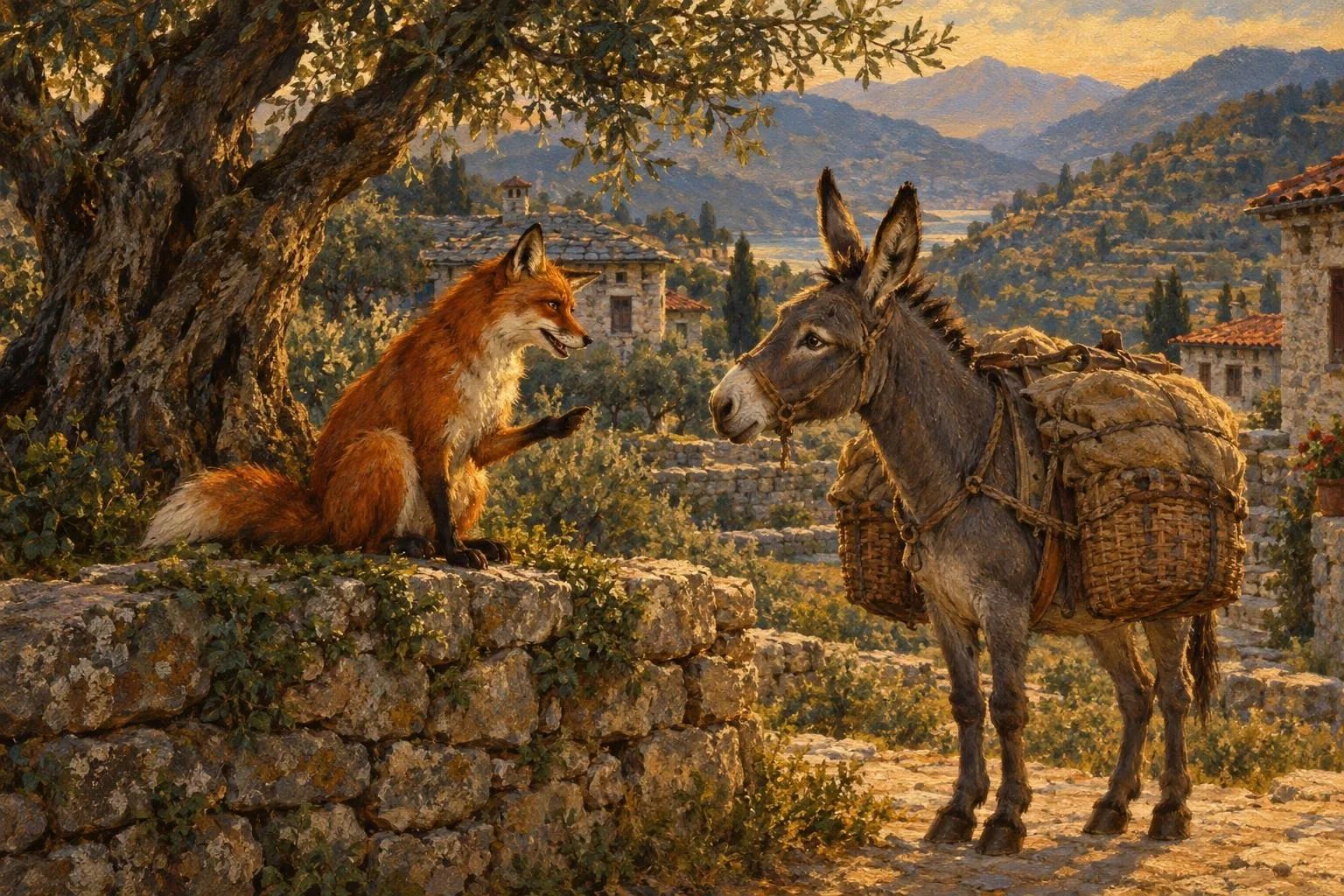
A good fable does not confine its lesson to the last line. The fox who flatters the crow to get the cheese, or the donkey who thinks himself wiser than the rest, are figures that outlast their time because the people they stand for never disappear. For Albanian readers, they are also the memory of a long tradition of translation, in which generation after generation of translators and poets tried to make Albanian a language of the world’s shared wisdom.
Sources
- Françesk Anton Santori, Përrallëzat (Merita Sauku-Bruci), Studime Filologjike, nr. 3–4 (Albanica) (2016)
- Rreth fabulës dhe mundësitë e përhapjes së saj te shqiptarët (Veli Veliu), Gjurmime albanologjike (Albanica)
- Përpjekje për ta përcaktuar burimin e fabulave të Naimit (Veli Veliu), Gjurmime albanologjike, seria e shkencave filologjike 17 (Albanica) (1987)
- Johann Georg von Hahn, Wikipedia (accessed 2026-10-16)
- Njëzet shkrimtarët që krijuan traditën e letërsisë për fëmijë, Shqiptarja.com