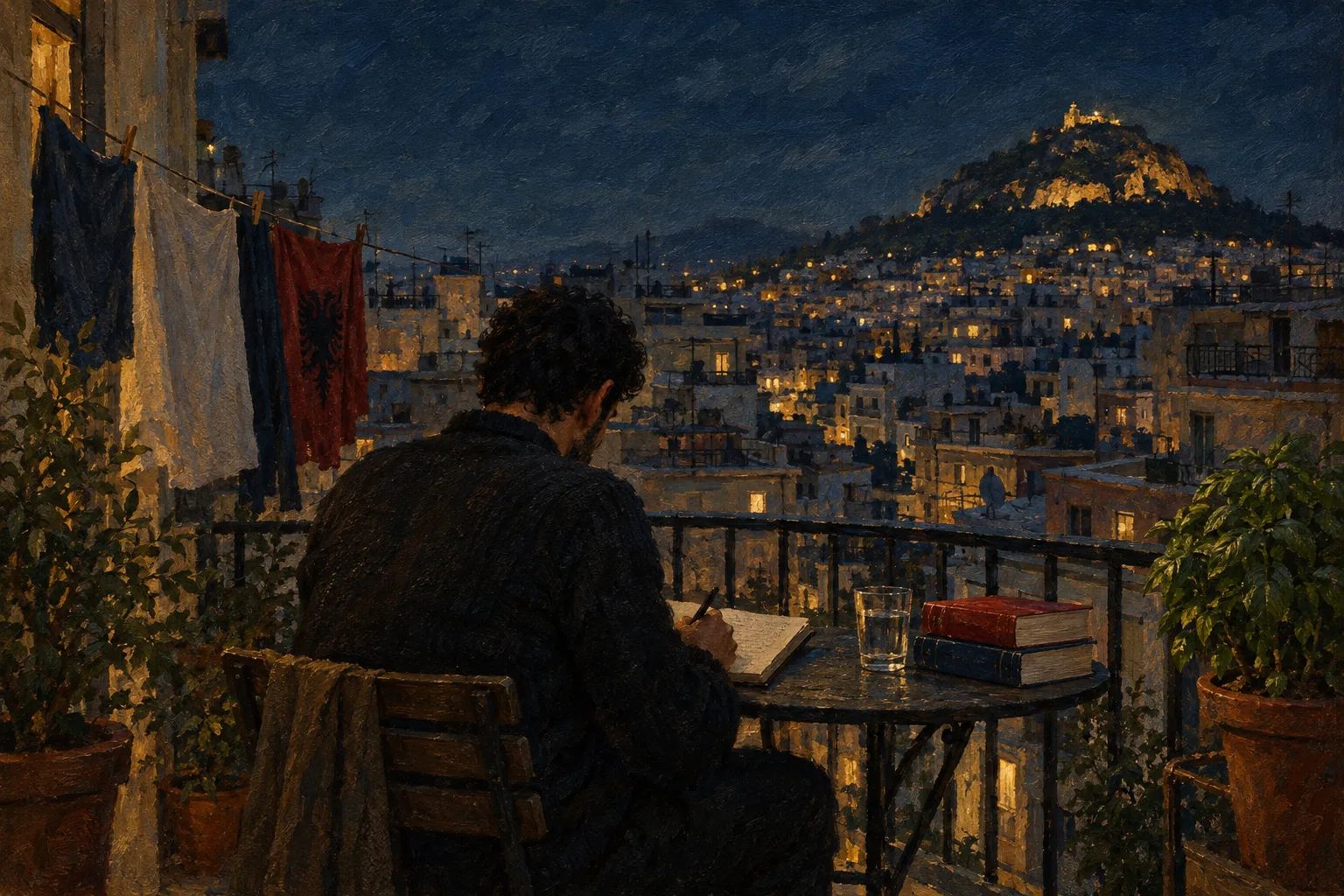
Thirty-five years after the first border crossings, Albanian emigration to Greece has left behind not only memories and wounds, but also a literature written in two languages and addressed to two readerships.
A large community
The Greek census of 2011 recorded 480,851 Albanian citizens permanently resident in Greece, according to Eurostat data. A more recent indicator comes from the Albanian elections of 2025, the first with voting from abroad: according to the OSCE/ODIHR, 68,386 voters registered to vote from Greece, the second-largest group after Italy. Behind these numbers stand whole generations: those who crossed the border in the early 1990s, and their children, raised between two languages.
Such a community could hardly fail to produce writers. Some had published in Albania before they left; others found their voice only in emigration. What unites them is not a style but a situation: writing from a country where the language of the street is not the language of home.
The anthology of distance
From the first years, emigrants who wrote sought each other out. The anthology “Balada e largësive” (The Ballad of Distances), published in Athens in 1995, gathered emigrant Albanian poets. Among them was Pilo Zyba, poet, prose writer and fabulist, a member of the League of Writers of Albania since 1980, who had emigrated to Greece in 1990.
The anthology’s title states its theme: distance. It is not only geographical. It is distance from the natural reader, who stays at home; distance from everyday language, which in emigration is replaced by another; and, as the years pass, distance from the remembered homeland itself, which changes without consulting the one who left. In the poetry of emigration, longing is no longer a passing feeling but a lasting condition, a way of seeing the world.
Choosing a language: the case of Kapllani
Gazmend Kapllani took a different path. Born in Lushnjë in 1967, he left for Greece in 1991, studied philosophy at the University of Athens and earned a doctorate at Panteion University with a study of the image of Albanians in the Greek press and of Greeks in the Albanian press. He wrote his first novels in Greek, a language that was not his mother tongue. The first, known in English as “A Short Border Handbook” (2006), drew on his own border crossing and was translated into Albanian, English, French and Italian.
For a decade, from 2001 to 2011, Kapllani also wrote for the Greek newspaper Ta Nea. Yet his application for Greek citizenship, filed in 2008, was rejected, and in 2015, after twenty-four years, he left Greece, citing harassment and threats. He now teaches at DePaul University in Chicago. His path shows that writing in the host country’s language can open a new readership to an author without necessarily securing belonging.
The mirror from the Greek side
Meanwhile, Greek literature has begun to look at this experience from within. On 8 March 2025 the Albanian embassy in Athens hosted a discussion of a novel by the Greek writer Kristina Frangeskaki, translated into Albanian by Eleana Zhako. According to the embassy, Frangeskaki is the first Greek writer to devote a novel to an Albanian family. Emigration is thus no longer only the subject of those who lived it, but also of the neighbours who watched them arrive.
Albanian émigré literature in Greece is therefore not a closed body of work. It stretches between small Albanian-language anthologies and Greek-language novels, between the poetry of longing and the prose of the border, between authors who stayed and those who left again. What holds it together is the question each of them asks in their own way: what it means to write about one country while living permanently in another.
Sources
- One million Albanians live in Italy, Greece, Tirana Times (Eurostat data) (2015-12-24)
- Republic of Albania, Parliamentary Elections, 11 May 2025: Interim Report, OSCE/ODIHR (2025-04-28)
- Gazmend Kapllani, Wikipedia (accessed 2026-10-16)
- Discussion of Kristina Frangeskaki’s novel at the Embassy of Albania in Greece, Ambasada e Republikës së Shqipërisë në Greqi (2025-03)