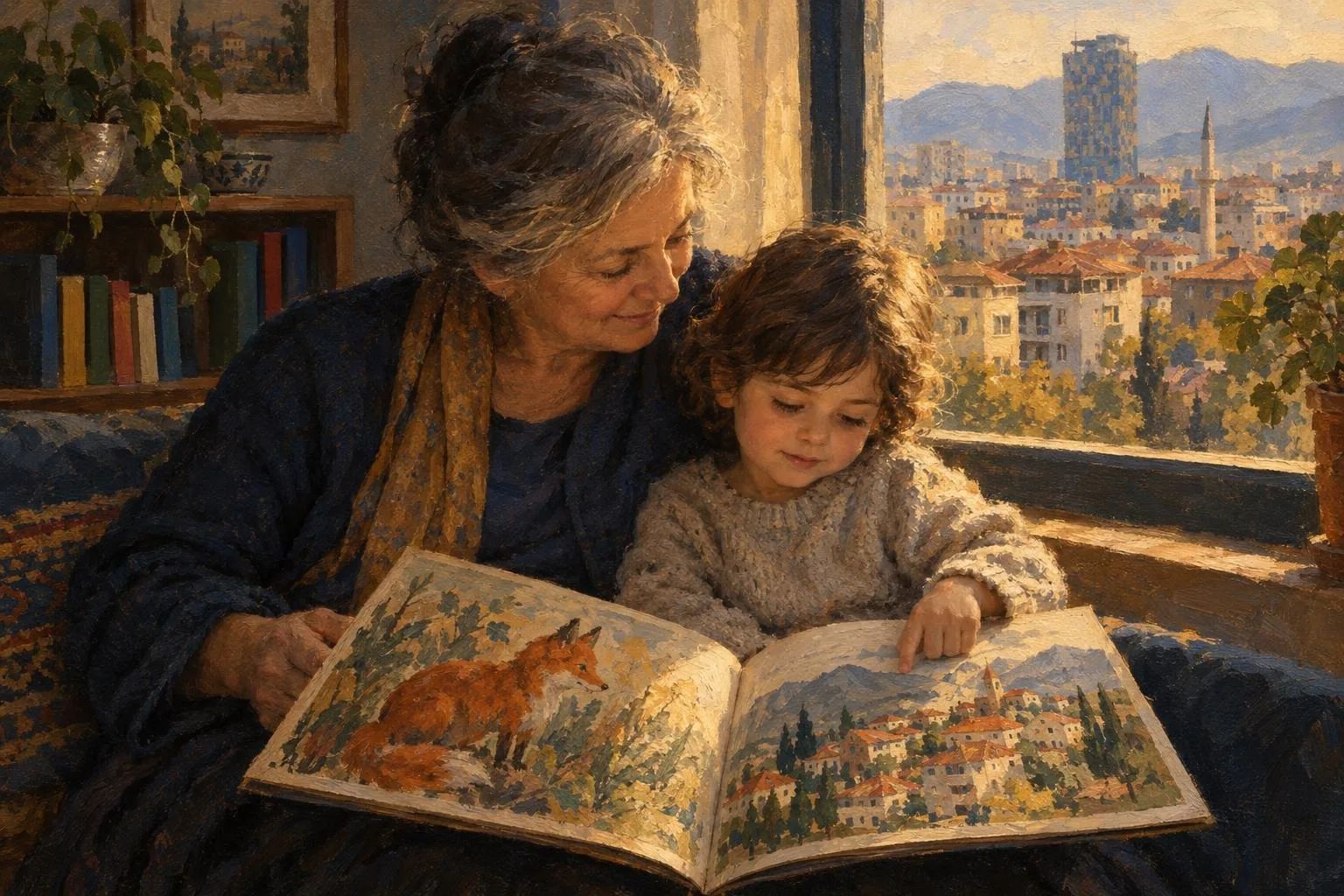
Albanian children’s literature has a longer tradition than is usually remembered, but publishers themselves acknowledge that today’s market favours translations and that young authors struggle to reach the shelf.
A tradition that exists
Asked where the Albanian children’s books are, one should first look to the past. Bedri Dedja published “Heroizmat e Fatbardh Pikaloshit” (The Heroic Deeds of Fatbardh Pikaloshi) as early as 1954. Adelina Mamaqi wrote verses such as “Mësoi Adi shkronjën ‘A’” (Adi Learned the Letter ‘A’), Sokol Jakova wrote “Përrallat e gjyshes sime” (My Grandmother’s Tales), Petraq Zoto “Bishti i dhelprës” (The Fox’s Tail), while in Kosovo Rifat Kukaj created the novel “Gogozheli i Gogozhinës”. Names such as Xhahid Bushati, Skënder Hasko and Astrit Bishqemi carried this line on after the 1990s and into the early years of this century.
That tradition had a common trait: the characters spoke Albanian not as a translation but as their own language. They had names, landscapes and jokes an Albanian child recognised without explanation. That is precisely what risks fading when the shelf fills mainly with books from other languages. A children’s book is not only text: it is also illustration, format, paper and price, and each of these links has costs that a small Albanian publisher bears less easily than a large foreign one.
What publishers and authors say
In 2019, after a 6 per cent VAT was imposed on books, publishers, writers and illustrators publicly discussed the state of children’s literature. The publisher Irena Toçi called the rate small for the state but heavy for publishers. Arlinda Dudaj said her house receives many Albanian children’s manuscripts, but that many do not reach the required quality, so she is especially careful in this genre. The writer Pandeli Koçi located the problem in the lack of institutional support for young authors, while the illustrator Ilir Zaloshnja pointed out that hand-drawn illustration speaks better to children, yet is poorly paid.
Five years later, at the 27th Tirana Book Fair in November 2024, no prize was awarded for the best work of children’s literature in Albanian. In November 2025 the writer and publisher Rudina Çupi noted that universities offer no creative writing programmes, that book prices have doubled since the pandemic and that the large bookshops are concentrated in Tirana, while in many other towns they are little more than kiosks. In her view, although there are successful series and loyal readers, there is a shortage of books that introduce children to their cultural heritage in a creative and accessible way.
What is lost
Translations are not the problem; a child who reads Andersen or Rodari in Albanian is enriched. The problem arises when translation takes up all the space and the original book becomes the exception. Then the child learns that good stories always happen somewhere else, with other names, in landscapes they have never seen. Their mother tongue becomes a language of translation even in the imagination.
The question also concerns Albanian children growing up abroad. For them, an Albanian children’s book is often the only written link with their parents’ language. If that book does not exist, or is hard to find, the language remains only the language of the kitchen and of phone calls with grandparents, not a language of reading and fantasy.
A shelf to be filled
There are still authors who write for children in Albanian and publishers who take risks on them. Books such as Pilo Zyba’s “Pyetjet e Vogëlushes” (The Little One’s Questions) and “Aventurat e Elonës” (Elona’s Adventures), or the series of contemporary authors, show that the will is there. What is missing, according to people in the field, is an environment that makes this work sustainable: programmes for young writers, support for illustrators, well-stocked school libraries, bookshops outside the capital. Without them, the question “where are the Albanian children’s books?” will keep getting the same answer: they exist, but you have to look for them.
Sources
- Letërsia shqipe për fëmijë në zgrip, Shqiptarja.com (2019-04-14)
- Panairi i 27-të i librit, ndahen çmime për vepra dhe autorë. Mungoi vlerësimi për veprat poetike e letërsinë për fëmijë, Shqiptarja.com (2024-11-16)
- Letërsia për fëmijë e prurjet, Çupi: Duhen programe krijuese! Botuesja: Libri po shtrenjtohet, ka mungesë të librarive, Shqiptarja.com (2025-11-16)
- Njëzet shkrimtarët që krijuan traditën e letërsisë për fëmijë, Shqiptarja.com