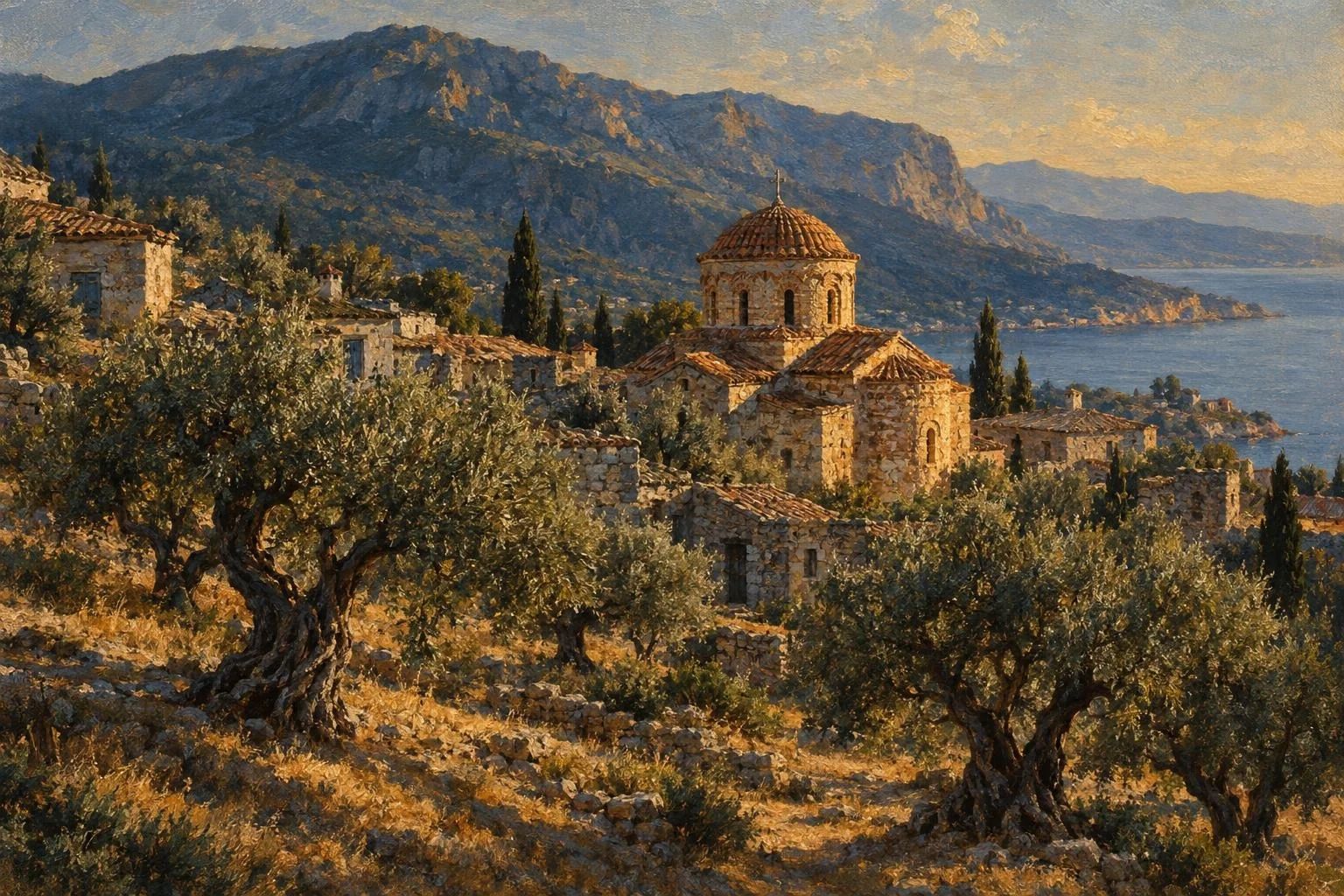
It was 1994. The mountain village of Lakonia in the Peloponnese of Greece lay stretched across a dry slope, like a memory forgotten by time. The stone houses, built one above the other as in an ancient tale, bore on their bodies the cracks of the heat and the south winds. The olive trees all around were not the majestic giants you saw in prosperous fields—they were low, bowed, like people who had learned to live on little.
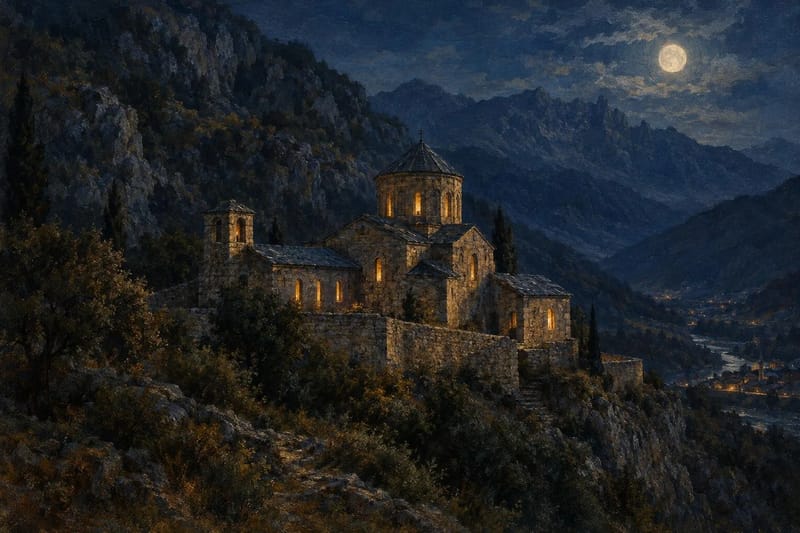
In the center of the village stood a Byzantine-style church with a circular dome and a large cross on the roof, which lit up at night and could be seen from afar.
It was a large church for those two or three villages that felt like neighborhoods in that place. Silent, with white walls that took on golden hues in the afternoon light. It was not just a place of prayer—it was the heart of the village. Around it lay a small square with a few shops, where life flowed slowly, without haste, like an old clock that no longer had any need for time.
I had come there for work.
They said builders were needed to rebuild the church roof—a fund from distant emigrants in Australia had revived this place. And so, among many others, I too found myself before the door of the village priest.
He welcomed me as if he had known me for a long time.
He was in his sixties, with a calm face and eyes that did not judge you. His voice had a disarming softness. He did not let me go to his parents’ empty house, as he had initially suggested. “No,” he said, “a man needs voices in the house.”
Their house had a warmth that did not come from the walls, but from the life within them. The wooden ceiling, darkened by the years, seemed to hold the voices of those who had lived there. The evening light scattered softly, giving everything a honeyed hue, as if time had softened inside that space.
Panajota, the priest’s wife, moved with a confident calm. Her full figure, carried with a kind of silent pride, and that long braid falling down her back, gave her a look that stayed in your mind. It was not a beauty that struck you immediately—it was one that revealed itself slowly, in the way she spoke, the way she looked, the way she understood without asking.
Her daughter Elpidha… was a whole other world.
A slight smile, like a light turning on without a sound. Her eyes did not merely look—they invited. Her eyelashes fluttered slowly, as if keeping a secret. Her long hair flowed over her shoulders like dark water, and every movement she made seemed to want to hide and be seen at the same time.
In that house I began to feel… at peace.
The evenings were long. After dinner, the priest and his son would go upstairs, with a simple excuse—reading. But in truth, it was a silent withdrawal, leaving space for us who remained below.
Me, Panajota and Elpidha.
Our conversations stretched on until midnight. They started with Albania—with its wounds, its banned religion, a system that had left behind a great void in the soul. But little by little, the conversations slipped into something more personal… softer… more dangerous.
One night, it was past eleven o’clock.
The pale light of the lamp filled the room with the color of sweet mandarin. The wooden ceiling seemed to breathe. Silence had become part of the conversation. The play of light and shadow on the walls gave you the feeling of a dreamlike state.
Elpidha leaned forward slightly.
“Mama… I’m getting sleepy…” Her words were like a caress, like a plea. “I don’t want to leave…”
Her voice was soft, slippery, like water on leaves.
“Can I come and rest my head in your lap?”
Panajota did not move right away. Then, with a calmness that shocked me, she said:
“Why come all the way over here, my darling? You have Thodhori closer…”
In that moment, something changed in the air. I froze.
Elpidha did not ask for permission. She gathered her hair with a quick motion and rested her head in my lap, as if it were the most natural thing in the world.
My body became alien to me. I did not dare to move. I looked… but with fear. Her calm forehead, her eyes closing slowly, her soft lips… and beyond, a beauty that should not be seen, but which drew you in like a silent sin. In that moment I realized—
Panajota was watching me.
Not openly. But with that secret gaze that knows more than words. Every time I turned my head, she pretended to be busy with something else. But her presence was there… strong… aware.
Time melted away.
Her voice kept speaking—stories from life, questions about me, about my feelings… But I was somewhere else. On a blurred boundary between gratitude and a feeling that should not exist. I did not want to move. Neither to avoid waking her… nor to ruin that moment that felt like a forbidden dream.
PILO ZYBA