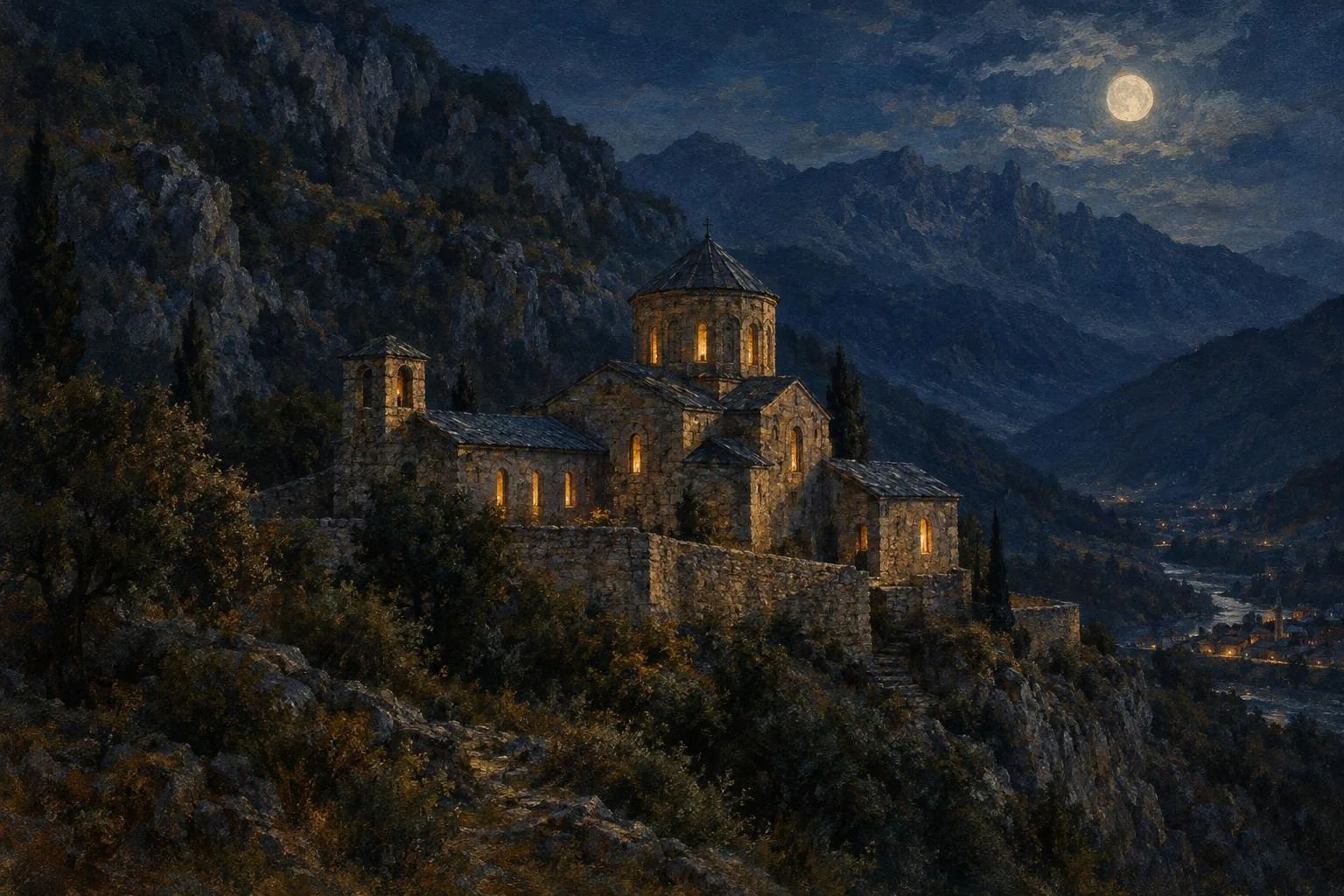
A pale evening light fell over the town of Pejë, mingled with the shadows of the mountains and the heavy silence of the centuries-old stones. There, in the lap of the hills that had seen empires rise and fall, stood the old monastery—a body of stone with the wounds of history on its shoulders.
It had once been an Albanian Catholic church. Its walls had heard prayers in the language of these lands, had seen medieval knights bow their heads before the altar, and, according to legend, Skanderbeg himself had been crowned there, under the candlelight and the shadow of the cross.
But history, as always, does not leave things in peace.
After invasions and the long flow of centuries, the monastery had changed its face. The crosses had been enlarged. The inscriptions had been replaced. The language of the stones had been forced into silence. And over that silence another name, another flag, another memory had been placed.
The Serbs called it their property.
Kosovo was now an independent state, but the monastery remained like a nail driven into the trunk of history—a nail that could not be pulled out by time or by war.
At night, the large phosphorescent crosses shone on the hill like the cold eyes of wolves. They could be seen from afar, as if they wanted to tell the people:
“We are still here.”
But the earth beneath them held another memory.
A memory not written in state orders or invaders’ decrees, but in stones, in graves, in the language of songs and the silence of generations.
Three monks lived in that monastery. Three men united not by faith, but by fear.
Fear of one another. Fear of the past. Fear of the secrets each kept like a knife under his cassock.
The first was Zllatko Kopiliçi.
A tall man, with a harsh beard and eyes as frozen as Slavic winters. Age had weighed down his shoulders, but not his ambition. There was something torn in his face, as if life had clawed off his skin.
Born of a secret affair between a Serbian woman and a Russian agent, he had entered life as a disgrace and survived as a silence.
To erase the traces of the scandal, his father had done two things:
he had cut off his blood inheritance and locked his life within the walls of religion.
Since then, Kopiliçi had lived among icons, but without ever believing in saints.
The second was Svjesto Qorroviçi.
A single eye sat on his face like a window that had survived a fire. He had once been a beautiful and highly intelligent child. But one day he had seen what he should not have seen: his mother in the bed of the party secretary.
From that day on, his life had become an eye violently gouged from the face of innocence.
He saw little, but suspected much.
The third was Sovjet Hajvanoviçi.
Tall, pale, and with a face where stupidity and cunning seemed to fight every day to hold the throne.
He had grown up among horses and donkeys on his grandfather’s farm. But his fate had changed the day a horse kicked him in the forehead.
Since that time, something in his mind had snapped forever.
When he woke up after months of unconsciousness, he repeated only one word:
“Hajvani… hajvani…” And so the family surname turned into a curse.
Now the three of them lived in the monastery of Pejë like three ravens on an old bell.
None of them trusted the other. None of them fully believed in God. But all three believed in fear.
And fear had come again that black Friday.
It was a heavy evening, with a low sky and a wind that whistled through the pines. In the monastery courtyard stood the black minibus, washed and ready for the road.
The curtains were drawn.
The monastery doors were locked slowly, as if the stone itself did not want to let them leave.
Above the heavy wooden gate, the wind shook a small rusty bell.
Its sound came out faint, like the voice of someone trying to speak after many centuries of silence.
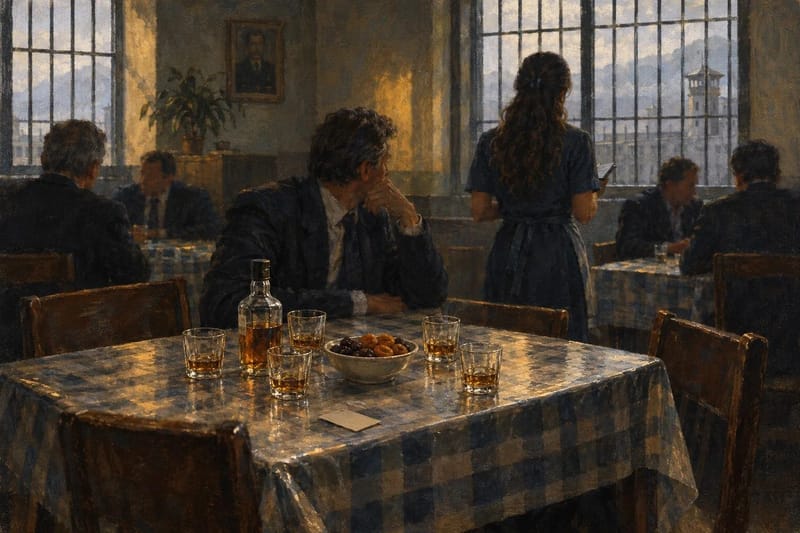
The three monks climbed the stairs and entered the abbot’s room. Silence reigned inside. A silence that had weight.
Kopiliçi opened the large ledger. The pages sounded like the wings of bats.
“Now we must decide…” he said in a low voice. “Who will set off with the shipment?”
No one spoke.
Hajvanoviçi wiped his sweat with the sleeve of his cassock.
Qorroviçi looked with his single eye, first at one, then at the other, like an old wolf sniffing out a trap.
They knew what they were transporting. Evidence that had to be erased from the land where it was born. Everything had to be taken to Leskovac. Everything had to lose its tracks. Because true history was the greatest enemy of the lie. But the roads of the night do not forgive. Especially when history decides to take its revenge.
The road stretched through the dark valleys like a black snake vanishing into the mountains. The minibus moved slowly, its lights cutting through the darkness and the phosphorescent crosses on its sides shining like night wounds. No one spoke inside. Only the hum of the engine and heavy breathing filled the space.
Kopiliçi gripped the steering wheel tightly, as if he wanted to squeeze fate itself with his hands. His beard trembled slightly every time the vehicle went into a curve.
Qorroviçi sat half-leaning against the seat, but his single eye never stopped moving. He stared at the darkness outside as if expecting someone to emerge from the forest. Meanwhile, Hajvanoviçi drank from a bottle of raki every now and then, his hands shaking.
The mountain had its own silence. A silence that did not resemble peace, but an ambush.
Somewhere in the distance, the water of a waterfall could be heard. From time to time the wind blew, and branches slapped against the roof of the vehicle like the fingers of the dead.
After midnight they stopped by a spring. They got out without speaking. The water fell from the cold rock and gleamed under the pale moonlight.
Kopiliçi cupped his hands with water and washed his face. For a moment it felt as if he were washing away his sins, but when he raised his head, he saw his own shadow in the water and recoiled. Shadows cannot be washed away.
Hajvanoviçi lit a cigarette and cast his eyes toward the forest.
“I don’t like this road…” he murmured.
“Roads aren’t made to be liked,” Kopiliçi replied. “They’re made to be crossed.”
Qorroviçi laughed dryly.
“But some roads lead you straight to the abyss.”
No one spoke anymore. They set off again. The deeper they went into the mountains, the more the night seemed to close in on them. Somewhere on the road, a large raven appeared. Pitch black. On top of the body of a crushed animal.
It raised its head toward the vehicle’s headlights, but did not move.
Hajvanoviçi crossed himself immediately.
“Ravens don’t come out at night for nothing…”
“Don’t talk like an old woman,” Kopiliçi said, but his voice did not come out confident.
The vehicle passed by the raven, and for a moment all three turned their heads back.
The raven kept watching them. Like a guard of death.
Further on, the crack of a rifle was heard. All three shuddered.
Kopiliçi braked hard. The vehicle skidded slightly on the wet asphalt.
“They’ve been following us…” Hajvanoviçi said, his lips trembling.
“No one knows anything,” Kopiliçi tried to speak calmly, but sweat had covered his forehead.
Then a wolf emerged from the darkness. A large wolf, with gray fur and blood on its back. It crossed the road with a heavy leap and vanished into the forest.
“They shot it…” Qorroviçi said.
Kopiliçi clenched his jaw.
“The sheepfolds have masters now.”
The words hung in the air inside the vehicle like a curse.
Because each of them understood that it was no longer about the wolf. It was about them. The journey continued. The night was ending. A cold morning light was dawning on the horizon.
Hajvanoviçi took the wheel to drive down the mountain pass. His hands were tired, but he did not want to show it. The other two were dozing. Only the engine hummed. The curves became narrower and narrower. Below, the abyss opened up. Above, the rocks loomed like the faces of giants. And right there, it happened.
A fox suddenly sprang from a bramble bush by the side of the road. Its eyes flashed in the headlights. Hajvanoviçi screamed and spun the steering wheel. The minibus lost its direction.
A metallic crash exploded in the air. The vehicle hit the guardrails. For a moment it seemed to pause over the void. Then the abyss opened its arms. The vehicle rolled once… twice… three times…
The screams mingled with the noise of the metal. The windows shattered like ice. And then… silence. Only the wind blew through the abyss.
When the first car arrived nearby, dawn had begun to lighten the mountain. The driver got out, terrified.
Down below, among the brambles and rocks, the black minibus of the monastery could be seen.
He called the police immediately.
“At the Grishta pass… the monastery’s vehicle has fallen into the ravine…”
Within a few minutes, the police, an ambulance, and local residents arrived. No one spoke much. They just looked.
The descent into the abyss was difficult. When they reached the bottom, they saw the bodies. The three monks were dead.
Their eyes were still open. On their faces remained that fear which had followed them all their lives. Fear had not left them even in their final moment.
The police began inspecting the vehicle. One of them opened the back door. And he was left breathless. Inside there was no food. No church supplies. No medicine. No clothes. It was filled with wooden crates. With icons. With old crosses. With manuscripts. With archaeological artifacts. With fragments of history extracted from the lands of Kosovo. Old Albanian evidence. Traces that someone had wanted to erase.
The policeman touched an ancient icon that showed an old inscription in Albanian. For a moment he fell silent. As if he were hearing the voice of the centuries.
A light morning breeze blew over the abyss. And for the first time in a long while, it seemed as if the mountain itself was breathing in relief.
The news broke quickly.
The television crews arrived.
The cameras filmed the abyss.
The people began to talk. And along with the news, the truth also came to light.
History was being stolen. For years. At night. In silence. Under the shadow of crosses and black cassocks.
But history has a law of its own.
It can be wounded. It can be covered up for a time. It can be imprisoned in monasteries and archives. But it does not die. Because the earth knows its children. And the stones speak, even when men fall silent.
PILO ZYBA