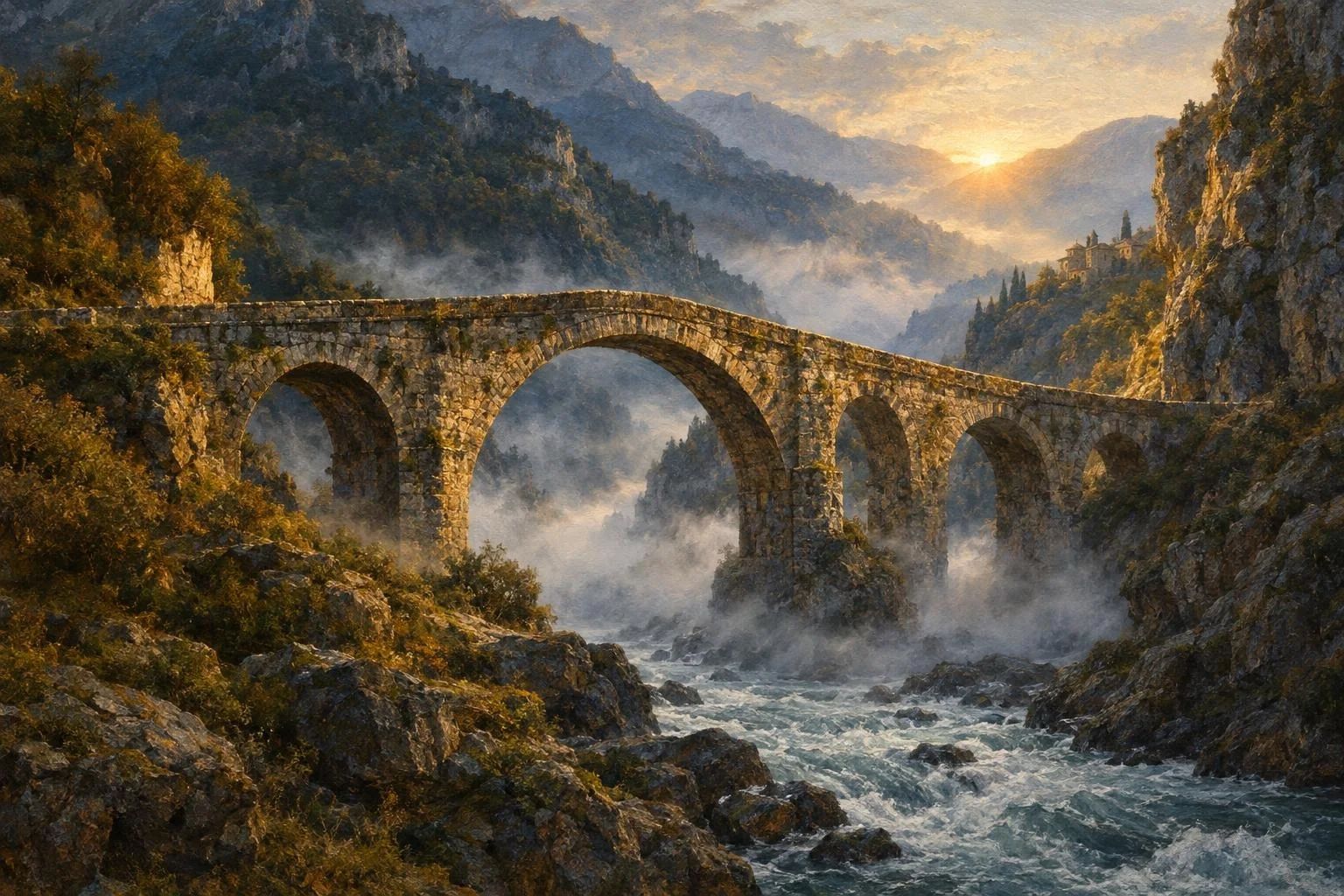
The popular proverb “A good neighbor is the door to paradise” often comes to mind. It has been more than nineteen years since we cut the barbed wire with our southern neighbor, Greece, to build better relations. Nature placed us next to each other, and gave us a roughly similar history. We have experienced roughly the same fate. We have fought against the same enemy, always keeping each other as friends. We have reached the point where, if we take a look, with very minor differences, even our legends are the same. “Kostandini e Dorontina”, “Legjenda e Murimit” or some other comes to mind. In the case of the Greek legend, it is about a bridge called the “Bridge of Arta”, which suffers the same fate as the Rozafa castle: built by day and torn down by night. To stay standing, Rozafa required besa in its foundation. Once besa was placed in its foundations, it survived. But let us leave the legends for a moment and return to the reality of our days.
Indeed, it is bridges that perform this noble service, but there are also bridges that do not enjoy this fate, or even worse!
A bridge of understanding, a bridge of love, kept long-suffering Kosovo neither in heaven nor on earth. For such a bridge, it paid a tribute of blood, pain and endless suffering over the centuries. Somewhere this bridge is built, and somewhere it is mined. Someone extends the hand of peace like a bridge over all the hatred that has been created, while another group mines them for the sake of invisible bridges.
A bridge of sincerity and goodwill is required, so that Macedonia feels like a state like all the others and with all the rights they enjoy. But the bridge of negotiations cannot be found, or do they not want it to be found?
And if they do not want it, why? Who is hiding behind their interests? Who benefits from keeping this issue, and others that fill the globe, left hanging?..
The answers are many, just as there are many possibilities to resolve these issues that keep the globe trapped in a constantly set snare and in a state of uncertainty.
But let us leave them and return to the purpose of our writing.
For nineteen years we have believed in such a bridge between Albania and Greece. In a bridge that will simultaneously connect the love of thousands of emigrants with their parents and relatives in their homeland. There comes a moment when we are truly optimistic. With our good work, with our civilized behavior, we lay secure stones in its foundations, but what happens?
The moment we hope its walls are coming to life, after a quiet night, in the morning its walls appear torn down again; instead of hopes, a pile of fear and uncertainty. Emigrants always have their papers in order, yet lack a document in their pocket to enter and leave their homeland. For a single certificate, you have to leave work for at least a week, travel from Athens to Tirana, to get stamps, pay fees, and toil away. All while the rent is due and classes must be paid for. All these tolls for an economic emigrant who has come to Greece to earn his daily bread. The host state reaps him, the mother state milks him. What is the emigrant to do?
Unbelievable, but it always happens just like in the legend. What takes a year of effort to fix is destroyed in a day. Rightly, the question arises in the mind and heart of every emigrant: “Who benefits from this situation?
Who mines the walls of the bridge, and why?”
I, who have the legend of the bridge before me, ask the question: “Why so much time to build a bridge? For us it has been and remains built.”
I was born in Përmet, in a village called Çarshovë, a little further down at “Tri Urat” where the new customs office has now been built. Well, taking no more than fifty steps, you step onto Greek soil. Here is what a fellow villager told me when I set off nineteen years ago: “As soon as you leave Tri Urat, on the right side of the Vjosa’s flow, you will see a path that runs through the plane trees. If you stick to it, in no less than an hour you will come out in a village called Ajetopetra (Eagle’s Stone), and upon arriving you will ask for Jani Panariti.” The old man mentioned the people he had known and traded with. Considering his age, I thought they must have died. But I was wrong. The road to Konicë, where they used to trade, truly untrodden for more than 45 years, had somewhat lost its vitality to time, but it had not lost its contours. The bridges built over the streams stood unmoved before the wars of the time, and the many years of war with atmospheric and political rains and snows. Like faithful lovers, for years, they awaited their lost loves, which did not delay in appearing one day. The village houses, most of which had been bought by Albanians, served them as a place to rest their animals and as hotels for sleeping.
When I knocked on the door the old man had told me about, and as soon as I said I came from Albania, they let me inside. By a fireplace, an old man of about 75 welcomed me, tall with white hair (as if he carried Mount Pindus itself on his head), calm and noble.
“I haven’t seen him for a full 45 years,” he told me, “but I have never forgotten him. I give you my word that I will soon go to meet him in Albania.” And he kept his word.
A year later, together with his son, I went out to wait for them at Kakavijë. I watched them arguing with the customs officer, and I realized something was wrong. In the end, the customs officer, a young man in a green uniform, signed the papers and allowed him to enter. (It seems he forgave him for something because of his age.)
The day of August 28 will remain unforgettable for me, even more so for old Kostë and Mr. Jani who had come from Greece. So many years, so many impressions and memories! Their meeting was simple, without the flashes of photojournalists and interviews of journalists, without cameras, but dozens of times more sincere than all the meetings of diplomats put together, or ministers who meet and meet, say and repeat the same words, which they conclude under the pop of champagne bottles and the smell of roasted meat. “They play the same old tune,” as the people say.
After that very touching meeting, they went to Kostë’s house, which Jani had visited other times before the 1950s.
The conversation unfolded warmly and amicably, sometimes in Albanian and sometimes in Greek. I sat and asked myself: “Which of them is Albanian and which is Greek? Mr. Jani who speaks Albanian, or old Kostë who speaks Greek?” And I ran through my mind the words of politicians, that minorities are bridges of connection between peoples and states. What a pity, when the peoples themselves have long since erased these prejudices from their memory.
At a moment when everything had dissolved and become one, and this was the joy, Mr. Jani pulled a pistol from his belt, and a wristwatch from his shirt pocket. I couldn’t understand anything!
“This is your pistol, and this is the pocket watch,” he addressed Kostë. “You entrusted them to me when you left Greece for the last time, on August 28, 1947. You told me the roads were closed, and if they found them on you, they would imprison you. Here you go,” and he handed them to Kostë. “We Balkan people do not forget our trusts. And when I went to America for 20 years, I left word at home, in case you came to get them, or sent someone else.”
I stood there as if walled in, with the bottle of raki in my hand. Before me appeared sometimes Kostandini of the ballad with his sister, sometimes Mr. Jani whom I had in front of me. These were the characters of modern legends.
I could not help but believe that the bridges we speak of are indeed built. In them reside besa and love, and the desires of thousands of emigrants.
It has its roots deep in antiquity, but historians have fallen into a lethargic sleep, while politicians have drowned
the “troubles of the peoples”. The handshake of these two men was and is for me the best bridge for connecting our two peoples. The besa that keeps the foundations of love unshaken.
By Pilo Zyba