When I came out of the cemetery, the sun was strong, almost like a hot iron. It beat down on the marbles that had the brightness of a mirror, and ricocheted back to blind your eyes. As always, it amazes me that the world goes on normally, while you step out of a place where time no longer moves.
The flowers on their graves were still fresh. It felt as if my mother was about to say to me:
“Don’t stay in the sun too long, you’ll get tired.”
The road home was the same. But I was no longer the same person I had been when I left it in the morning.
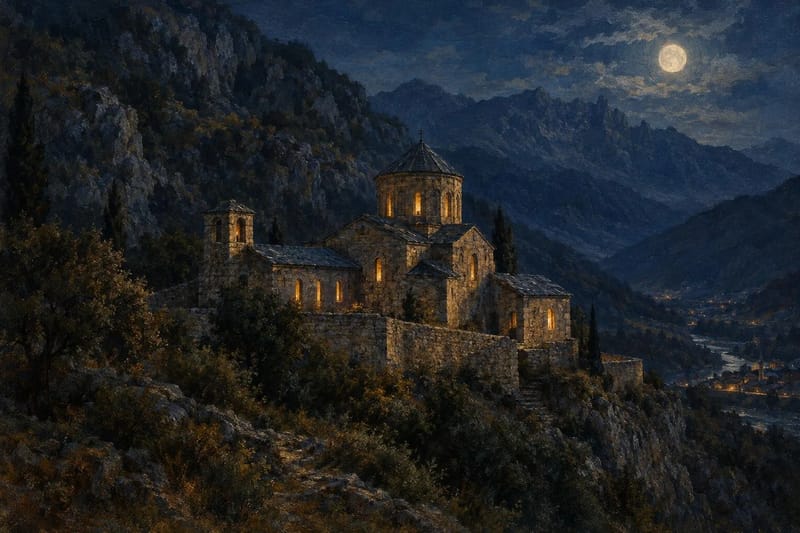
Before the city, the Laç of old, with few changes in its buildings, but with great changes in its faces and movements. People rushing about, people I do not know. Inside them the struggle for life, for profit, for their children. The green trees. Once, somewhere, they had the beauty of my own age, still un-grown. Now, with open arms, they embraced the sky, as if to say, “The past was in the roots, while the present is in the leaves, and the bird nests we carry on our backs.” Deep in the mountain gorge, the magnificent Church of Shenjt Ndoit that was once leveled to the ground. The noise of cars, voices rushing in the wind like kites to catch the threads of everyone's desires and thoughts...
The key turned in the lock with that familiar sound—a sound that does not just open the door, but opens an entire life behind it.
Inside it was cool. The coolness of walls that have heard laughter, little arguments, the smell of bread, the winter cough, the evening radio.
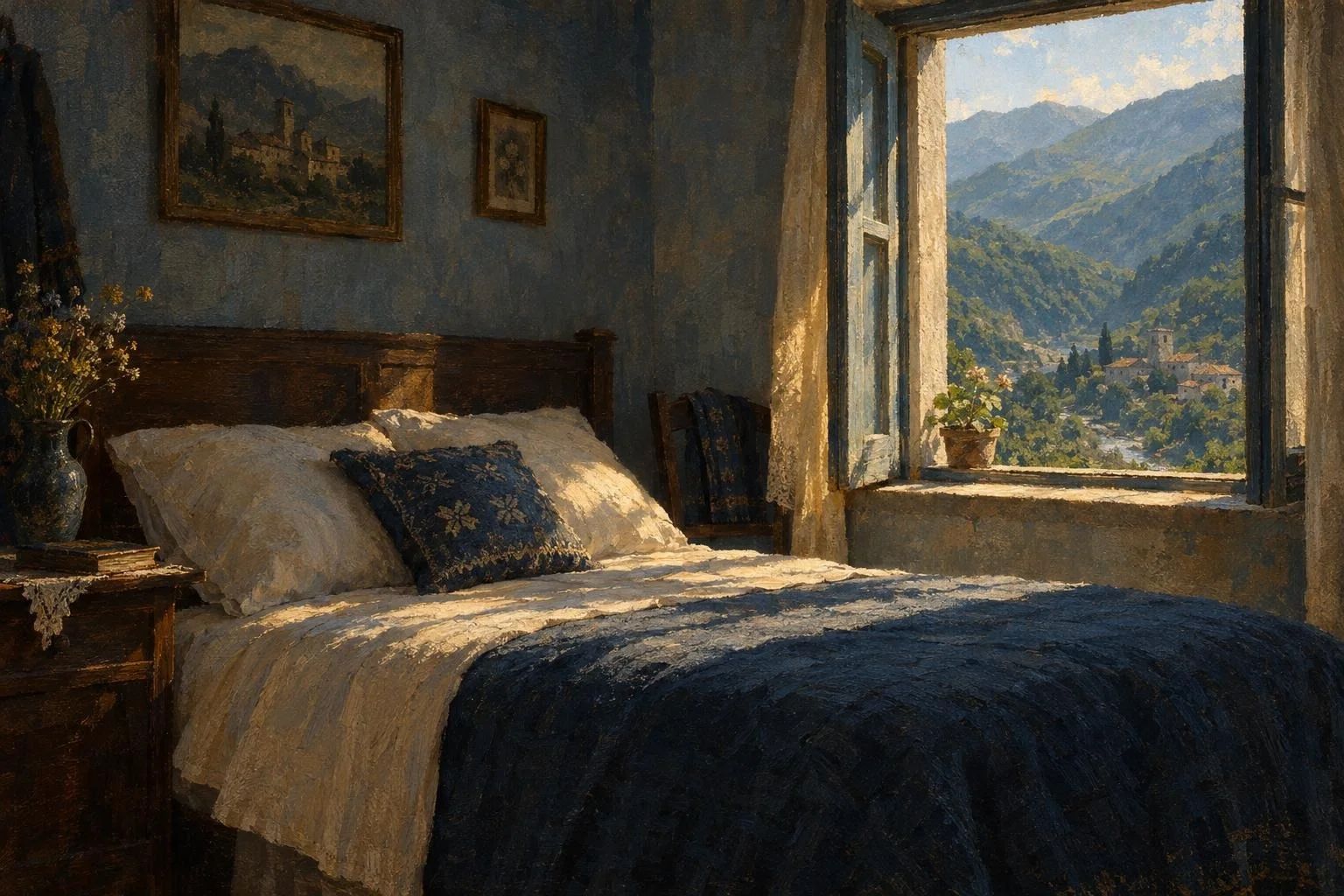
I felt the need to take a deep breath. I lay down on my mother’s bed without thinking.
Like a movement the body knows on its own. The mattress sank a little. And in that moment… it felt as if my head fell into her lap. Not as a memory. As a physical sensation. But as a softness you cannot find anywhere else in the world.
My eyes remained half open. On the opposite wall, the afternoon light spread slowly.
And within that light… they took shape. Not as ghosts. As a presence.
My mother was in the kitchen. Bent slightly over the stove. The same movement of her hand as she stirred. The same quietness that raised me without a fuss.
A wisp of steam rose beside her… and for a moment the scent of the house came to me, a scent that no longer exists anywhere else.
My father was sitting on the divan. On that divan that time has kept just so, simple, covered with a cloth and embroidered with ruffles and pleats by my mother’s hand. His hands on his knees. Waiting. Then… he raised his head. Not toward me. Toward my children. His eyes filled with a light I had never seen as clearly as I did now.
A longing that did not know where to direct itself.
He opened his arms. Slowly. With that gentleness that asked no permission. My son approached him. As if drawn by something he could not understand with his mind.
My father took him on his lap. Held him tight. Like someone who has waited too long for an embrace he didn't know would ever come.
Then he took my little daughter too. He placed her on his knees. He held them both with the hands that once held me, and smiled.
Not a big smile. A quiet smile… that smile people have when their hearts are full and aching at the same time.
And I… felt something tear open inside me. Because I thought:
“Could they have forgotten that lap? Or does the body remember love… even when time separates people from one another?”
I wanted to shout:
“Hold them… don’t let them go… stay a little longer…” But my voice caught somewhere between my chest and my throat.
A quietness entered my body. Heavy. Soft. Merciless. Like when you realize that love never vanishes… but sometimes it continues to live only on the other side of time.
My father with his gaze that made you feel protected even when he didn't speak.
My mother with her silent way of always being near.
A quietness entered my chest. Painful. Soft. Like when you realize that love does not vanish—it only changes form.
Then… like mist… they began to fade from the wall.
I shut my eyes tight. Like someone trying to hold water in their hands. And then…
Footsteps. Girls' footsteps.
Light as leaves touching the ground without a sound. Carefree as early summer. Full of life, full of light, full of a future that seemed endless back then.
Then voices:
“Iris… Iris…”
Her name spread in the air like the scent of spring. Her voice—young, lively, crystalline—like water flowing over white stones. Untouched by the years. Untouched by pain.
Only life. She, Pranvera, who brought spring to that group of girls who looked like an entire flower garden of colors and scents.
Then the window above my floor opens with the noise I still remember. Even though half a century has passed, its sounds had not changed. No one had put a drop of oil on its hinges. A small noise, but back then it was the beginning of every afternoon.
“I’m coming!”
Then Erida—always in motion, like a warm June wind.
“Come on, the game is starting! We won’t find a seat! The triangle is completely full!” In her voice there was haste, but also joy.
Like someone afraid of missing a single crumb of life. Tall Erida, like a willow with her hair falling to her waist, straight in some places, curly in others. She didn't want them to miss a moment of the girls of Laç playing and winning on the basketball court in the first division.
Then Donika… always the one who gathered the others, like an invisible thread tying them all together. Her voice had that sweet certainty that only true friendships possess.
My heart filled with a strange light. I wasn't just hearing voices. I was hearing my own time.
Their footsteps on the stairs were music. A music that only youth knows how to create. We used to know people by their footsteps. Footsteps were the signatures of the soul. We knew them by the diction of their voice, as if we had all graduated in singing and knew the vocal sounds that came from the musical instruments of everyone's lungs.
Then came the laughter. A laughter that burst like the sun over the neighborhood roofs.
That filled the hallway, the stairs, the air, the light. A laughter that made you believe life is always ahead. That nothing bad can happen in a world where girls laugh like this.
I stood up at once. As if called by someone. I went to the window. I wanted to see them. Just for a second. To see the spring running through their bodies. The beauty of that age that does not know how beautiful it is. That light that exists only before life learns how to hurt.
I opened the curtain.
Outside—heat. Silence. Motionless air. Not a footstep. Not a voice. Not a laugh.
An old woman, with a cane in her right hand and a bag in her left, walked slowly home. The city does not breathe. The voices had flown away like migratory birds, but ones that would never return. They have left the great nest of the city empty. Over it only the dust of forgetting, and the dust of the street, like a bitter virus seeking to make people flee. Empty streets, empty soul. Only emptiness. And then I understood: memory is not just a thought. It is a dwelling place.
I went to the kitchen. I put the water on for coffee. The steam rose slowly, like breath.
And I thought of my children's words: “We should sell it. No one is going to live here.”
Perhaps they are right. Their world is somewhere else. But they do not know…
This house is not brick. It is not concrete. It is not property. This house is the place where my parents still speak to me. Where my youth still runs up and down the stairs.
Where the laughter of a generation wanders in the air. This house is my memory… and memory is not for sale. Because no one can buy what continues to live inside you.
And maybe one day… when I am no longer here… someone will open this door… and will feel… a life that has never left.
This house cannot be sold. Its value cannot be bought by anyone, no matter how much money and gold they offer...
BY PILO ZYBA
London.....12.02.2026