
In London it rains even when it isn’t raining. It is a dampness that gets into your clothes, your hair, your thoughts. Ardit had understood this from his very first month. The city does not push you to cry. It teaches you to keep everything inside.
He was twenty-seven years old. Tall, with an upright posture and that regular stride he had never lost from the military academy in Albania. He had once dreamed of the uniform. The honor. The flag. Now he wore an orange reflective vest and filled buckets with concrete.
Without papers. Without a voice. Without a future he dared to think about out loud.
Little was spoken in construction. Most were like him—people living in temporary spaces. Rented rooms. Cheap phones. Clenched dreams.
He did not go out in the evenings. He did not linger in tube stations. He did not look policemen in the eye. He had become a master of evasion.
That day began like any other.
He got on the 53 bus that passed through Elephant & Castle station and took him near his room in Lewisham. A grey sky. People with tired eyes.
He stood, counting the stops in his head. He stayed near the doors, just in case, ready to jump out and get away as quickly as possible. Suddenly he felt something. A gaze. A man in his fifties. A black coat. A simple tie. Calm but persistent eyes.
Ardit lowered his head.
“Could he be a plainclothes policeman?” he thought! “Could he be someone who has been following me?”
Then a quick, shameful, wild thought:
“Could he be one of those… because England has a bad reputation for those kinds of men?” He still had a way to go.
He got off at the next stop. He walked quickly. As if trying to hide from someone.
Then he heard footsteps behind him.
“Excuse me…” the voice was soft. “Where are you from?”
He turned around, ready to run away.
“From Albania.”
“Do you work here?”
“Yes.”
“Where?”
“Construction.”
“Do you have papers?”
Silence.
“No.”
The man sighed softly.
“How much do you make?”
“Two thousand five hundred.”
The man looked him straight in the eye.
“I need you. I have been watching you on the bus for a few days, but today I decided to speak to you.”
Ardit smiled bitterly. He knew very well that no one in London needed him.
“I own a funeral home. I need a man. Tall. Tidy. With a serious demeanor. Just like you.”
The young man fell silent and lowered his head; he had dreamed of other things for his life.
“I pay well, five thousand pounds a month, you will also get tips, and I will try to sort out your papers too. I had a boy from Estonia, but he left.”
Ardit raised his head. He cast a glance at him. The world went deaf for a moment.
“I will think about it,” he said, and walked away with a look as if to say, we’ll see.
The other man, calm and smiling, handed him his card with his address and phone number.
“I will expect you at 11 o’clock.”
Ardit walked away, dragging his feet. Inside him, two thoughts pulled in opposite directions at the ends of a rope he called life. Which side would win? How life takes you sometimes, he thought; he himself did not understand what was happening to his situation. He could not fall asleep all night. Towards morning he dreamed of the blackened beams of his house, and his father smoking a cigarette by the hearth. His mother had gone out to work; she looked after an elderly woman in the neighborhood. Her children had long since emigrated to America.
*
The next day he went to the meeting place. He watched a funeral ceremony up close. An old stone church. White flowers. A violin trembling like a broken breath.
Four men lifted the coffin. The coffin tilted to one side; one of the men carrying it on his shoulder was shorter. Ardit understood, put himself in his place, and leveled the coffin.
All four walked in step, with one rhythm, slow, silent, with faces that had taken on the color and the grief of the dead person’s relatives accompanying him.
It was a care that looked like a prayer. An elderly woman stroked the wood. A little girl cried soundlessly.
Ardit felt a weight in his chest.
This was not a job. This was a border between worlds.
He accepted.
Life changed.
Black suits.
Shoes that shone.
Hands that were no longer cracked.
He began to learn things that no one teaches:
How to hold the silence when someone calls out the name of a dead person. How to look at the ground when the family collapses in tears. How not to turn to stone.
The money began to add up. Every month he sent some to Albania.
His mother laughed more. His father spoke little, but his voice had grown calmer.
But after every phone call, his room grew larger. Emptier.
One day the owner told him:
“You are very good. Do not rush the papers. Many people leave when they get them.”
He understood.
He was being bought with stability.
The years passed.
He buried hundreds of people. He learned stories without meaning to:
Men who never returned home. Women who died with a photograph in their hand. Children holding no one’s hand.
He began to fear one thought:
He was living amidst the end of others… without having started his own life.
Then—the phone call.
His mother was crying.
His father had died in his sleep.
He sat down in the changing room.
The black suit hung before him. He cried soundlessly. Because he understood: he who had buried the world…
would not bury his own father.
He sent money. He sent a wreath. He sent a letter. But he was not there when the earth fell on the coffin.
After that day, something inside him broke. He began to feel that every coffin was also a little bit his own.
At night he would think:
“Perhaps I too… will be carried by four strange men.” One winter, during a ceremony, he felt a pain in his chest. He ignored it.
He had to be strong. Always strong. But the pain returned. Then it became like a stone inside him.
One morning, getting dressed for work, he sat down on the bed because he could not breathe.
The ambulance came quickly. Very quickly.
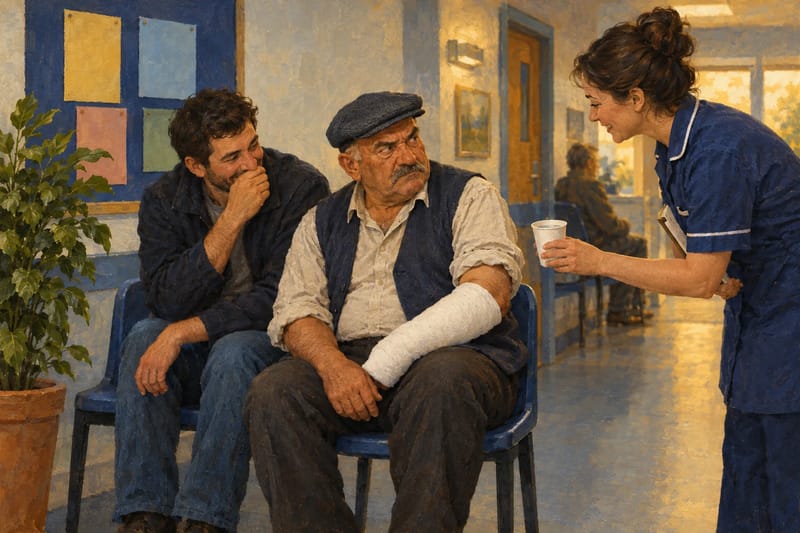
In the hospital, the lights were very white. The doctor spoke slowly. Words he did not remember entirely. Only one sentence:
“Your heart is very tired.”
He spent his last days watching the rain from the window.
He wrote his mother a message:
“I am fine. Do not worry.”
The final lie of love.
On his last night, he dreamed of his father.
He was sitting in the yard. As always.
“You got very tired, son,” he said.
Ardit smiled.
“A little.”
He died early in the morning. Without a sound. Like someone who did not want to bother anyone.
Few people attended his ceremony.
The owner. Two colleagues. A nurse who had seen him smile.
Four men lifted the coffin.
They walked slowly. With dignity. As always.
In Albania, his mother received a phone call.
And her world went voiceless.
Ardit was buried in a quiet corner of London.
Without a flag. Without his language. Without his mother’s voice.
Only rain.
But in the inside pocket of his suit, they found a photo.
Him.
His mother.
His father.
And on the back of the photo, in small handwriting:
“Do not forget me. I was trying to come back too.”
And so, a boy who spent his life seeing others off…
was seen off himself by a city that never called him by his name.
PILO ZYBA
London...8.02.2026