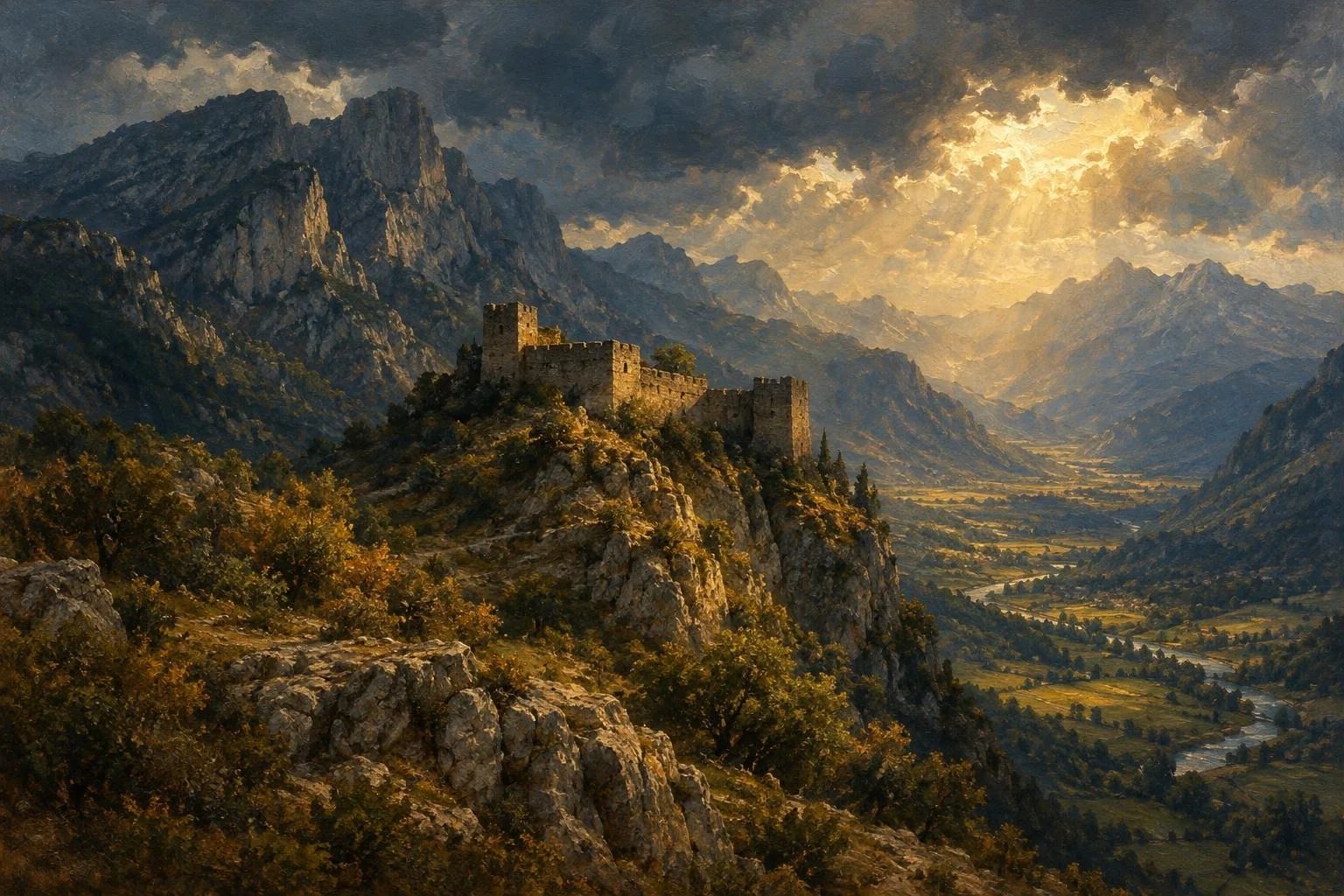
By Keze Kozeta ZYLO
On every crest of Zagori,
On every plateau and mountain slope
The years passed down history…
Life did not halt its stride.
From the book: “The Herdsman and the Devil’s Bird”
You cannot always have a muse to write a poem or to review a book.
There are many reasons for this, but what constantly draws me toward this endless world is the art found within a book, or history written with art.
I had this kind of feeling with the book “The Herdsman and the Devil’s Bird” by the writer from Zagori, Jorgo Telo. The book’s title is intriguing; it feels as if it urges me to take a battlement from Ali Pashë Tepelena’s castle and bring it to the world-famous Metropolitan Museum in New York, where the ivory portrait of Ali Pasha, painted by Jacob Ritter von Hartman (1795–1873), is housed.
This feeling arises in me because the castle’s battlements and the history of Ali Pashë Tepelena are so strongly intertwined that they create the twinning of an epic as historical as it is legendary. His severed head being brought before the Sultan, the tyrant who barbarically oppressed Albania for 500 years, constitutes an undeniable fact of the Pasha’s war against the Sultan, captivating me entirely, and I feel as though I am experiencing what Jean Cocteau wrote about poetry: “In Baudelaire, a single lightning-flash of a line was enough to take the whole poem and lift it to the sky.”
The poet Telo, although disabled in a wheelchair, appears to me surprisingly chivalrous alongside the brave men of Ali Pashë Tepelena, but Telo is different from the Pasha because he fights only with a poetic sword…
His poetic verse holds joy and sorrow in a poetic vibration, with a waking dream of Zagori, where the author also has his roots.
The verses in this poem are clear evidence of the heroic resistance and the tragedy contained within the artistic portrayal. Even though his hero, Ali Pashë Tepelena, belongs to two centuries past, we feel the presence of the invisible close by, and we plunge into an aesthetic expression between the national historical figure of Ali Pashë Tepelena and the world-renowned English poet Byron, who describes his journey to the palaces of Tepelena almost like a resurrection engulfed by the poet’s intoxicating passion.
This poem is a clear service rendered to history and to its howling voices that want to bury history at any cost.
In every stanza we understand the poet’s state of mind, his reflective and philosophical musings. He artistically brings forth the popular historical memory and the generosity of Zagori toward Ali Pashë Tepelena. The cultured and equally hospitable people of Zagori continue to hold in their oral traditions the bond they had with Ali Pasha and the powerful support they gave him to break away from Turkey once and for all.
The noble herdsman Ded’ Gjoni and Hil Dede opened the doors of their hearts and welcomed him just as the region of Zagori knows how to welcome, in all its majesty.
Here is how the author sings of him:
At Hil Dede’s* he found the door of hospitality / at the herdsman Ded’ Gjoni’s**, a noble heart. / To the brave youth, Ali Tepelena / All the mountain peaks looked like battlements.
The entire poem is a message, where a density of artistic devices such as metaphors, symbols, animism, and alliteration so beautifully weave the body of the poetry.
The author becomes a rider of dreams with powerful poetic images that sometimes soften within sorrows and sometimes become barricades against those who infect history.
His verse is twinned with history; consequently, he has known how to take an X-ray inside the bulletproof room he has built. It is known that Ali Pashë Tepelena expressed his gratitude to many supporters of his cause, which was solely the detachment of Albania from the claws of the Turkish Anatolian empire, and so for all his liberators and supporters he built stone houses, aqueducts, and bridges for the whole region and the city, and so on…
Of the Pasha’s charity, the poet writes: To this very day / though the waters have flowed like a river / Every memory in Zagori / keeps that man fresh in mind…
The metaphor in this book has built its nest with the threads of the poet’s heart, which also hold within them the roaring of river waters…
They are a volcano in his soul that never sleeps, which is why the epithets for the people of Zagori, such as lightning-fast braves and captains of Freedom, are inevitably also part of the soul of the poet from Zagori; they are part of that people who gave us the immortal Çajupi, the prominent linguist Ilia Dilo Sheperi, and others… Here is how the poet Telo expresses himself about the gratitude of Zagori:
The gratitude for the people of Zagori seemed to speak with its own mouth / With the mouth of bridges and houses and grinding mills / Like a true lion / he put the Ottoman to the sword… / He raised himself up high / and breathed life into Albania.
The book “The Herdsman and the Devil’s Bird” is a lyrical-epic poem with an infinity of interpretations and a density of meaningful expressions that brings to life the figure of Ali Pashë Tepelena and his ties with the generous people of Zagori, who produced outstanding men and pens.
As a reader, I experience the highly surprising harmonization of the lyrical-epic discourse with the construction of sententious verses for the Pasha who shook the Empire and Europe.
The Pasha had one burning desire / to break away completely from the Porte / He gave courage to the peoples… / Europe was amazed by him / Centuries flowed and were not forgotten / He turned into a legend / We see him sculpted / Song and pen take him up…
This poem reminds historians and howling voices to reevaluate history, and the myopic to take off their dark glasses, because the sun is piercing the maddened clouds that argue mercilessly with one another, because: The covenant he created / together with friends and rulers / Turned the Sublime Porte the color of a quince / while making plenty of rivals for himself…
His bravery and courage will be told generation after generation; he turned the traps set for him to ash, and so the poet’s pen flows like a mountain waterfall:
Like a great landlord the Vizier / declared himself autonomous / With breath and vigor he set to work /
As if he were Sultan on the throne / To this very day / Ali “speaks” to us in gratitude /
The bearded man draws near to us / Except… with two graves, the poor wretch…
These verses bring to mind the poetry of the great Greek poet Yiannis Ritsos, who writes among other things: With a wild lily
I lit up our wildest nights. … adoring even Him who climbs the hill amidst the gilded sunset. Look: On his left sleeve there is a square purple patch. It
cannot be seen clearly from here. But that is exactly what I wanted to show you. And perhaps for that especially I would deserve to be remembered by you.
In conclusion, this epic-lyrical poem with the leaven of art takes us to the source of memory and raises to the zenith the reverence for great national figures.
March, 2011
Staten Island, New York