A True Story
When I returned from Greece after two years of emigration, Albania was no longer the country I had left. The streets had changed, the people, the way they spoke, the way they dressed… but above all, the official posts had changed.
Those we once knew as having a “bad biography” had now taken on state duties. One had become a prison commander, another a commissar, and a few others whom nobody used to take seriously now spoke in an official tone and carried files under their arms.
One day I decided to visit Genci, my childhood friend. We had broken bread together, we had roamed the streets of Tirana together, we had even taken a beating or two together in our youth. Now I was told he had become a director at Prison 313.
I dressed up nicely, like an emigrant returning from Greece who wanted to look a bit “European,” and set off for the prison.
When I got to the door, I fell back on my old habit: I opened the door and tried to walk right in. Back when I was a journalist, I was known everywhere and nobody asked me where I was going.
But times had changed.
A burly military man immediately blocked my path.
“Where are you going?”
“I want to see Genci,” I told him calmly.
He raised his submachine gun slightly toward my chest and said in a dry tone:
“Genci is not your friend. Stay right there!”
That was when I realized that democracy had arrived with military ranks.
I was standing at the door like a schoolboy outside the principal’s office, when a moment later the meeting room door opened and several men in serious suits came out.
The first was Genci.
He saw me and shouted:
“Oh, Pilo! Is that you?!”
“It is,” I said. “But this gentleman here won’t let me in.”
The military man immediately stepped back.
“No, no… I…”
And he lowered his weapon as if the submachine gun itself were apologizing.
Genci laughed.
“Come upstairs and let’s have a coffee. We’re on a meeting break.”
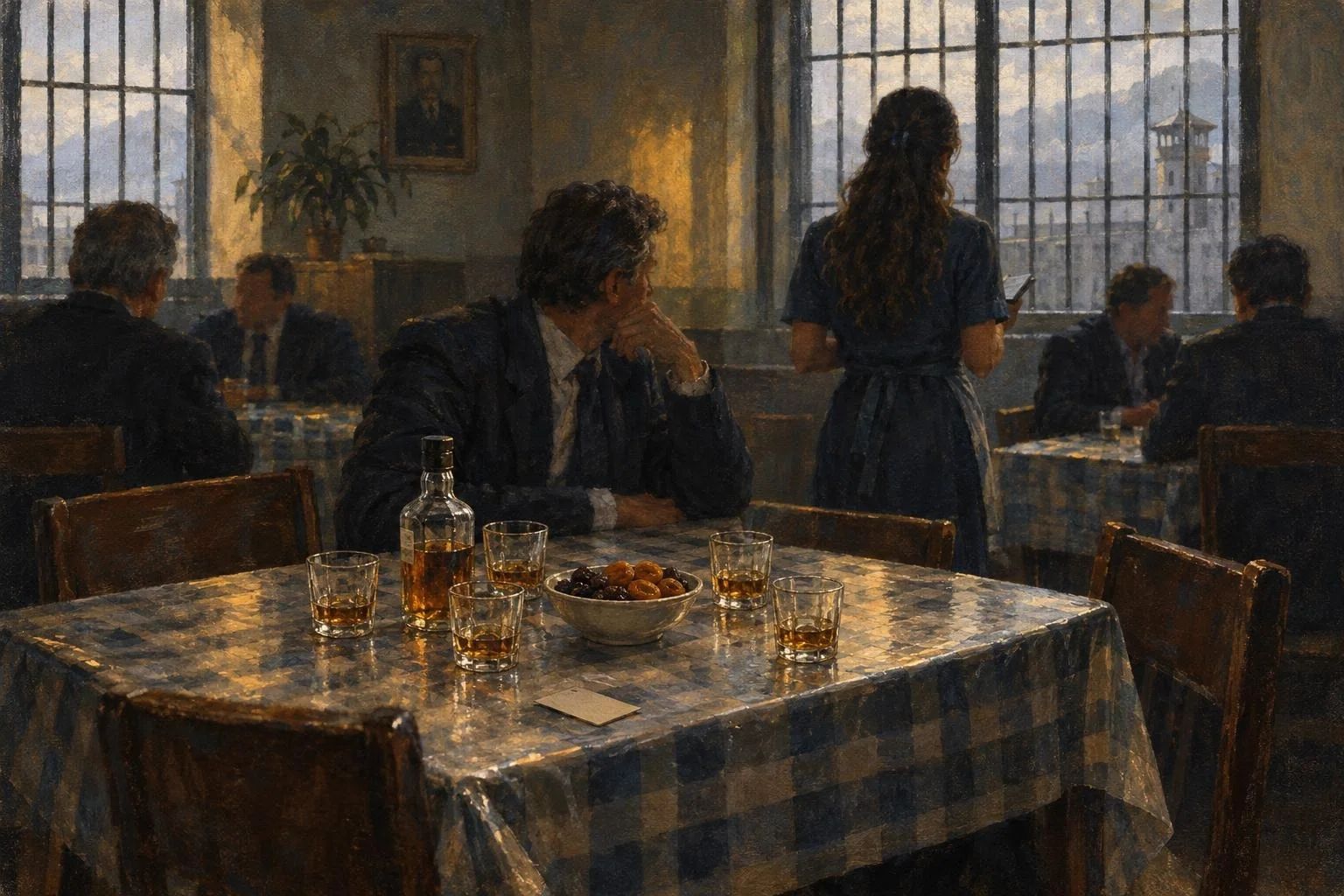
We went up to the café on the second floor. It was a typical state institution café of that time: hard chairs, tables with plastic tablecloths, and a beautiful, long-haired waitress who looked as if she had lost her way and ended up in prison by chance.
“Bring us a bottle of whiskey, five glasses and some dried fruit,” Genci said with the self-importance of a finance minister.
The bottle was so small it barely wet our lips. I didn’t drink much, Genci even less, but with the chat about emigration, prisons and the politics of the time, the whiskey quickly evaporated.
The waitress came back. But strangely, she didn’t approach Genci. She approached me.
“Would you like anything else?” she asked me very politely.
I was a little surprised. I thought:
“This really is true democracy… they even ask the emigrant.”
“Bring another five doubles!” Genci said.
The girl brought them and walked away again.
There were two other people at the table who looked burdened with troubles. You could tell from their faces that they either had a relative inside, or were expecting some favor from the “new power.”
When we finished drinking, Genci called the waitress:
“Come here so we can pay!”
Once again she came straight toward me, notepad in hand.
“Come over here, girl!” Genci told her, laughing. “How much is it?”
He paid right then and there, and before leaving, he pulled out a business card.
“Keep this,” he told me.
I took it and looked at it.
“What is this?”
“My business card.”
“Are we going to talk through business cards now?”
He laughed.
“No, man. But I’m in meetings all day. At least you can call me and we can set up an appointment like important people.”
They left. I remained alone at the table, thinking to myself about how life turned around: once I used to walk freely into offices, while now I waited for permission at the prison door just to have a coffee with my friend.
The waitress saw me deep in thought and approached.
“Who are you?” she asked me.
As a joke, I told her:
“I am the one who got Genci that job.”
She laughed and walked toward the counter. But halfway there she turned back.
“And what kind of work do you do?”
“I am a deputy in the Greek parliament,” I told her with a straight face.
She looked at me in astonishment.
“Why do you ask so many questions?” I asked her.
And then came the final blow.
“I’ve been working here for two years,” she said, “and I’ve never seen Genci pay. Now I understand why he paid today…”
I burst out laughing.
I said goodbye and left.
Later, when Genci returned to the table, she told him:
“He’s a very nice man, that gentleman who got you your job.”
“Which gentleman?”
“That deputy from the Greek parliament…”
Genci had laughed so hard he could barely catch his breath.
“Him?” he said. “He’s a comedy writer. Don’t believe a word he says!”
And so ended my story as a “Greek deputy” and as the man who supposedly appointed the prison directors of Albania.
But, for a few minutes, I accepted the post with great pleasure.