Kalamata at that time, thirty years ago, had a special light. Not just from the sun that caressed the sea every morning, but from the people who arrived there with unfinished stories, with memories in their pockets and with hopes that had not yet given up.
I had opened a small bar. It was no architectural marvel, but it had soul. And in the evening, when the lights dimmed a little and the music began to breathe, it became a world of its own.
I did not know that Ladi was there. Word spreads fast among Albanians, like the wind that asks no borders. And one day, I saw him at the door of the bar.
We looked at each other for a moment and time snapped in two.
“Do you remember?” he said to me without saying it aloud.
And it all came back to us. Tirana in the ’80s. The streets we measured in footsteps, the bars we had christened with our own names, the long beers and the books we made with a dedication that seems like a luxury today.
Six months in a state hotel, with a serious mission on paper—but with a golden little life in reality. We searched all the newspapers and archives to write a book about the “Chemical-Metallurgical Combine” of Laç. The days flowed, the per diems flowed, the salaries flowed, and we flowed right along with them.
But Kalamata had its own rhythm.
Every evening, at eight o’clock sharp, a minibus would pull up in front of my bar. And out of it stepped eight girls—like a show that needed no advertising. They would eat dinner, and then head to the nightclubs for striptease and other services. At this hour, but also much earlier, the bar would fill up with people of all ages. The girls were true pearls in their beauty, their posture and their walk. One of them, a Ukrainian with long hair the colour of ripe wheat... When she tossed her head, it looked as if the whole sea was rippling on the coast of Kalamata.
Her short skirt drew everyone’s attention; it looked as if she were on a catwalk, and not just her, but their whole group.
The bar was packed, not for the food, nor for the drinks, but for the atmosphere.
My two parrots, who had learned to repeat the orders, made the situation even more absurd. One would squawk “beer!”, the other “double!”, and the crowd would laugh like they were in a stadium.
One evening, watching all that commotion, Ladi said to me:
“Pilo, you should charge admission with tickets... you’ll sell them out a day in advance.”
We raised our glasses and laughed. We didn’t know if we were running a business or a theatre.
But the climax wasn’t there. The climax was the “Plucked-Neck Duck”. That was what Ladi called his scooter. A kind of small Vespa, once red, but which time had treated like a tired story. Scraped in places, faded in others... but alive.
“I resurrected it myself,” he would say proudly.
And one night, after a long dinner, he said to me:
“Hey Pilo... why don’t we hop on and go for a drink at the complex?”
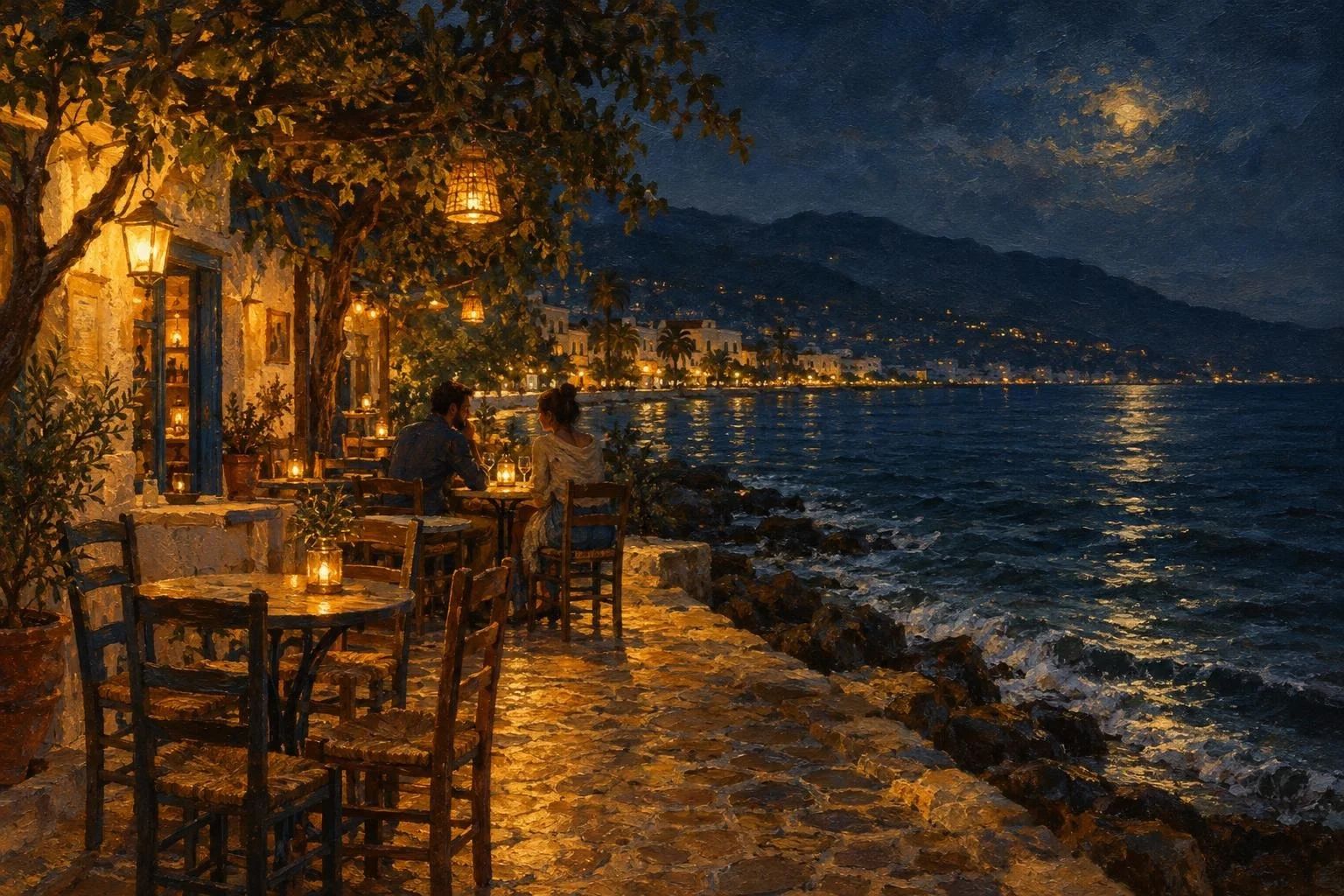
The complex was a large hotel centre that looked like a fairytale in the evenings under the moonlight. The seafront in Kalamata from the port to the complex is a straight line as if painted by hand... Trees and lights along the sides, and the moon, which makes it bright enough to read the very grains of sand. We didn’t need anything more. We hopped on the Duck and set off.
The coastal road was straight, like a promise that never ended. The moon shone brighter than the streetlights. The sea looked as if it were listening to us.
And suddenly... the scooter started to howl. Not just noise. A howl.
“What’s wrong with it?” I said.
“The muffler has split...”
“What’s a muffler? I’m as dumb as a brick when it comes to vehicle technology.”
“The exhaust!” And he gave it some gas.
It wasn’t a scooter anymore. It was a metallic beast announcing our arrival to all of Kalamata. People turned their heads. Some laughed. Some turned serious.
And before we knew it... we found ourselves facing a police roadblock.
Three policemen. Then four. All with a look that didn’t leave much room for negotiation.
“Where are you going in such a rush?”
“For a drink,” Ladi said calmly.
“Whose scooter is this?”
“Mine.”
“Papers?”
And right then... disaster struck. Ladi burst out laughing. Not a normal laugh. A laugh that takes your breath away.
From the back, I started laughing too. Without knowing why. Simply... because he was laughing.
At one point, I fell off the scooter.
The policemen looked at us as if we had come from another planet.
“Where are you from?”
“From Albania...”
“The scooter’s papers!”
Ladi... laughed even harder.
The chief lost his temper:
“Why are you laughing?!”
And finally, between laughs, Ladi said:
“You’re asking us for the scooter’s papers...”
“Naturally,” the chief said. “Every moving vehicle has papers. And it has passed its inspection and technical insurance.”
“Yes,” Ladi interrupted him. “But you’re asking me about the scooter,” and he laughed again. “How can the scooter have papers, when I myself don’t have papers...” and he burst into laughter again along with me... in fact, we had overdone it a bit; back at the bar when we were eating dinner, we had knocked back a couple of glasses.
Silence reigned. A silence that lasted a lifetime. Then one of the policemen said:
“Let them go... they’re either drunk, or they’re crazy.”
They cleared the way for us. Ladi gave it some gas. The “Plucked-Neck Duck” howled again... this time as if it were laughing with us too. And its voice faded into the sea.
Even today, when I remember it, I think: not everything that is ruined is worthless. Some things... are simply too alive to be taken seriously.
BY PILO ZYBA