From my notebook of memories
I first met the daughter of the Greek poet Yiannis Ritsos, ERI (Eleftheria), at the gathering held in her father Yiannis Ritsos’s birthplace, on the occasion of the anniversary of his death in 1991. A short woman, always smiling, warm-hearted, and exceedingly unassuming.
I saw her being escorted by a whole group of people, local and foreign poets and writers, state representatives and local municipality officials. I did not know which one she was; I just watched the line of people moving from one direction to another. Those were difficult years for us too at the time; we stood out from afar simply by our clothes. I wore a jacket I had been given at the shop where I worked; the sleeves were a bit too long for me and my shoulders looked as if I had shoved them into a large sack that was not meant for the fruit it held inside. My trousers were rolled up, and the only thing that actually fit me was the white collar of a shirt that had come from Australia.
I tried several times to step in front of her to shake her hand and introduce myself, but it was impossible. Her father’s guests and friends were so numerous that it was very difficult.
In the center of the village that July evening, the main square where the large stage had been set up was so packed that never in my life had I seen so many people gather for a single man, and simply for a poet at that. I did not understand it; Ritsos was a communist by conviction (as I had read), yet capitalism was paying him great honors. Those who had imprisoned him for a whole lifetime were now handing him the golden crown.
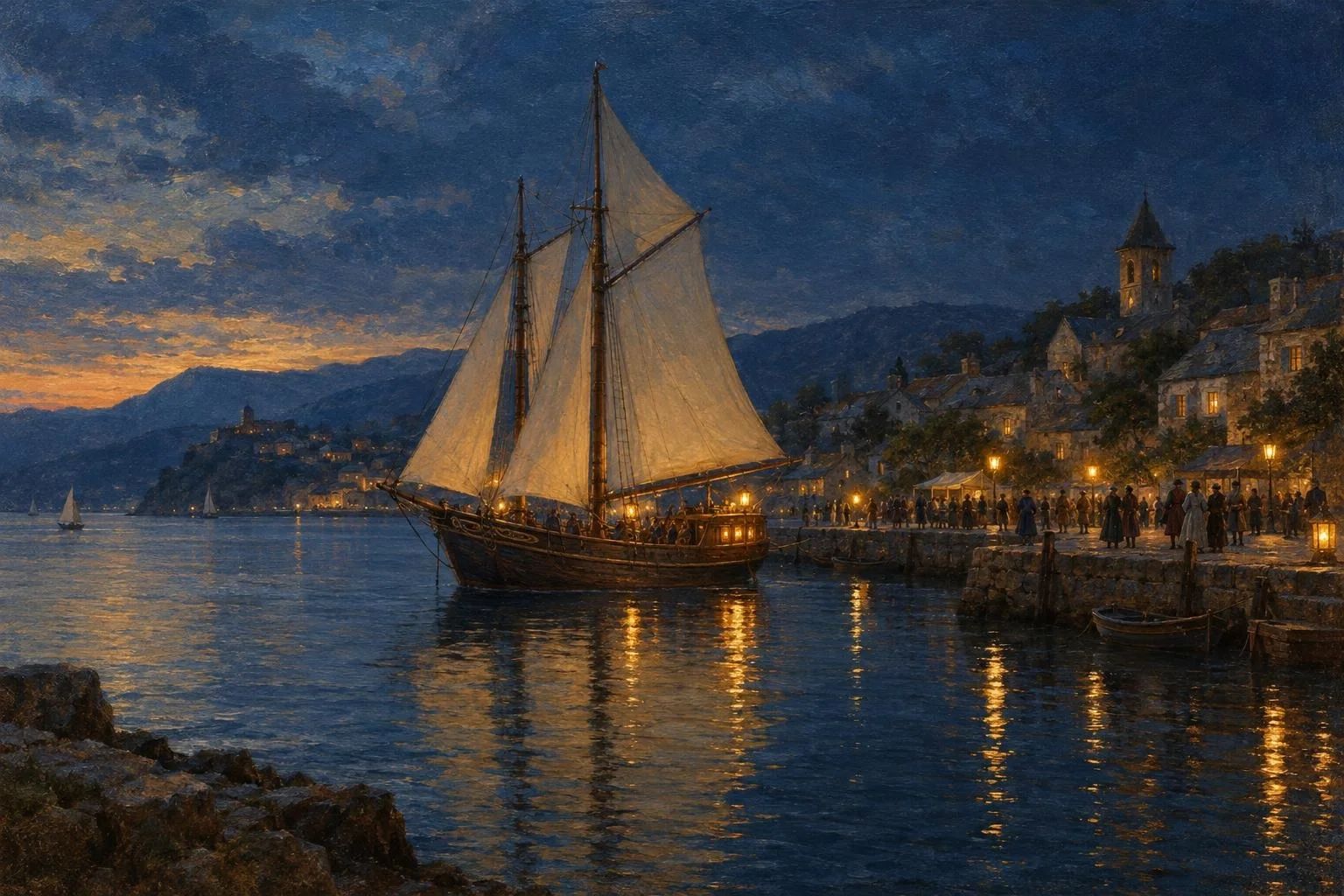
A large sailing ship stood in the port. His poems were written on its white sails. It was night, but the poems could be read very easily as they were struck by small but powerful spotlights. A large megaphone recited the poet’s verses. A cannon shot was heard, and then the great ship began its journey out into the deep sea. Dozens of fireworks took over the sky, as if trying to reach the place where the poet’s soul rested. The recitation continued through the ship’s megaphone as it glided over the silken sea beneath the full moon, which reflected its beautiful face on the surface of the water.
“Where is this ship going?” I asked a gentleman next to me.
“Around the world,” he replied. “It sails to carry his word to all the harbors of the world. To carry our national and contemporary culture to our brothers who speak other languages.”
The poet with his daughter Eri Ritsos
I had lost her. A large screen showed interviews and footage of Ritsos. It seemed to me that God’s own love had descended to earth. The great orchestra resounded and the choir had commanded the sea to be silent. It seemed to me that the sea itself was mesmerized by the commemoration they were holding for Ritsos and had been left breathless. The vast marine expanse resembled a stage that carried the songs, the footage, the voices of the people. Their laughter flew into the space of the night, as if trying to catch the stars. Above and below, sky and stars. Stars and the moon reflected in the water, or the sea reflected in the depths of the sky. It was past two in the morning and no one was thinking of leaving; everyone seemed in love with the evening, with the moon, with the stars that Ritsos had brought for them tonight. Drinks and roasted shish kebabs were being handed out everywhere; everyone ate and no one paid. I do not know why, but in those moments I painfully remembered Naim, Migjeni, Noli, Lasgush, and Fishta, who, although they gave their artistic soul to my nation, were buried by one and exhumed by another only to be buried deeper.
For the first time in my life, I fell in love with what I had written, not for any subsequent glory, but for the love the people expressed for their artist, for their poet. I felt as if I were in a dream; although meat, wine, and beer flowed like a river, I had not drunk a single drop. I felt as if everyone was looking at me, as if they were watching me. Even though I was happier than them, on this magnificent evening I felt lonely. Lonely in the face of my own nation, which treated its artists merely as servants of politics. Ritsos’s daughter stood in front of a canvas displaying her father’s photo and books, and people took turns taking pictures with her. I took a deep breath, as if I were about to start a marathon, and decided to go over, but I do not know what kept me rooted to the spot. It felt like everyone was looking at me. People came in groups and left in groups; I had remained standing. I drew attention without realizing it; a policeman came up to me and asked:
“Where are you from, what are you looking for?”
“I am Albanian,” I told him.
“Albanian…” he expressed a deep sense of surprise, then added, “Get away from here. That man over there is the Foreign Minister, Samaras.” But he did not touch me; he knew full well that everyone’s eyes were on us.
“I haven’t come for the minister, but for Eri,” I said, pointing my index finger at Ritsos’s daughter.
The policeman stood there as if turned to stone. He turned to Eri and, simply by his posture, let her know that I had come for her.
Eri broke away from the group and came over to me.
“Yes, are you looking for me?”
The words could not make it past the nest of my mouth. I was just looking at her; it seemed unbelievable to me that I was standing next to her. “Which village are you from?” she asked. She was completely unassuming, calm.
“From Albania,” I answered her, as if caught in the act. Nineteen years have passed since then. When you think about it today, these actions seem ridiculous.
“Albania is not a village!”
I nodded.
“Come, let’s take a picture!”
I cast a glance around; it felt as if everyone was looking at me. I refused.
She took me by the hand and sat me down in the front row.
“I will come over as soon as I finish the photographs,” she told me, and walked away, no more than six or seven meters far.
I was lost in my own world; I had not seen my children, my wife, or my parents for months. Longing had overwhelmed my feelings, but the stares of everyone else carried an even heavier weight, so much so that I was ready to fall to my knees. I thought about leaving, but I also didn't want to; she herself had told me she would sit with me.
The minister said his goodbyes and left, and along with him, a large part of his entourage.
The crowd dispersed somewhat; here and there empty seats appeared.
Eri came over and placed her hand on my shoulder.
“Have you been in Monemvasia long?”
“A year,” I think I told her. I don't know if she understood or heard me!
People kept coming up to her, but seeing that she paid them no mind, they walked away on their own. Finally, the square began to thin out.
“Why did you come specifically to Monemvasia? Did you know of it before?”
“No,” I replied. “I knew it was Ritsos’s birthplace, so I came. Your father was alive then.”
She looked deep into my eyes and smiled softly, very softly. I read her smile under the moonlight, while the sounds of her voice I feel I still hold in the deep sky of my memories.
Someone came and brought us a tray of shish kebabs and a bottle of wine; in truth, I hadn't seen her order them. They set them down in front of us.
“Eat,” she said, handing one of them to me.
I did not make the slightest movement.
“We will eat them together,” she said. “You see, I haven't eaten either.” She started to eat and left the other one in my hand. We filled our glasses and lost ourselves in conversation. The others were waiting for her, but she wasn't budging. The stars began to hide in the depths of the sea; it was starting to dawn. The smell of iodine was overpowering the meat and the sour aroma of the drinks.
I looked at her eyes, her lips, her slight frame. “We must be the same age,” I thought, and later I proved that I had not been wrong.
“Where do you work?”
“At Panajoti’s tavern.”
“We will drink our morning coffee there,” she whispered with a smile, and pointed to the tavern where I worked.
I smiled and cast my eyes into the depths of the sea, as if to tell her: “Morning has come, look, the day is breaking.”
She understood my thoughts and laughed without checking if anyone was watching her. Her laughter flew through the night, plunging into the depths of the sea and the sky, as if it wanted to announce her joy to the angels.
I do not know why her voice sounded to me like the laughter of my own children; I had not seen them for a year. My son was seven years old, while my daughter was only three.
To be continued
PILO ZYBA