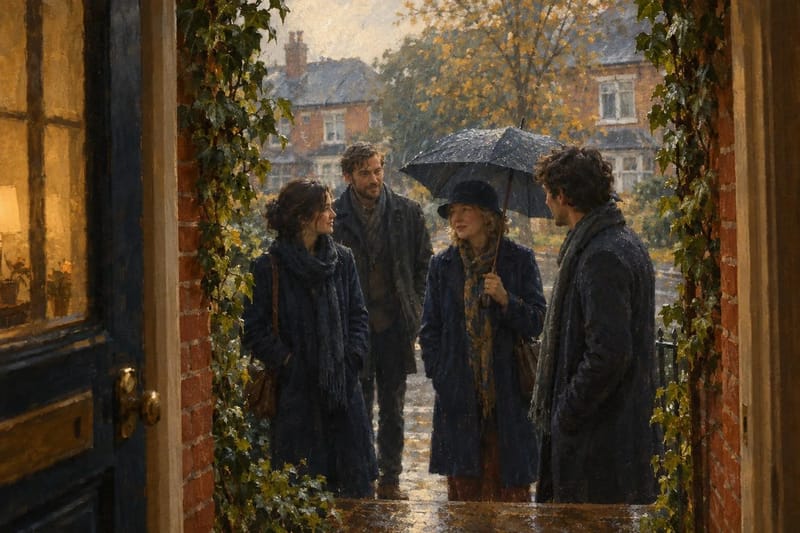
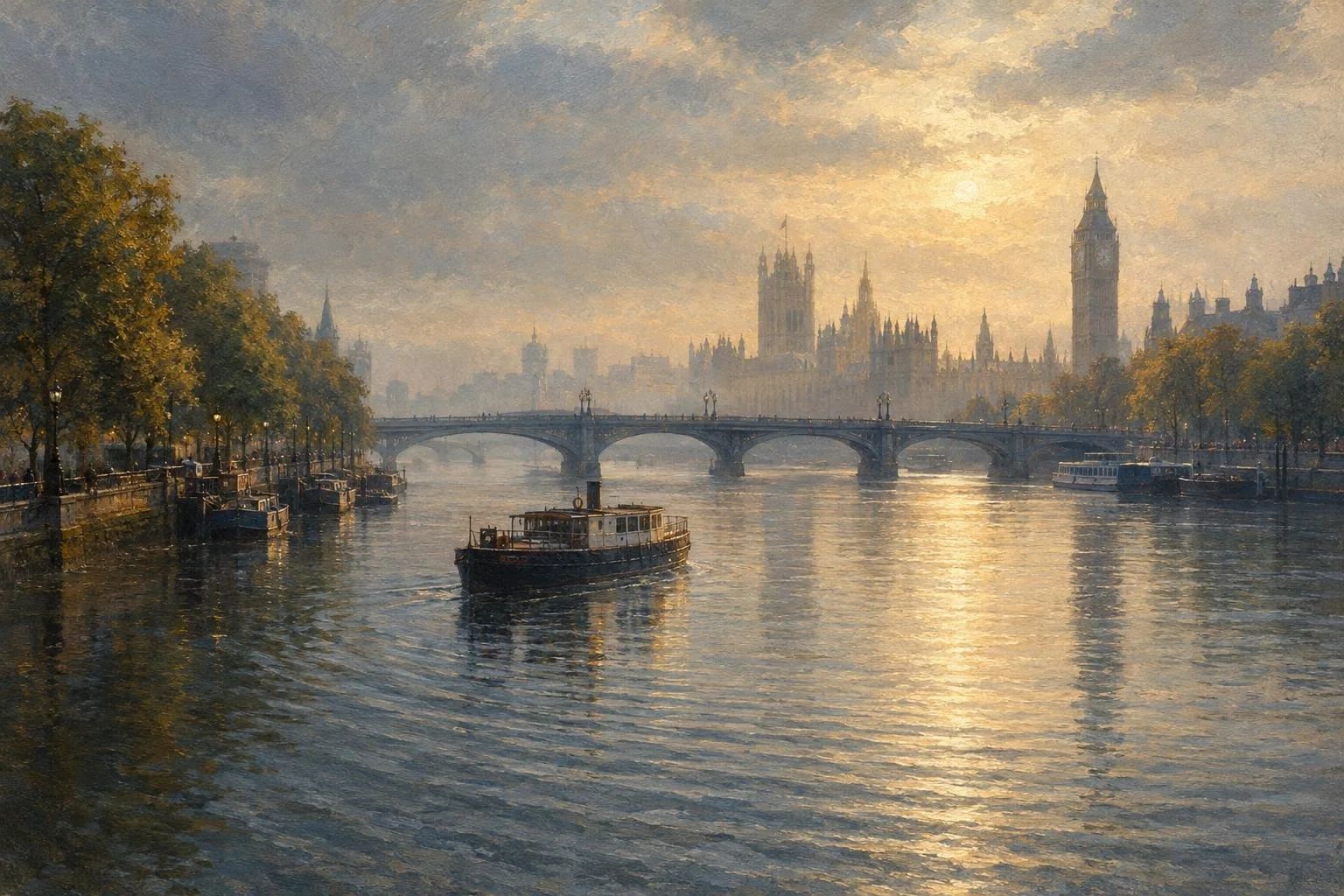
I have been in the great city of London for more than six months, right where the powerful heart of England beats, pumping blood, oxygen, and the health to live throughout its body. London resembles a large, blue lake surrounded by ornamental trees, which look like green eyelashes over a beautiful eye.
Something strikes me; it holds a unique perspective for every visitor, but for me even more so.
The center of London is like throwing a stone into the middle of a calm lake. From the moment the stone hits the water, successive ripples form and spread rapidly everywhere, in a uniform, beautifully circular way, creating a harmonized undulation in its visual appearance, but also in that of daily life.
London resembles an elegant lady walking in the economic, political, aesthetic, and beauty parade, head held high and proud in a United Europe. This catches the eye at first glance for anyone trying to enter the fold of this society.
Peace and cleanliness reign everywhere; movements are perfect, in the streets, in coexistence, in legality.
Anyone might rightly ask: “How did this happen, and how did the streams flow to get here?” Let me make a parenthesis; London is a conglomerate of colors, ideas, nations, and policies.
The traffic flows on the opposite side of the road, unlike the rest of the world, but surprisingly, things move in the world’s direction with safety and calm, knowing only an upward climb. Everyone has the right to ask, why, and how?
The streets are narrower than in Berlin, Rome, Paris, Milan, or Vienna, and yet everything runs perfectly. I travel by bus for at least six hours every day; the streets are full of bends and narrow within the city, and at the end of every roundabout there is an even smaller narrowing, accompanied by a concrete curb with signage in the middle of the road, unlike the rest of Europe, and railing enclosures on the side of the road for citizens. This enclosure and narrowing is designed so you cannot drive faster than the speed limit, 40 km per hour. But besides the rules, conditions have been created that block the path even for the irresponsible.
It is hard to read this “hermetic” state as a visitor; it is difficult, unless you yourself are part of its movements and life, to read the political shifts and directions, the curvature and rhythms of the private and national economy, which survive and every day add a brick of security to the state’s economic and political skyscraper, to elevate the social, economic, and civic condition.
In this country, the individual is under the gaze and surveillance of the great eye of the Cyclops state. This starts from the cameras on the streets and buildings, to phones and computers, to the signatures you provide, which are a necessity everywhere. In this developed country, even a breath sends vibrations into the health of society and the individual, captured in the state’s massive camera of electronic technology.
London is a multiplicity of nations, civilizations, cultures, languages, colors, and human races, but what happens?
In this country, even the thief becomes conscientious, and even the killer lays down his weapons. Every second of the day and night, the state is aware of its national tree. Every shake, every fruit, every leaf blown by the wind is calculated to fall into the basket of national interests. Pedestrians’ pockets are empty of cash; everyone only carries a bank card. At every entrance, at every exit, the state knows exactly the individual’s income, to take from them what it must, and to give them what they are owed.
I come from my Albania, but after having worked for 22 years in the Greek state. And today, after 6 months in London, I understand the illness of the Balkan patient that is Greece.
The shift in climate between the state (European Greece) and London has a great river in between. This river diametrically divides the directions, psychology, and economy of each. Here I also have in mind my Albania and my Kosovo, but I write about Greece because it is understood to be part of the European trunk. While anarchy and the prehistoric war for borders reign in the Balkans, on the other side, order and perfect legality fight for peace and precision, to nourish all the organs of its body so that the whole is accurate in weight, in harmony, and in national and individual interests, in beauty and in health.
Recently, I got my passport at the Greek Embassy, as the institutional offices had requested it. When I handed it in, the clerk asked me for the receipt for the fee I had paid at the Embassy, but I told him that the embassy had kept it as an identification document.
Here is the English office clerk’s reply:
“Sir, the Embassy has kept its identification from you, and has left you unidentified. The tax payment document is proof that you have paid, and this passport is valid, and it is yours. Today, with modern technology, you can make as many passports as you want!”
It took me 25 days to get the passport from Greece to London. Meanwhile, with all the fighting I did, it took me 40 days to get the payment certificate for this passport from the Embassy. When I sent it to the English office clerk, he couldn't believe it and looked at me suspiciously because of this delay. Then he said with a laugh:
“Now I understand what they say about Greece!”
I stayed silent.
He added:
“That is why the giant tower of a state crumbles, when the stones of economy and politics are not placed at the right time and in the right place, not to mention placing them crookedly. Every stone placed in the state’s skyscraper is a foundation for the other stones that raise and support this skyscraper. Otherwise, everything goes crooked and can crumble like Greece today.”
He was speaking, while I pictured this skyscraper of the Greek state. About its palace, values, economy, and politics, I have a whole book that I wrote during my 22 years of living and working there, which I plan to publish soon here in London.
The clerk looked at me in surprise, and so he asked:
“What are you thinking about?”
I told him:
“I am afraid that, coming from where I do, I will be a stone, or a brick, that won't find its proper place in this country called England.”
He laughed:
“You are smart; I enjoyed our conversation, but here, everyone who comes is carved according to English architecture, and takes their rightful place. From what I can see, you will adapt to the climate very quickly. I see this in your requests, but also in your purpose for coming to Great Britain, which is not great in geographical space, but in its legal one, and in the opportunities it creates for the individual to see further, and to find the strength and means to make their dreams a reality, and to touch them with their own hands!”
He spoke very calmly, because I was watching and reading his eyes. I saw his smile and his resonant, yet convincing words.
I shook his hand and left, to meet him again in 15 days when he scheduled my next appointment...
BETTER A FRIEND THAN AN ESTATE
How valuable this proverb, passed down from the antiquity of my nation, has been and remains. Along its centuries-old journey, it has gained even more value, taking its place not only in the golden words of the nation but also in everyone's conscience.
I know you will laugh and say, “Pilo is preaching to us,” but surprisingly, this time Pilo is not preaching; he is telling a truth from his life in London. From the journeys of these years in Greece, Italy, France, Austria, and elsewhere, and now finally in England, which sits in the middle of the ocean—but not a problematic ocean like many European states today. But let us not stray from the topic.
In my country during the Dictatorship, when you were accepted as a member of the Communist Party, two or three witnesses were required to vouch for the candidate's morals, stance, word, and demands.
We curse those times now. We throw stones and sticks at those years, and heavy, completely unchecked words. I have done and continue to do this myself for 23 years, ever since I flew from the national nest into Europe for a better life. My only companion on these long journeys across Europe has remained the Dictionary of the Albanian Language. Although it grows uglier every day in its pages and its spine, it gains value every day from the wealth of language it keeps locked inside the drawers of its memory. But let me not get off topic.
I was 25 years old when my father insisted that I be accepted into that sole party of the time. After many continuous debates, I asked him:
“Why should I become a party member, Dad? I am a restless type and I make mistakes. And you know they will punish me!”
He was then the age I am today. He smiled and told me:
“You will be accepted so they don't stab you in the back. When you are with them, you face them, and when you face them, no one speaks against you, or they are careful about what they say. When you are not there, they throw stones and sticks at your back. And being restless as you are, this is better for your own interest.”
Thirty years have passed since then, and here in London I often recall this conversation. From the story I am telling you, right up to my arrival in the British Capital. I remember my father's psychology and perspective.
While looking for work in civilized London, I was filling out paperwork at a large and well-known foundation, known for its name as well as its activity. At the end of our conversation, the director of the Foundation told me:
“Among other things, we also need three references, who will provide their phone number, address, and email to our office. So that we can take your application into consideration.”
I was dumbfounded. I listened to his words, and before me appeared sometimes the face of Dictator Hoxha, sometimes my father's, and sometimes my future employer's.
“Why are you looking at me like that, sir? Did I say something strange?”
“No, sir, but I don't have anyone in London, nor in England!”
“It is a requirement, but look around, because never and nowhere is a person without friends, companions, and a circle!”
I said goodbye and left. The portrait of my late grandmother smiled at me through the streets of London. Sometimes in shop windows, sometimes on large advertising screens.
“Why are you laughing?” I asked her.
“I told you,” she said, “wherever you go, make a place for yourself!”
“Enough, Grandma, please! This is no time for jokes.”
She smiled bitterly as was her habit and shook the tree of her wisdom. She shook her long, fairytale-like hair like a willow tree, and added:
“Search, search and you will find them! Nowhere is a person alone in this world. And so it is in England too.”
And just like in the dreams where she often comes to me, she hid behind a street and vanished, never to be seen again... In those moments of loneliness, I wanted to shout out loud for her not to leave me alone, but she disappeared among the many passersby.
And indeed, my grandmother made me open the book of friends. To write the biography of my life, and of myself. And here is the conclusion of the proverb.
I, who considered myself lost in a London of 8 million citizens, did not find myself alone. Friends began to approach me in my memory, but also in reality. One phone call, two, and another, and out of the three references needed, ten were found. The first to smile at me was Vladimir Meminaj, who is truly the estate of my arrival in London. Then the writer, critic, and university professor in London, Fatmir Terziu. Further on, Sherif Bllaca from Peja in Kosovo. And I saved the dessert for last, instead of a spoonful of honey, because she is like honey.
When I left Albania, my last reference was only ten years old. She was a little child then, in a red polka-dot dress and beautiful strappy sandals. The daughter of my peer and schoolmate Izota Kartyçi (Avdyli). Besiana, who is truly a woman of her word, and stands by the given pledge of her reference, was no longer little, but had grown up, and was signing for me in distant London, even though she was further away than the others, in Manchester.
Unbelievable, but true. When I told this story of mine to Prof. Fatmir, he laughed as we drank coffee in the Wimbledon of the great names of world tennis.
“Wait, wait,” he told me, “how much more you will learn about London and England. This is the beginning. It has a beautiful name, it opens new paths in life for you, but it is also a 400-meter hurdle race. And these hurdles have now started to appear before you.”
I smiled:
“Why are you laughing?”
“I am laughing because as long as I have the estates my grandmother left me, I will never come out of the ‘war’ a loser. You, my brother Vladimir, Sherif, and Besiana, who is no longer little now, will not let me suffer, even though I am outside the lands we fled from for a better life, but without people and friends we cannot take a single step alone.”
We clinked glasses, while Baca Sherif laughed and combed his white hair with his fingers. Within them lay the manhood, word of honor, and nobility of Kosovo and its struggle for the independence sought for centuries...
BY PILO ZYBA