A Story for Children
The teacher put the cassette into the video player, and as soon as the first images appeared on the television, he began to explain with passion and love.
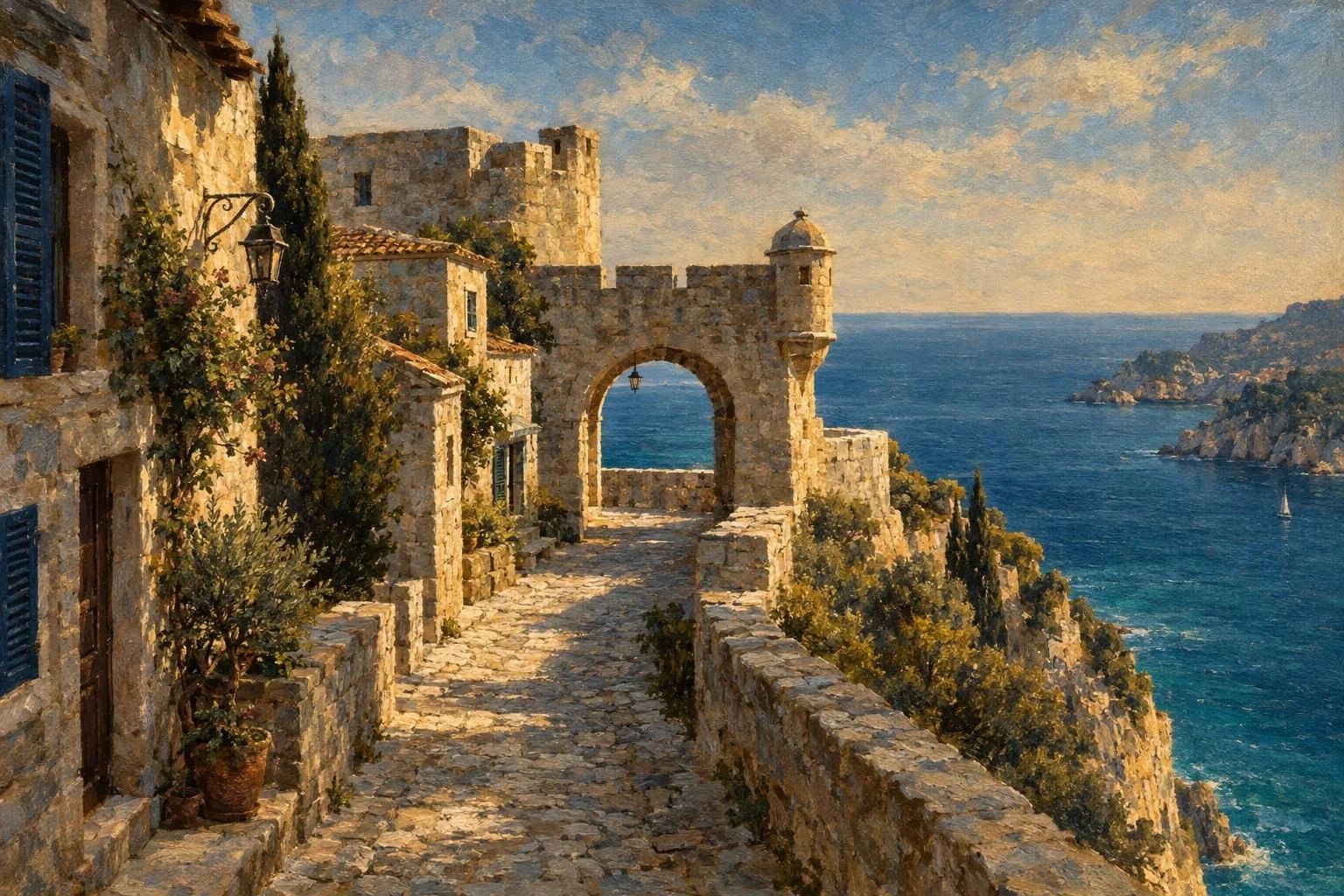
“As you can see both on film and from the images themselves, our little town is a true pearl in terms of visual beauty, artistry, and history. The castle you are looking at on the screen was built in the early seventeenth century. It was built by skilled, talented master craftsmen who came from Epirus. These are master craftsmen who have been historically known since before the fifteenth century. This castle has served as a center of resistance against the Venetians, the Slavs, and the Turks. The beautiful streets, built with carved stone according to the tradition of the ancient Epirotes, with their patterned alleys, serve today as the most powerful means of attracting foreign tourists, especially the French and the Germans.”
As he spoke, the teacher cast his gaze around and carefully checked the students’ concentration on the lesson.
The screen continuously showed the alleys of the castle, the characteristic houses with walls of carved stone bound with mud mixed with sea sand and lime. The windows were mostly medium-sized and faced the sea. Sometimes they were straight-cut, but generally, they were arched in the shape of Byzantine church domes.
The class was entirely plunged into silence. Consumed by a great thirst, everyone had focused their attention and their gaze on the screen, as if they wanted to eat it. These were the very same streets they walked on every day, played on every day, but they seemed like something else now that they were looking at them on the television screen. They looked several times more beautiful. You looked at them and fell into thought or dreamed. It seemed a wonder how, four centuries ago, in these narrow cobblestone alleys, warriors rode at a gallop on horseback, striking sparks from their horseshoes, just as writers and poets described them in their works.
On the screen, someone spoke about the fustanellas. The researcher, a tall man with a reddish and not very thick beard, spoke in a foreign language, but the teacher explained after him.
Although the images on the television changed constantly, Drilon, a slight boy with somewhat yellowed, carelessly combed hair, was lost with his gaze on the screen, but his mind was somewhere far, very far away. On the screen, it seemed to him as if he were watching “Mësonjtoren”. One of the brave outlaws in a fustanella, mounted on a white horse, riding at a gallop. The wind snatched at his long hair, while the pleats of his fustanella turned into wings, into wings that gave him flight. He remembered the folk festivals, and the ensembles with the beautiful Lab songs. Their united voice that echoed and flew like flocks of doves over the rooftops of the houses, and over the castle of Gjirokastër. Over the beautiful alleys and cobblestones, and over the tall bust of Çerçiz. Now it seemed to him that the doves of their songs had flown somewhere far, far away, scattered to... he himself was not able to give an exact explanation.
The teacher turned off the video player and coughed twice (a familiar sign this, to attract the students’ attention).
“The images you saw,” he then added, “were filmed by a German tourist. He filmed these images a few years ago when he came to Greece and did a historical study on Monemvasia, which, along with a small book”—and he took the book out of his drawer—“he presented at one of the universities in Germany and defended his doctorate.”
Everyone had turned to face the teacher, who was explaining with all his passion. The boy, still lost in thought, was dreaming. He kept his gaze on the television screen even though it was turned off, but it was easy to see that his mind was wandering somewhere else.
“Drilon!” the teacher called his attention.
The boy was startled.
Laughter erupted in the classroom.
Drilon lowered his head, ashamed, his face turning pale.
“Drilon!” the teacher spoke to him, to let him know that nothing was wrong. “In your country, in Albania, are there castles like ours, surrounded by high walls and battlements? Like our characteristic dress with the fustanella, what do you use—I mean, what did you use in the past? What were the brave men like, strong, tall, with a gaze... and what language did they use?”
“Excuse me, teacher,” someone from the back stood up to speak, although he spoke without the teacher’s permission. “The brave men in Albania wore baggy trousers, and instead of helmets, they had black headscarves like women!”
A prolonged laugh erupted in the classroom. It took the teacher a little while to quiet it down. But before it had fully quieted, another stood up and threw a handful of wasps.
“For a language, teacher, they used that of dogs, and for castles, sheep pens!”
While his peers spoke and threw taunts, Gjergji appeared before Drilon with his goat-head helmet, sword in hand, and the flag with the double-headed eagle. He restrained himself. Before him appeared the narrow alleys of his childhood, abandoned for three years. Here and there with drops of blood from his knees, scraped from playing with swords.
“Drilon!” the teacher maintained his calm. “Tell us something about your country, about your homeland.”
Silence had fallen over the classroom. Everyone was waiting to laugh again. To them, Drilon was someone who came from a foreign country, without history, without songs, and without... without... without...
Drilon snatched the flag and the double-headed eagle from Gjergji and told them that, when Istanbul fell, Gjergji and his brave men flew free on white horses, reaping victories in the battles of Torvioll, Kruja... Little Drilon lifted up in his hands and brought into that small village school Kruja, Berat, Durrës, Gjirokastër. He sat Boçari and Bubulina down at its desks. His voice was heard, resonant and melodious. It prevailed over the silence that had gripped the entire classroom. In truth, he was now a brave warrior fighting, fighting on his battlefield for life or death. He attacked his opponents from the flanks, from the front, and finally, with certain victory in his tender hands, he cast his gaze over them. Over those who, with their hands resting on the small desks, their gaze fixed on him with half-open mouths, were waiting, waiting...
Outside, the ringing sound of the electric bell was heard. It announced that the lesson was over, but no one was moving from the desks to get up. In the end, furious applause erupted in the classroom, starting with the teacher, passionate and accompanied by a “bravo” from many of his peers.
Drilon sat down. His small eyes looked like two hearths of fire, from which the flame of his gaze consumed the whole classroom. He understood himself that he had won, yes, yes... he had won an unusual battle. And even though far from the place where history was made, it travels with them far from the homeland, wherever they live. It creates its own hearth. With bravery, the besa, words as sweet as honey, and the language of the eagles.