Those days of March 1991 come to mind today, rustling like spring breezes through the leaves of the tree of my soul. I keep them suspended in the skies of my thoughts and I blossom into spring, for they still live and have built a nest within my being.
Kostandini Shkagos (Shkaku, the reason they had left their birthplace) was a doctor in Athens. A doctor who healed the sensitive hearts of its citizens.
In the Peloponnese, in the village of Lambokambo (Bright field, rich camp), he had a few grapevines. They were the vineyards of his ancestors’ goodness. So every year, he hired people to hoe them, water them, and harvest the fruits of his forebears. With the red wine from these vineyards, he invited friends and relatives to his table. “It’s from my parents’ vineyard,” he would say, filling the glasses. It seemed to him that this wine brought together at the table of unity the villagers, friends, the living, and those who had passed on but had left behind their blood in the vineyard.
My piece has nothing to do with the doctor, nor with his parents. He was merely the beginning of an event that I carry on my shoulders and in my soul, and which today I want us to share at the table of art.
“As for sleeping,” the doctor told me, “you will sleep in this house. Its door has remained closed since March 1947.”
To tell the truth, his words intrigued me. The fork with its piece of meat stopped halfway in my hand, while the glass of wine looked like a deep well, an abyss. It echoed with voices in my ears. The doctor did not let me sway any longer in the anxiety of his legend.
“We will clean it, we will fix it up, and then you will move in. After that, stay in it as long as you wish. As for food, you can eat at Mr. Jani’s, the owner of the tavern and his cousin.”
I noticed him and Jani exchanging glances. Their eyes hid a distant tragedy. I watched them, but I was unable to decipher a thing.
“Who lived in that house? Who has the keys, and why hasn’t it been opened for forty-three years?” Deep down, I did not want to walk through its door, but I had nowhere else to stay.
“Jani will tell you,” the doctor said. “There is nothing to worry about. No one is left of their family.”
“The house was left to me, but I haven’t had the time to fix it up. I am waiting to retire and then come and live here in my birthplace. For now, I am still working.”
“A tragedy happened in this house,” Jani said, cutting the thread of my thoughts. He paused for a moment, as if summoning his memories, and continued. “After the end of the Second World War, two brothers lived in that house. Kosta, the older brother, was the head of the Communist Party for the area, while Pandeliu was a teacher at the village school. In those days, the village and the surrounding ones had two hundred and fifty children. Their surname was Bletas.”
I smiled.
“Why are you smiling?” the doctor asked me.
“Their surname is Albanian.”
“How did you figure that out?” the tavern owner asked me.
“Bletas comes from the word bletë, bee. Bees are melisses, as I would say in Greek.”
“They truly were bees, not only the two brothers, but also their parents and their family,” Jani said. “The wasp of politics got between them and forever destroyed their nest, which produced honey for the whole area and the village where they were born. Like us, they too were Arvanites. As you know, even the bee has a stinger, a weapon it always keeps loaded. In a split second, even though it spends its whole life producing honey, it strikes, and with the sting of its hatred, it can even kill. In the midst of their discussions, politics stepped
in and divided the shared flow of their blood. It split it into two torrential streams of hatred. They drew their pistols and fired at the same time, departing from this world, which in truth is only one. Today, if they were alive, they would mock the ideas that pushed them toward the abyss of death.
That night I slept with sad dreams. I had been wandering around Greece for months; I missed my sisters, my parents, and my children, my friends, and even those who held different ideas from mine about politics, the economy, and society. The story that flowed from their lips had shaken me.
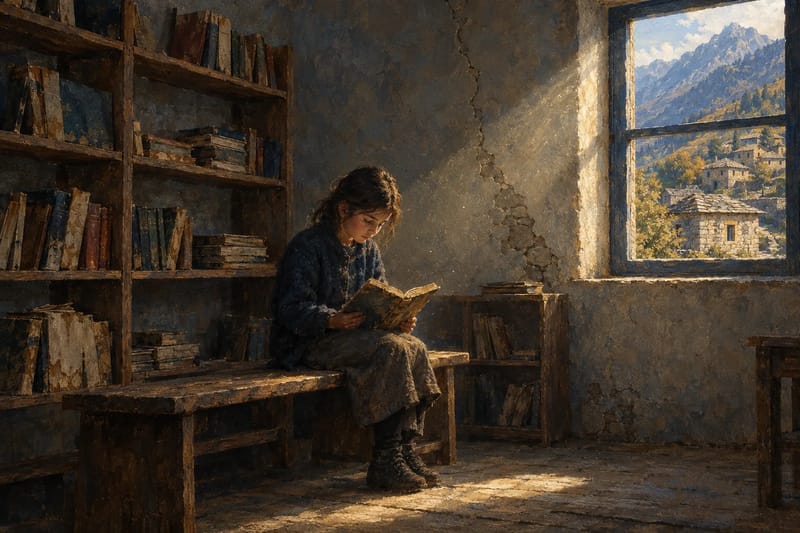
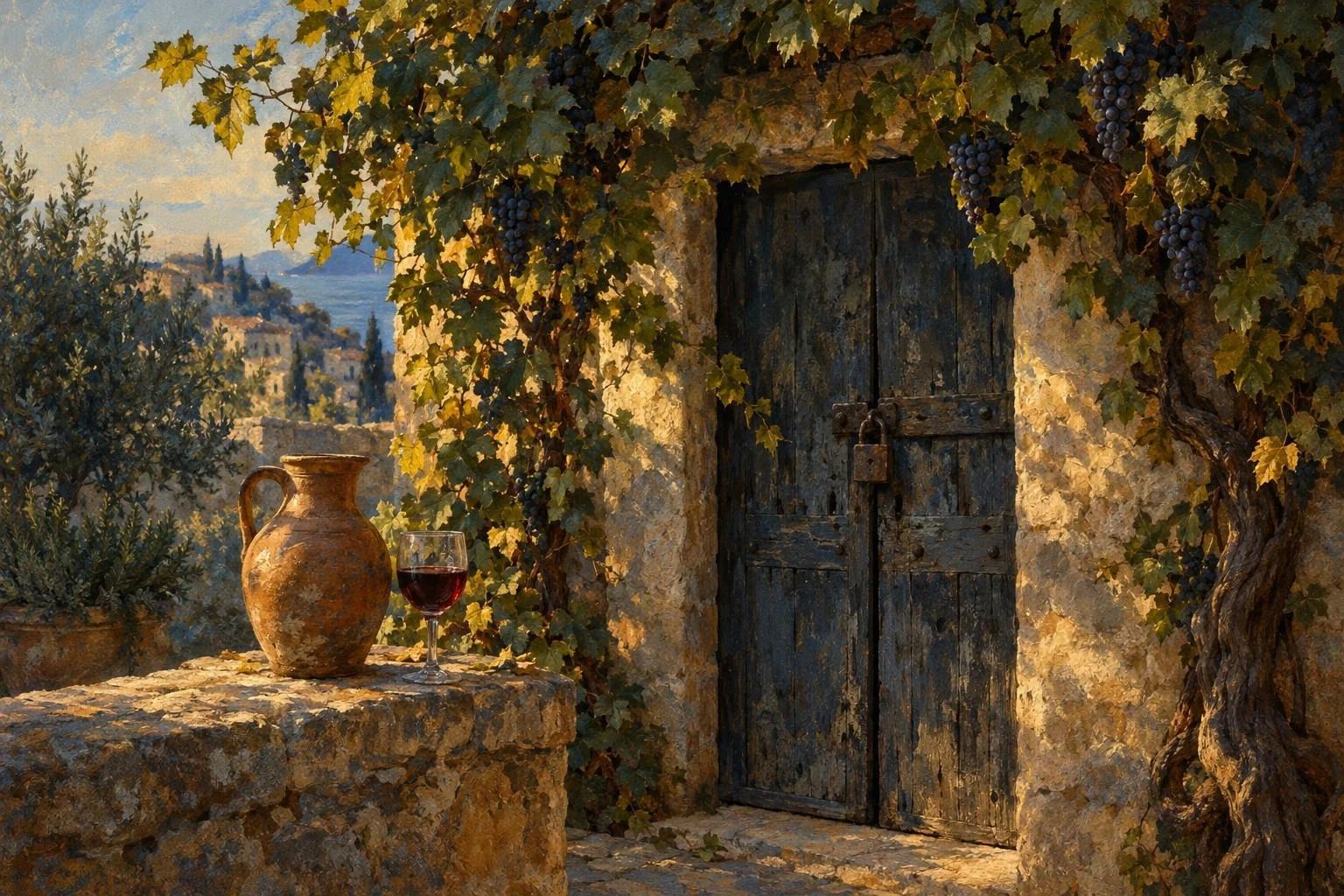
The next day I took the key, a little oil for the lock, and climbed the stairs of the house. It was a two-story stone house. Tens and hundreds of stony loves, intertwined shoulder to shoulder, held this human nest aloft. For years their unity had stood silent, speechless. It seemed to me that the eyes of the windows and the arms of the door would open and say to me, “Come in, welcome!” I felt like a wedding guest, arriving to open and create a new family upon an old foundation. My hands were trembling. The blood rushed with pressure through the long pipelines of my veins. With the turning of the padlock and the door, it felt as though the memories locked inside for forty-three years would come rushing out. I turned it, but it would not open. Then I realized that the tongue of the lock had been bitten by the teeth of the years, refusing to let that painful event reach me. The mouth of the lock did not want to speak and repeat the event from forty-three years ago. Times had changed. I poured the oil of reconciliation into its bosom, reminding it that the time for unity had come. The door of enmity had to be opened, so that love and life could enter. I do not want to get sidetracked by the flow of events; that is not the purpose of this piece. When the door opened, I opened the windows too. The sun’s rays poured in, and I saw that the ceiling beams had taken on the color and shape of the bones of a man dead for centuries. On the walls, the map of an ancient world was traced in large hieroglyphs. Its hieroglyphs spoke in a language I could understand. I had to explore this vast world, locked inside this little museum, with great care. In the wide hallway, set deep into the wall, were the doors of a cupboard, a musëndër, as we call it in Përmet. On the right was the kitchen, on the left two bedrooms. In each room there was a wardrobe, a trunk, and tables with a few chairs. Over everything lay a thin layer of rosy dust. A curtain of oblivion separating the past from the present and the future. I cleaned carefully all day, carrying out the tables, the chairs, the trunks, and so on. The next day I painted it, giving it the white color of the future. We brought in a radio and a television, so that the past could listen to the present and the future. So that a bridge of unity could be built, across which could pass the memories, the sorrows, and the joys it had held inside for centuries, before a single dose of politics had let in hatred, oblivion, and death. Now, I was the doctor who
with a prescription of love, would restore life and love to its bosom. On the one hand, I wanted to live with the present, but also with the past of this house and the other houses surrounding it, which had borne witness to its life and its joys. I had heard much about their lives, their bravery, and their songs. When I lay down to sleep, my imagination carried me fifty years back in time. I would look at the photographs of the brothers and think, “They could still be alive.” Both were under twenty-five years old. Only two precious objects remained as mementos of their lives. The watch of one of the brothers, and a notebook filled with songs by the brother who was a teacher. The watch had stopped along with his heart. I wound it up, and to my surprise, its gears began to turn, telling the story that had been interrupted forty-three years ago.
Today, nineteen years later as I write down the memories of that day, the turning of its hands and its ticking come to awaken other memories in me, urging me to tell you about the life and work of his brother, about the notebook filled with songs. The pages of the older brother’s soul have yellowed, wrinkled like the face of my late grandmother after her hundredth year of life, but they speak; they speak through the silence, through the beauty of the letters whispering in two languages. The two languages in this little book are intertwined, both Albanian and Greek. When you read it, it is hard to understand unless you know both. Where one becomes incomprehensible, the other clarifies it, and when one falls silent, its sister sings with a voice as beautiful as the soul. Within its pages lived two languages, which often
fought and often danced together. They often cursed each other, and at times cried out for help
when they lacked the strength to express their sorrow and their joy. These were the Greek language and the Arvanite tongue. I, who have held this notebook in the palms of my hands for nineteen years, know very well that I am holding two brothers who express themselves differently, but who share a single father: the one known as the Pelasgian language.
As you can see, I have a great treasure in my home. A treasure that one day I will pass on to you as well, so you may hear the babbling, the songs, and the long journey they have made to reach the doors of your homes. To make the telling of my story more pleasant, I offer you to read and enjoy two
poems, songs, or something else—I do not know what name to give them. If you can, dear readers, christen them with whatever name you wish. I have christened them “The Beauty of Feeling.” You will understand their beauty and their power for yourselves once you have read them.
In the future, you will also read their sister poems, which remained locked inside a trunk from 1947 until 1991, and since 1991 have kept my own creations company. I do not know their true age, for it is hard to determine the age of art. However, I believe the time has come for their voices to enter your hearts as well. I believe this time is knocking at the door of my desire and your love. Here are two of them.
AH, MY SISTERS!
Ah, my friends, ah, my girls,
Sing a song, for my heart is bursting.
Three years and three days have gone by,
Since I slept or closed an eye.
Past the doorway of my house,
Walks a boy, tall as an oak.
He is dressed in snow,
But his chest is warm.
His fustanella, fold upon fold,
I try to speak but find no words.
When he steps, ah, the fustanella
Brushes me softly like spring itself.
I speak to him but he doesn’t understand,
He is an Arvanite, they say.
Which of you will teach me a word,
That I might enter his soul alive.
And if I cannot and have no hope,
It is better you leave me to die.
***Love makes the beautiful Greek girl learn the beautiful words and the Arvanite tongue. She seeks to speak to her love in this language. Her love turns into song, while her sorrow turns into poetry.
I TOOK THE ROAD
I took the road and I walked and walked.
I remembered you there where I wept.
I went up toward the mountains (the mountains... eh)
I called out, until my head ached. (My head)
Ever since I left those fences,
My heart began to fade.
Come speak to me, dark-eyed girl (dark-eyed girl)
Let us not be parted, my partridge.
Although I am far from my birthplace of Përmet, I memorized the music and lyrics of these songs years ago. They have turned into lullabies that cradle the feelings of my soul and my longing for my birthplace, for my homeland. I caress them often; it feels as though I am waking them from a bitter sleep that time had cast over their pages. I wind the watch from time to time, to remind it that we live in a different era, and that it and our hearts must beat to a single rhythm: the rhythm of unity.