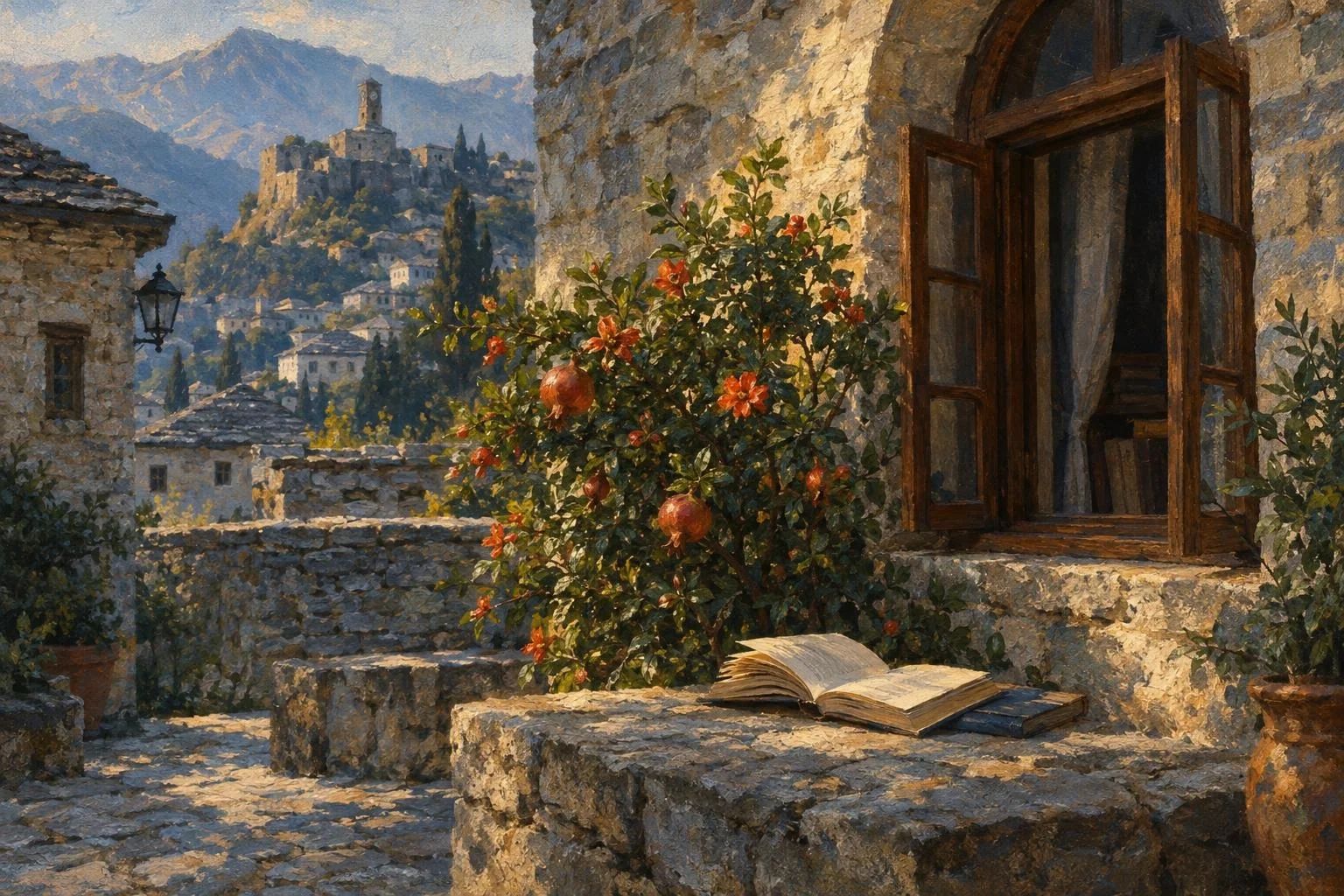
The poetry book “Dashuri Engjëllore” by the poet from Gjirokastër, Dëshira Haxhi, has been published...
A NEW VOICE IN THE ORCHESTRA OF POETS
By PILO ZYBA
A new poetic voice has arrived in the great orchestra of poets. Her name is tied to the poetic art itself. She is called Dëshira, and it seems to me that her very name is linked to her poetic desire. Dëshira knocks on the great door of poets and lays her first book, titled “Dashuri Ëngjëllore”, on the table. Those who know the poet closely understand and feel as they read that Dëshira herself and her rich artistic world are present in that verse. They understand her soul, her fragility, her desire, and her love for the poetic art.
The author comes to art mature, complete in what she writes, feels, and expresses through her verse. This shows that she has been writing for a long time, but has left publishing to time and the future. Her first book reveals her talent, as well as her high creative ability.
Her first book, “Dashuri Ëngjëllore”, is composed of three complete and meaningful cycles… for the sole reason of encompassing the entire artistic theme and,
to organize them into their respective windows, so that the reader knows where to find them, read them, and enjoy them according to the perspective the author has prepared for them...
In the first cycle, which also bears the title of the book, “Dashuri Ëngjëllore”, the poet unfolds her spiritual feelings for the reader. This cycle consists of 50 poems that sing to love, joy, feeling, sadness, and pain. All of these are seen from an original and beautiful perspective, expressed with delicacy and sweet verse. The poems stand out for their visual beauty and the colors the author uses in building their skeleton, but also in expressing the beauty of the poetic tree... moving on to the ripe fruit of thought, and the beautiful canvas of fantasy and literary figure. Here is how she expresses herself in the poem “Dashuri Ëngjëllore”:
I want to touch the sweetness of your smile
To have it in bed, in the thoughts of the late night.
Do you know that the key to my happiness,
Innocently, my love, you hold in your hand?!
In it, the beautiful poetic imagination stands out, as well as the manner and form of artistic expression. The verse is carefully crafted and interwoven with fantasy and poetic thought. The poem has bright artistic colors, sweetness, rhyme, and rhythm. The thought, verse, and poetic structure are in perfect harmony and possess musicality, beauty of expression, and clarity in achieving the poem's purpose.
In this cycle, Dëshira sings to love and all its feelings in different ways. In every instance, distinguished by the specific nature and weight of joy or pain, she uses
her artistic instrument that suits this feeling. Sometimes she becomes a violin and sometimes a sweet flute, sometimes a cello and sometimes a horn, sometimes a pianoforte and sometimes a harpsichord, but in all cases, whether with sad minor notes or pleasant, spring-like major ones, Dëshira beautifully expresses the thought, feeling, and artistic world of the poetic moment. All these poetic instruments used make up a complete, beautiful, accomplished orchestra, which is commanded and directed with care and skill by the poet conductor. The most accomplished poems that stand out in this cycle are “Dashuri ëngjëllore”, “Çmendurisht”, “Zoti harrojë hënën të ndezë”, “Skalita dhimbjen”, “Magjike”, “Shiu shtegëtar”, “Aromë romantike”, “Të vodha zemrën”, etc.
The second cycle bears the beautiful and meaningful name “Mozaik”. This title was not chosen without purpose, as the cycle itself is a beautiful artistic mosaic. It includes poems that encompass everyday life, such as the homeland, life in emigration, family relationships, meditations, dreams, parental themes, and national ones.
The author, with her original perspective, looks at the world from her poetic window with a special poetic eye. She then takes the impressions she has gathered into her artistic workshop and artfully turns them into canvas, knitwear, and beautiful poetic costumes for the reader to see, read, and enjoy. What stands out most in this cycle is the author's ability to observe, select, and elevate into art the themes she considers an integral part of society and the individual, bringing them onto the poetic stage for everyone to see and enjoy. She does this truthfully, without pretense, without superfluous words, but with the beauty of
the word and poetic thought, and the interconnection of the theme with life and vice versa. The poet is sparse in words but broad and diverse in thought and theme. She gives freedom to the verse and thought, she does not prune the phrases or words but lets them bloom within the poem just as they are, without framing or censoring them, to bring the poetic thought exactly where she wants it. Everything flows naturally through the greenery of the poetic forest, gaining the beauty and distinctiveness of blossoming and the aroma of taste and artistic thought. Here is how she expresses herself in the poem “Ëndërroj”:
I feel very well today,
Like a feather quite light,
That flies through space
And stops wherever it likes.
The words seem ordinary, but the poetic vision is very sweet; it holds within it the beautiful colors of feeling, to express the joyful spiritual world, the vitality of life that courses through the arteries of the poem.
In this cycle, the most accomplished poems are “Vëndlindja ime”, “Babait”, “Kurbeti”, “Ëndërroj”, “Emigranti”, “Për nënën”, “Fotografia”, etc., etc.
The third and final cycle bears the title “Prozë poetike”, another hallmark of the author. In this cycle, another of Dëshira's characteristics stands out: she expresses her poetic thought no longer in poetry, but in prose. In prose, yet it is truly a poem with a longer span and more poetic fantasy. The fantasy is deep and masterfully expressed in terms of
the chosen word, and the author's desire to express what she thinks with the highest possible artistic notes on her poetic pentagram. And she achieves this as a mature poet with a far-reaching and rich artistic purpose. Both prose poems stand out for the poet's ability to construct, deconstruct, and put down on paper the art she envisions. And she does this with care and professional skill, with poetic taste and aroma, without stumbling in the flow of thought, of inspiration, or in transferring both onto the blank page.
So, if we take the book as a whole, it resembles a rich exhibition that holds within it the theme, the beauty, and the poetic art, but above all, accomplished poetic colors that are promising for the future.
The truth is that the author in question wanted the book to also include a cycle of poems in the Greek language, which she has published from time to time in daily and monthly periodicals published in Greece, but I did not agree. This was for the sole reason of not spoiling the charm, colors, and beauty this exhibition possesses. The poems in the Greek language will be published in a separate book for the readers who belong to it.
On this occasion, we wish the author a good journey in the long marathon of poetic art. And we believe that her flute will very soon take its rightful place in the great orchestra of poets.