For five centuries the Arbëresh preserved their language without help from any Albanian state; now that Tirana wants to help, the question is how to do so without turning them into a mirror of itself.
The Arbëresh communities of southern Italy descend from waves of migration that, according to Minority Rights Group data cited by Tirana Times, began in the mid-fifteenth century and continued until the mid-seventeenth, as Albanians moved west under Ottoman pressure. Today they live in dozens of mountain towns and villages spread across seven regions: Abruzzo, Molise, Puglia, Campania, Basilicata, Calabria and Sicily. Cut off from the main trunk for some five hundred years, their dialects bear little resemblance to the standard Albanian of Tirana. For a speaker of Albanian today, hearing Arbëresh is like hearing a language one both knows and does not know.
The spring rites before UNESCO
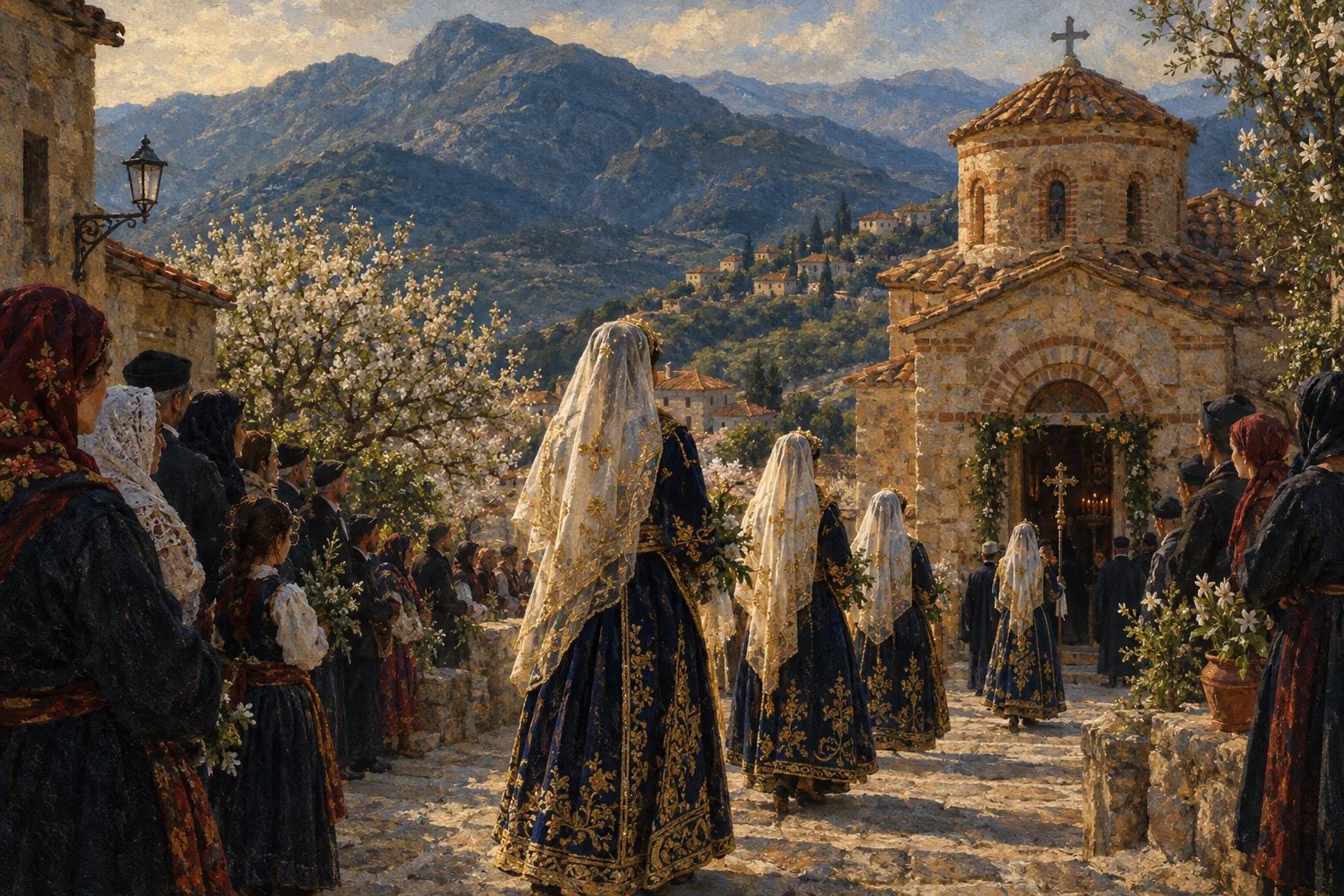
The most concrete project for safeguarding this heritage was born not in Tirana but in the universities of Calabria and Palermo. The “Francesco Solano” university foundation coordinated during the pandemic, building on three decades of research by the Albanology chairs of Calabria and Palermo, a long period of fieldwork to identify and describe the network of rites that make up the shared heritage of Arbëria. The result was the “Moti i Madh” (The Great Time) candidacy, forwarded to the Italian National Commission for UNESCO with a request that the Arbëresh spring rites be inscribed as intangible cultural heritage of humanity.
The file was prepared by a group of specialists in Albanology, anthropology, ethnomusicology and cultural history from the universities of Calabria, Palermo, Salento, Venice and Milan, among them Matteo Mandalà, while Tirana's Ministry of Culture lent its support under Minister Elva Margariti. The foundation's director has stressed that the most valuable support came from the communities themselves: some forty letters of endorsement from the groups that practise these rites. This detail matters, because it shows that intangible heritage is kept not in archives but in the hands of the people who go on living it.
When Tirana remembers
For a long time the Albanian state saw the Arbëresh mainly as a symbol: proof of the nation's antiquity, a memory of Skanderbeg, illustrious names of the National Awakening. This has begun to change. On 22 November 2023, in Tirana, during Arbëresh Day and the third Diaspora Summit, representatives of the Italian regions where the community lives, of Arbëresh municipalities, academics and artists signed a joint declaration with Albania's leaders. It called for new ways of passing the language and culture between generations and for a stronger bond between the Arbëresh and the more recent Albanian emigration to Italy, while praising Italy's Law 482 of 1999 on the protection of linguistic minorities.
At a later gathering with the Arbëresh community in Tirana, President Bajram Begaj called the preservation of Arbëresh a question of identity requiring immediate action, congratulated Altimari and Mandalà on the UNESCO file and proposed opening a museum for the Arbëresh in Albania. He also mentioned the inclusion of Arbëresh in schools, programmes on Rai Calabria and the Albanian public broadcaster's initiative for a channel devoted to the diaspora.
"Ne shqiptarët kemi nevojë për të mos harruar." ("We Albanians need not to forget.") — President Bajram Begaj, at the Arbëresh Assembly in Tirana
Preservation or mirror?
There is something touching in this belated attention. But there is also a risk worth naming. When a larger state, or a kin state, approaches a linguistic minority, the temptation is to see it as a mirror of itself: the Arbëresh as Albanians frozen in time, a living museum of what Albania was before the Ottoman conquest. The picture is romantic, but unfair. The Arbëresh have been Italian citizens for more than five centuries, with their own church, literature, Albanological scholarship and a history that includes the unification of Italy, as the Tirana declaration itself points out.
Real preservation of Arbëresh does not mean bringing it closer to standard Albanian, but giving it the means to go on being itself: teachers, textbooks, radio, a complete dictionary, a linguistic atlas. These are precisely the projects that scholars in Calabria have named as the next steps. A museum in Tirana may be useful, but only if it does not replace support in the places where Arbëresh is still spoken.
The “Moti i Madh” candidacy reminds everyone of a simple truth. The spring rites did not survive because someone declared them heritage, but because every year, in the squares of Arbëresh villages, people went on singing them. The task of institutions, in Rome or in Tirana, is to make that work easier for them, not to take it over.
Sources
- Kultura jomateriale e arbëreshëve të Italisë propozohet për në UNESCO, Shqiptarja.com
- Samiti i Diasporës, nënshkruhet deklaratë për ruajtjen e trashëgimisë kulturore arbëreshe, Shqiptarja.com (2023-11-22)
- Begaj në Samitin e Diasporës te arbëreshët: Shikojmë veten në pasqyrën e historisë, Shqiptarja.com
- Albania and Italy strengthen cultural ties at University of Calabria, 9Colonne
- Six centuries on, Arbëresh community preserves traditions, Tirana Times (2011-11-11)