A researcher argues that in January 2026 the number of Albanians living abroad overtook, for the first time, the number living at home; official figures do not measure this turning point directly, but they show the direction clearly.
What the official figures say
According to the Institute of Statistics (INSTAT), on 1 January 2026 Albania had 2,335,930 inhabitants, 1.16 per cent fewer than a year earlier. In 2025 births exceeded deaths by 1,147, but net migration remained negative, at minus 28,531. Only Tirana county grew, by 0.7 per cent, while Kukës and Shkodër each lost more than 2.5 per cent of their residents. The median age reached 45, up from 44.3 a year earlier.
INSTAT itself notes that the migration figure is calculated from “the best possible proxy data” in statistical surveys: it is an estimate, not a count. The census of September 2023 had recorded 2,402,113 residents, about 14.5 per cent fewer than in 2011. Taking that period’s natural increase into account, the decline implies the departure of roughly 490,000 people in twelve years.
The researcher’s view
The researcher Enea Janko, in an analysis presented in January 2026 on the News24 channel and reported by BalkanWeb, argues that January this year marks the moment when the Albanian population abroad overtook the population at home. His analysis draws on INSTAT data for 2011–2025 and on emigration visa records for the United States and other countries, and projects that the gap will widen by 2030.
It is important to be clear about the nature of this claim. It is a research estimate, not an official figure. There is no single number for Albanians in the world, because it depends on what is being counted: citizenship, birthplace, ancestry or civil registration. The public debate on the causes of emigration, from the economy to services and governance, is wide; this essay does not try to settle it, but to see what the available sources show.
The diaspora as voters
One concrete indicator came from the parliamentary elections of 11 May 2025, the first in which Albanians abroad voted by post. The right followed a Constitutional Court decision of December 2022 that asked parliament to implement it within a year. According to the OSCE/ODIHR observation mission, the out-of-country voter list closed with 245,935 names from 85 countries. More than a third were in Italy (91,223) and more than a quarter in Greece (68,386), followed by Germany, the United States and the United Kingdom. Some 41,000 applications were rejected, among other reasons because applicants could not prove their address in their country of residence.
The overall voter list, drawn from the National Civil Status Register, contained 3,713,761 names, including those living abroad: markedly more than the entire resident population, children included. The gap shows how many citizens remain registered in their home towns while living elsewhere. The parties also approached the diaspora differently: according to the Citizens.al portal, the Socialist Party and the “Shqipëria Bëhet” initiative ran campaigns abroad with concerts and large rallies, while the Democratic Party, the Opportunity Party and the Together Movement kept a more restrained presence.
A new literary canon?
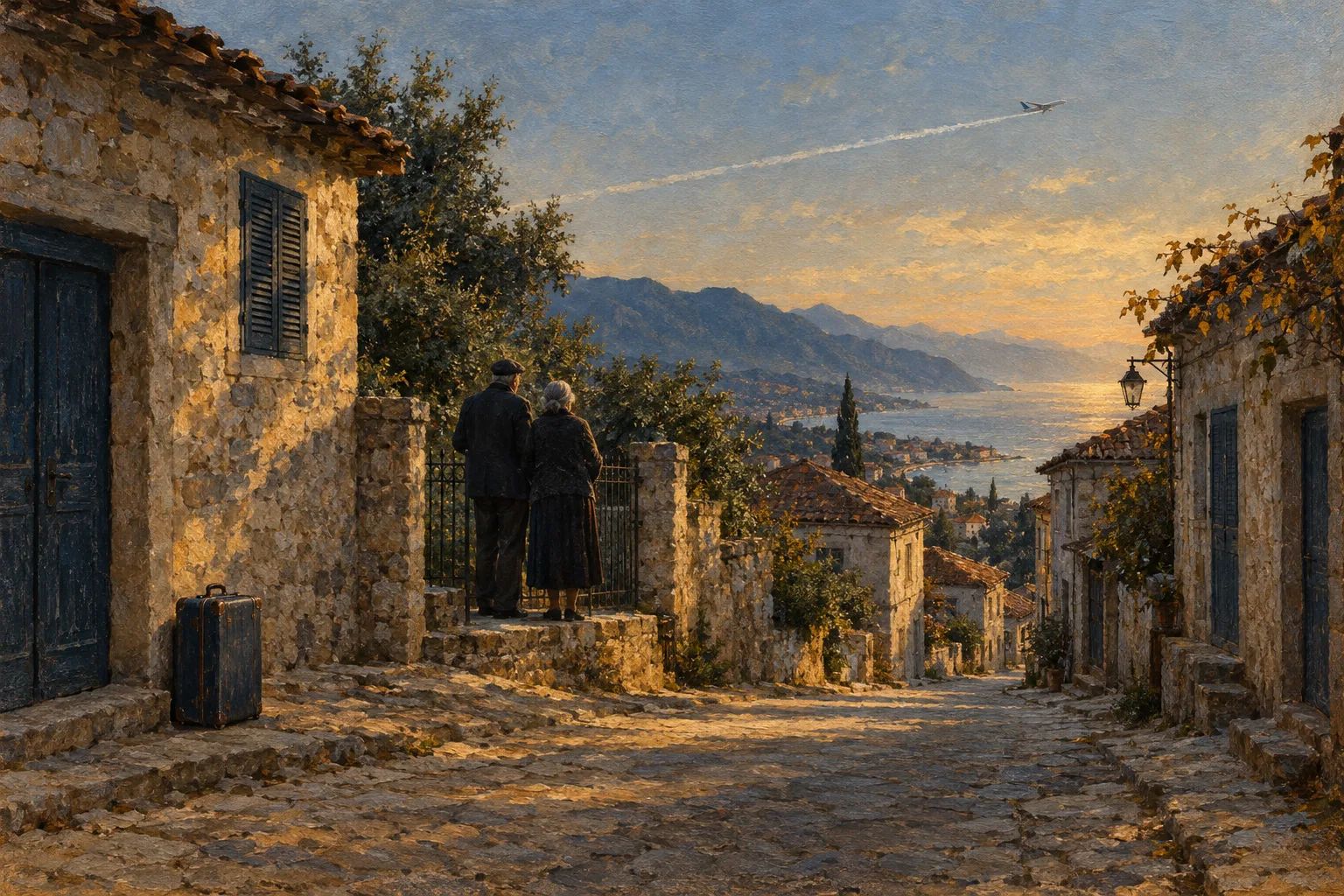
If “outside” is becoming as large as “inside”, the questions are not only demographic. Who will keep written Albanian alive among children growing up in Italy, Greece or Germany? Which literature will count as Albanian when some of its authors write in Italian, Greek or English, and some of its readers read Albanian as a second language? This review has written before about diaspora literature as a space where identity is rewritten every day.
This year’s figures move that subject from the margins towards the centre. A culture living in two places needs institutions that see the whole: publishers who distribute across borders, libraries that serve distant readers, schools that teach Albanian where the children actually live. Whichever figure proves accurate in the end, the cultural question stays the same: how a language can remain shared when its speakers are divided between two geographical spaces of nearly equal size.
Sources
- Popullsia e Shqipërisë, 1 Janar 2026, INSTAT (2026-06-02)
- Censi 2023: emigrimi tkurr Shqipërinë, popullsia plaket me 7 vite, Citizens.al (2024-06-28)
- Ndodh eksodi i dytë në Shqipëri! Eksperti jep alarmin: Më shumë shqiptarë jashtë se brenda, BalkanWeb (2026-01-24)
- Republic of Albania, Parliamentary Elections, 11 May 2025: Interim Report, OSCE/ODIHR (2025-04-28)
- How much can the diaspora vote affect the 2025 elections, Citizens.al (2025-04-28)