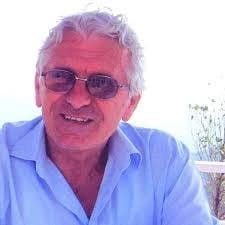

WHAT AZIS NESINI SAID ABOUT THE ALBANIAN PEOPLE
I don’t know whether Azis Nesini said those words.
That is all.
Or, more precisely, that is exactly why I am writing.
My literary encounter with the well-known Turkish writer came about through a selection of his stories translated by a young translator, Spartak Kadiu, who at the time had not yet taken a razor to his cheeks.
Having agreed to edit the book, I found myself, almost without realising it, immersed head to toe in the sea of Azis Nesini’s work.
Azis Nesini
And the better I came to know the writer, the more I was drawn to the man.
For Nesini was one of those writers who saw the world not only through
a writer’s eyes, but also through a satirist’s eye: the eye that spots a small crack in a wall, follows it and discovers the whole building.
When he came to our country in 1979, he was no stranger to Albanian readers. His books had been translated and published. He was welcomed by the Writers’ and Artists’ League, headed by Dritëro Agolli, and by the magazine “Hosteni”, with Niko Nikolla.
This is where my story begins, though not Nesini’s story. My story about something Nesini said.
A few hours before his meeting with Albanian writers, Dritëro Agolli and Niko Nikolla took their Turkish guest for a walk around Tirana.
They sat down at a café near Kafe Opera.
Nesini spoke through an interpreter. He listened. He laughed. He watched.
And, as happens in Albanian cafés, a writer came over and joined them.
Then another. Then another still.
The first had just finished a book of more than two hundred pages. Nesini naturally asked him what his book was about.
“Distilling raki,” the other man replied at once, quite casually, as though he were talking about an episode from the Second World War.
And here he launched into a detailed and passionate explanation of the “trickle”.
“Do you know what the Trickle is, that thin little stream, like a newborn kid’s piss, without which the raki would come out as fizzy water rather than first-run spirit?”
“Believe me,” he insisted, “I swear on these two eyes. May I go blind if I’m lying to you!”
“Now there,” Nesini thought to himself, “is the sort of human oath you no longer find among modern writers.”
And he listened all the more closely to the stories of the Albanian guests.
Then another came along. He too had written a book. Army memoirs. The essence of the book was simple: when a recruit goes absent without leave, he thinks of home, his sweetheart, his comrades, his friends. When he returns, he thinks of his punishment. In short, a Freudian psychological analysis, wouldn’t you say?!
Nesini listened.
The latest arrival turned to Dritëro Agolli and told him he had just got up from his desk. He had written a story for “Hosteni”. “Of course,” he declared, “a story with a little salt and hot pepper!”
Here Nesini, a satirist himself, could not contain himself. He shifted in his seat and listened to the other man, all eyes and ears. He seemed to be seized by a pang of jealousy, as though the man had encroached on his territory.
The newly arrived writer went on in earnest:
“The heroes of my story are two friends who are together night and day. As the saying goes, they even share the food from their mouths. As they talked over their troubles, one of them, who was involved in politics, promised the other that if he won the election for mayor of Shkodër, the cradle of Albanian humour, he would find him a decent job the very next morning.”
Sometimes even dreams come true.
The new candidate won, and when his unemployed friend came to see him, the new mayor scratched his head, embarrassed and beset by the great difficulties he had faced from his very first day in the mayor’s chair, and said in exasperation:
“You know what? Why don’t you take that broom by the town hall entrance, the one they’ve been sweeping the square with, and get straight to work?”
Two days later, the new mayor of Shkodër received an urgent telegram:
“Mr Mayor! I am in Lezhë, continuing the work as you instructed. The brume (broom) you gave me two days ago wore away against the asphalt a good while back. Send me a new brume.”
Before the interpreter had even finished translating the story, Azis Nesini had caught its point and could not hold back his laughter. There could have been no greater endorsement for his unknown Albanian colleague than the famous Turkish writer’s hearty laughter.
I think that, at that moment, the Turkish satirist had begun to understand Albania.
Not through speeches.
Not through reports.
Not through ceremonies.
Through coffee.
Through raki.
Through the soldier who goes absent without leave.
Through the writers who always had a new book in their pockets.
And perhaps through the very fact that, if he stayed at that table a little longer, yet another writer was sure to appear.
As the time for the meeting drew near, the group got up and made their way to the Writers’ League.
After the words of welcome, Nesini took the floor.
And then, according to the account that has reached me, he said:
“My dear and cherished Albanian friends, a people of writers!”
That was all.
That was the sentence I was looking for.
I looked for it in newspapers.
In magazines.
In memoirs.
In people’s accounts.
Among the traces of that visit.
I found many things.
But not that sentence.
And then Huan Rulfo came to mind.
Rulfo says that a creative writer must know what he knows and what lies he tells. Because if you stick only to the truth of what you have seen and heard, then you are writing history or reportage.
Rulfo held out his generous hand to me.
He told me, as though he were sitting beside me:
“Keep going, my friend!”
And I went on, certain that I was not writing the minutes of Nesini’s meeting with Albanian writers.
I am writing about a sentence.
A sentence that may have been spoken.
It may not have been spoken.
It may have been phrased differently.
It may have been misheard.
It may have been embellished along the way.
But whatever happened, it has survived.
And that makes me think that memory is sometimes a strange archive.
Documents can lose a sentence.
Memory can save it.
And there is that scene before me again.
The café near the Opera.
Dritëro Agolli.
Niko Nikolla.
Azis Nesini.
But also the writer of the raki book.
The writer of the army book.
The writer who writes about the yearly promises of new jobs...
And others who come, one after another.
Nesini listens, watches and thinks.
Surely, as he listened, the man who had written more than a hundred books was now turning something over in his mind, thinking of writing a little Albanian story.
Because he knew better than anyone that absurdity need not be invented.
You need only look for it, and you will find it sitting somewhere beside you.
In a café.
In an office.
In an army unit.
Outside, out on the roads of the homeland.
But also at a table of writers.
Or in a hall where a foreign guest rises to speak.
And says:
“My dear and cherished Albanian friends, a people of writers!”
That sentence, then, the one I could not find.
The one that spread far and wide.
The one that brought me this far. “No comment.”
Because perhaps, after all, it does not matter so much whether Azis Nesini said those words or not.
What matters is that someone gave them to Albania.
And Albania remembered them.
Perhaps that is why the sentence lives on.
Even though the document is missing.
And I am still looking for it, even after so many years.
Perhaps in vain. But perhaps not entirely in vain. For, as the dialectic of our people has it: Play for nothing, but don’t play for nothing! By making a move, you will find and change something.
Rulfo has already told me not to stop.
Because literature begins precisely where the document ends.