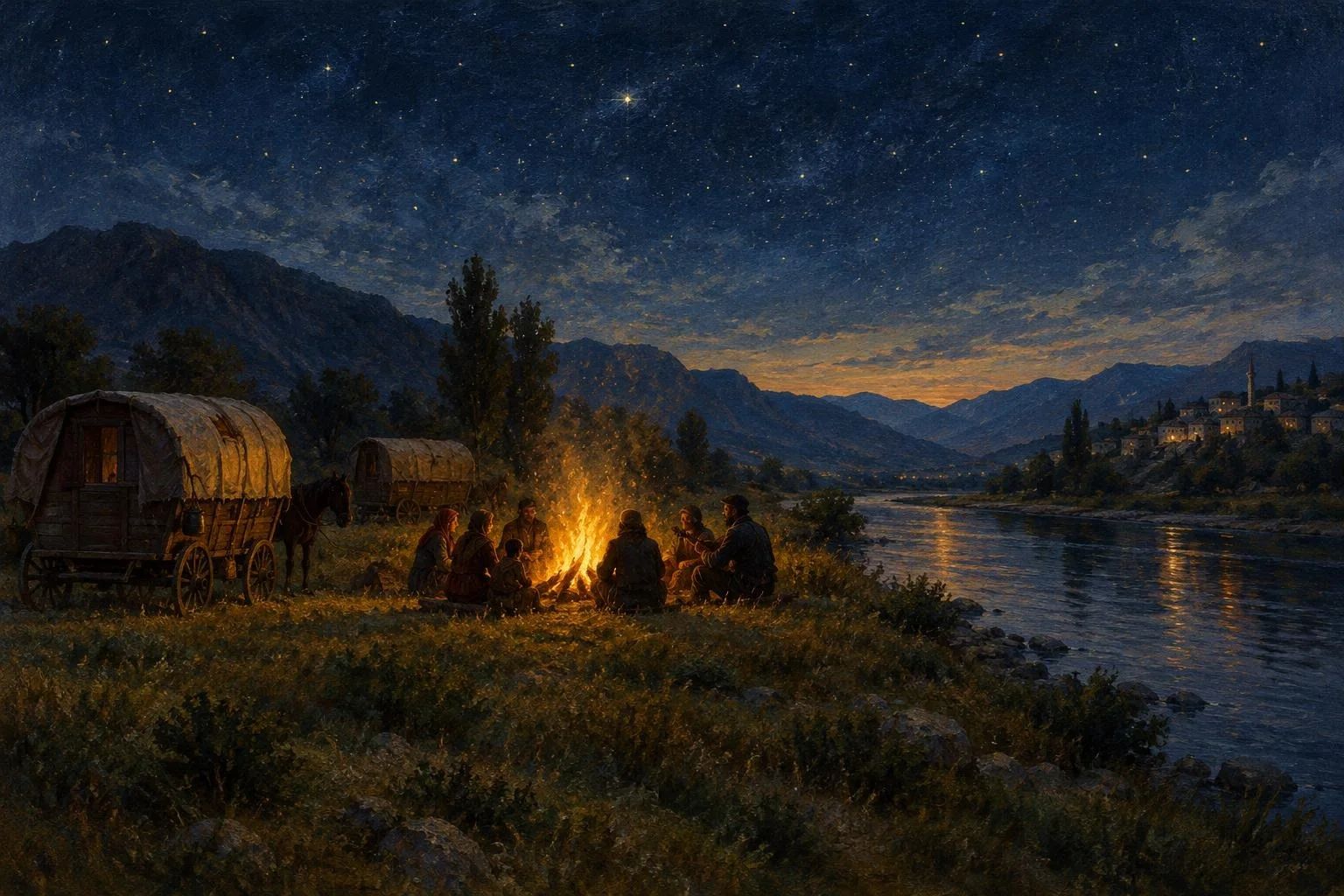
DEDICATED TO THE ROMA OF ALBANIA
A Study
They are used to little in life
The quiet, pure-hearted Gypsies
even at night they sleep uncovered
even in bitter winters in the storm!
They never asked for land or territory
Because they were never given a state in this world
The freest in the world, yet the most discriminated against
Without a homeland, without shelter, all their lives on the streets, the good Gypsies!
And they sing the ballad of life...
Without graves, without names on doors, without a mark or trace,
But there are no souls like theirs in any other race,
as they sing with no bread in their bellies and still hold weddings!
As they preserve that beautiful language of theirs
And the code of their black-grape race...
As they fall in love in huts and on riverbanks
And kiss with such love by the crackling fire!
While the world writes of laws for freedom and rights everywhere
And billions are poured into luxury and arms
For the poor Gypsies, for the stateless beggars of the world,
no one considers that a race is suffering under discrimination!
But one day their fate will be reborn
And a humane wisdom will be found on Earth
To honor and recognize their rights
As a nation with origins and a Homeland
Llemadeo
The Roma, or Gypsies as we are used to calling them, can be found everywhere, of all ages, diverse but sharing the same troubles. Left on the margins of life, the vast majority of this community lives in poverty. They are people whom life has left on the streets, in difficult conditions for survival. Without essential medical protection in the merciless battle of what tomorrow will bring.
In an effort to get a closer look at the situation of this community, and to learn more about them and their way of life, we visited their largest neighborhood in the city of Elbasan.
During a visit to the largest Roma neighborhood in Rrapishtë, you could not help but notice the miserable condition of this minority, which was reflected everywhere. Houses built with randomly found boards and scrap metal, or at best, a very old building with tiny, dark, unventilated rooms filled with dampness and gloom. In these makeshift homes, built by themselves amidst the harsh reality they are offered, parents live with children who multiply year after year.
Everywhere around, you could encounter pale faces, uncombed hair, and torn clothes. In the heat of the day when everyone rests during the lunch hour, your eye would catch a few small children leaving their neighborhood to look for food or something else to help themselves and their families. They were the usual children that every citizen of Elbasan already knew as the beggar children.
As I observed all this misery and thought precisely about the future of these unfortunate children, and how their peers at this very moment were enjoying a lovely lunch prepared by their mothers and resting in a comfortable bed, I suddenly heard a voice that brought me back to reality. It was these children, two little boys reaching their hands out to me, asking with words and simultaneously with faces innocent to this reality that I give them something.
Touched by this situation I was seeing, I pulled the children over to a nearby bench and handed them something. I asked them why they were out at this lunch hour.
Innocent as they were, they said in unison, “Mom and Dad are waiting for us to bring something home. They don’t work and don’t have money to feed us and our other brothers. The few coins we get from people who happen to give us something to eat on the street are enough.”
One was seven years old, while the other was nine. An age that expects them to be at school desks, where instead of bruised, dirty hands, uncombed hair, and torn clothes, they are forced to wander around in all weather, be it sun, rain, snow, or strong wind. Instead of taking the place that rightfully belongs to them, that of a student at a school desk alongside their peers, combed, washed, and in a clean uniform to show that they too, just like the rest of society, are capable of learning... but no, this is the reality, however bitter it is for these children.
I said goodbye to the children and continued on my way... My attention was drawn to a young girl who was pulling a cart loaded with discarded objects. I walked toward her, stopped, and greeted her, asking if we could talk. I did so with great care, as I did not want her to be hurt by any word that might make her feel bad. She had a very expressive and beautiful face, with typical Gypsy features: black eyes, prominent eyebrows, and curly hair. She was wearing pants, a long skirt, and a blouse that was torn all over.
At first, she was shy and could barely speak, but then she began to tell me about her family. She was only fifteen years old and already had two children to care for. “They need to be fed,” she told me, “and we don’t have the means. Unfortunately, we are not registered in the civil registry, so we can’t get even the slightest help from the state.”
“At home, I have my mother-in-law, my father-in-law, my sisters-in-law, and my brothers-in-law. We all live together in one place. But poverty exists regardless. We are forced by our circumstances to go out and rummage through the garbage in the hope that people have thrown away something we can use. This is one of the ways I clothe my children, or even find some slightly outdated household appliance that might still work. It is a struggle to survive due to the impossibility of finding a job, the lack of income, and the lack of help from the state...”
She invited me to go to her house, as all the women of this community were having a gathering today, and she expressed the desire for me to join their usual meeting.
As we walked toward her house, we continued talking. She told me, “Girls who dress differently from the majority are singled out and looked at differently. We can’t wear very modern clothes, not only because we can’t afford them, but also because they insult us afterward. These are unspoken rules set among Roma girls and women.”
“We are all the same and that is how we should be,” she continued to emphasize.
Just as she finished her words, we arrived at a new house recently built by an association specifically for them. She invited me inside, and I was introduced to all the women who were there. It was a very modest house, but it did not lack the hospitality and love they offered to new guests. They tried at every moment to show their pleasure that a young woman had come to their home, a young woman who was interested in knowing a little more about them. And with great kindness, they began to talk about their problems as if they were talking to their best friend. Among them was a young woman, a coordinator for a center that helps the Roma community. She approached, introduced herself, and began to speak more about the goals and objectives this center has for this community.
“My name is Olsa Isarai, and I collaborate with a non-governmental organization called ‘Youth with a Mission’,” she said. “This organization has no personal profit but works with people who need social and economic assistance. Since 2003, we have been going to a neighborhood where the population is mostly Roma. Touched by the situation they lived in and how they lived, we started visiting their homes more often. The companionship and the conversations we had sparked a desire to help them more, by building houses, because they were living in tents, and we have been helping them learn how to read and write. For them, all this has been a great help, as they have now learned how to read, write, and sign their names.”
“Our next project for them, seeing the condition of this community, was setting up a feeding center for the children of this community, as these children had many deficiencies and what their families offered was completely insufficient.”
“What pushed us the most to set up this center specifically dedicated to feeding the children was the malnutrition of a nine-year-old girl who died of a lung disease. But thank God, a fellowship in Elbasan, ‘Jesus United Us,’ helped us with this project to materialize the plan for feeding and clothing these children.”
This is the darkest and most touching part of this community. A bitter and very painful reality. But... the Roma cannot be defined solely by their poverty and their inability to be someone. Now, their integration seems to have found its “compass,” guiding their development, integration, and progress so they can be accepted as a whole part of society.
We break away from this dark part of reality to show precisely the other side of the coin for this community.
It is my pleasure to introduce a lady in her thirties named Silvi Bastri. She completed her first degree in music, specifically in vocals. Then she studied communication sciences, and now she holds a first-level master’s degree, working as a press and communications spokesperson.
She has a mission in her life: to contribute to the development of the Roma community.
Classic, simple, and beautiful. This is how her entire presence can be summarized in essence. A lady who does not like to stand out only for her voice, but also for her elegance, her strength to fight, and her drive to build something for the benefit of her community. For the benefit of the Roma community.
I have described it as the confession of a “free spirit,” because such are her words, and such is she as a whole. There is a beautiful intertwining between her love for art and her inexhaustible strength to build a solid wall of support for her community.
And as she speaks about herself and her community, every word takes on a certain color, a beautiful intonation, a perfect shape... expressing endless love and only love...
“I dream of La Scala, I even see it in my dreams, and who knows, one day... yes, yes, of course in a dream, where else...” she continued, expressing what she loves most, her passion for singing...
“...For my diploma, I sang Santuzza’s aria, Bach, the famous Verdi, and Shkodra jare songs. I was an absolute marvel. Endless applause, and on my hand I felt the most sincere kiss from the esteemed professor and my idol, Gaqo Çako. For me, it is the most beautiful memory a lyceum student could ever forge in the odeon of the Academy of Arts, a pleasure that no one else had but me...”
“Music stimulates a happiness in me that I have never had. I often play the piano in a duet with my daughter, and I paint whenever my happiness is disturbed...”
“I feel peace in the large photographs on the wall, which are endless in my room. I talk to them and smile, I sing and tell them at every moment of the day that I am madly in love with everything created by happiness. And God knows how much I love happiness, how much I want to be happy...”
And after all this love she shows for her vocal studies, she does not forget to mention, and to praise in superlatives, the music of her genes, the Roma music she has felt since she was in the cradle...
...I go crazy when I hear Roma music. It is the sweetest and most soulful music on earth, and this is because it has come down through the centuries and is always transmitted across time. For this, the nomadic Roma everywhere undoubtedly deserve special credit. I have sung it and I will sing it. Perhaps it is also a bit genetic, the very fact that I enjoy it, Roma music I mean, but anyway, being an artist is more beautiful than adapting to bastard political phenomena and commenting on them...
And so, rebelling against this power that has never given proper support to this community, she continues to emphasize this further through words that this time she expresses with more force and inner anger toward politics and politicians.
It is certain, you have wasted time, or it is just so you can satisfy the ego of political scoundrels who might say after reading it, “You know, you comment beautifully,” and then nothing beautiful happens...
And what remains for the people who sought to be free, who sought freedom of speech, who do not even understand freedom as a term themselves, and in its name destroy and allow the bastards of this politics, poor in innovation and infinitely bestial, to stunt the only thing we have besides money and politics: the freedom to live. I love democracy, but I love it as an artist. Only in this way can one resist this maddeningly bastard world...
And so, slightly hurt by the bitter reality for her community, she returns just as beautifully and calmly to speak in general terms, about herself, showing us her strength intertwined with the intelligence and class of a woman that not everyone possesses, to face the discrimination of society and the hardships of life, with an optimism that lifts her up in every difficult moment to fight and achieve what she has most aimed for and aims to have.
Everyone is diverse in their own world, and the life of each of us is part of the whole. So we are a bouquet of diverse flowers, which presuppose an undeniable naturalness and uniqueness, each for their own ego.
I am very different from the rest of society, for the very fact that I belong to the Roma minority. My goal is to be myself and to adapt to others astutely, to get where I wanted to go, because sometimes working is not what matters, but knowing how to manage the situation is very important.
It is undeniable that I have had many difficulties in life, both personal and professional, but I know one thing above all else. Every problem has a solution, sadness must be reined in, and you must never say good morning to pessimism.
Otherwise, I would not be where I am today, working with the greatest love for my center for CSD Rom…
Today it is a rather bitter paradox if we cast our eyes before the 90s and make a comparison with after the 90s, as we see exactly a 60-year-old who knows how to read and write opposite a 20-year-old who does not even know how to sign his name.
It is a pity to find that a man or a woman does not know how to sign their name, or even know how to read and write it...
Time passes and the illiterate multiply day by day; unfortunately, this is also the negative image that is undesirably fabricated for the Roma community...
...But initiatives have begun, though not so much from the state, but from themselves, from the Roma community itself, and undoubtedly also with the immense support of non-governmental organizations.
There are hundreds of associations and centers today that collaborate to help this community. To integrate them into society in all possible aspects, such as social, educational, and cultural.
...Every Roma is the undeniable image of a center that forges with its helmet the love for peace and integration.
The Center for a “Contemporary Roma Vision” (Centro vas jek Somvaxtuno Dikhipen Rromano)
Whose mission is: To work with the Roma and young Roma intellectuals in Albania in order to promote their educational, cultural, economic, and social development, as well as to contribute to the development of democratic institutions in Albania. To keep alive and spread the Roma language and culture, and to carry out activities for this purpose. To encourage public opinion to respect human rights, the rights of the Roma, and especially their language and schooling. To help integrate young Roma intellectuals into this center. To maintain ties with Local and Central government to support the employment of Roma wherever they are. To contribute to supporting the rights of the Roma ethnicity and respecting these rights within the framework of the various International Conventions our country has acceded to. To organize various cultural, artistic, economic, and sporting activities, studio recordings, and CDs, so that the center can use the proceeds for the smooth running and realization of its activities. Since its foundation, the Center for a “Contemporary Roma Vision” has played a very important role in promoting young Roma intellectuals and in the educational, cultural, and social development of the community. The community of Roma parents has been systematically encouraged and made aware of the importance of educating their children, working constantly to develop an educational-instructional activity at the center, which has proven highly successful and effective with this group of children. In its five years since foundation, the center has tried to solve problems institutionally and draft projects whose main focus is cooperation with various state actors, who are not only interested in solving various issues but are also the legal backers in many situations. In the field of Culture, and more specifically in elevating the traditional and cultural image, the center has carried out a series of cultural activities and artistic concerts featuring the performance of the “Folk Rrom Albania” ensemble, established for this purpose. The employment of Roma is one of the priorities for which the center's staff has held meetings and talks with various state actors, and talks with various state and private actors. We feel comfortable because, even though we are young in terms of the time the center has been active, we feel secure since only intellectuals will be able to help the Roma community with seriousness and dedication. The latest activities implemented by the organization: The main focus of the center is education. Currently, its premises host 53 Roma students who do their homework and the lessons assigned by their teacher in the compulsory 9-year system.
Silvi Bastri and Astrit Bastri have been working for 5 consecutive years for the growth and strengthening of this center, caring for it personally just as a mother cares for her children. And this is evident everywhere, not only from her loving words about this center but also from the children, who constantly express their immeasurable love for this lady, who has known how to win over and capture the hearts of all these children who today work together for a single goal: their integration into society.
Often, undertaken initiatives alone are not enough to help this community. Above all and beyond everything, it requires working and giving a lot of love, showing appreciation step by step and encouraging them to walk further down a great and very difficult path, demonstrating faith in the abilities, desires, and goals they have for themselves for the near future.
And this center does not lack this love, as it is best demonstrated by the smiles of the children who clearly feel good and valued, and by the sparkle in their little eyes, which express hope and optimism for the future.
The first thing that catches your attention as soon as you look at the children's rooms are the endless paintings hanging on the wall, with corresponding dedications, whether for their teachers or for the various desires that stir their thoughts.
They are simple, which is why they are also beautiful, as they symbolize the simplicity and purity of a child.
It is a simple room without many comforts, without many toys, but a very special room for these children, a room that gives you the feeling of a warm hearth, where every corner of it symbolizes these children without whom this center would have no meaning.
Observing everything carefully, I try to imagine this room as the greatest treasure of this center, carrying within it every story of each of these children, every effort to learn, and every desire and hope that one day they too will learn and become someone in life.
And so I am closing with these verses, full of optimism for their work and their future, integrating soon and enjoying their rights just like the rest of society.
...But one day their fate will be revived
And a human wisdom will be found on Earth
To honor and recognize their rights
As a nation with an origin and a Motherland
aims to have.