A Story
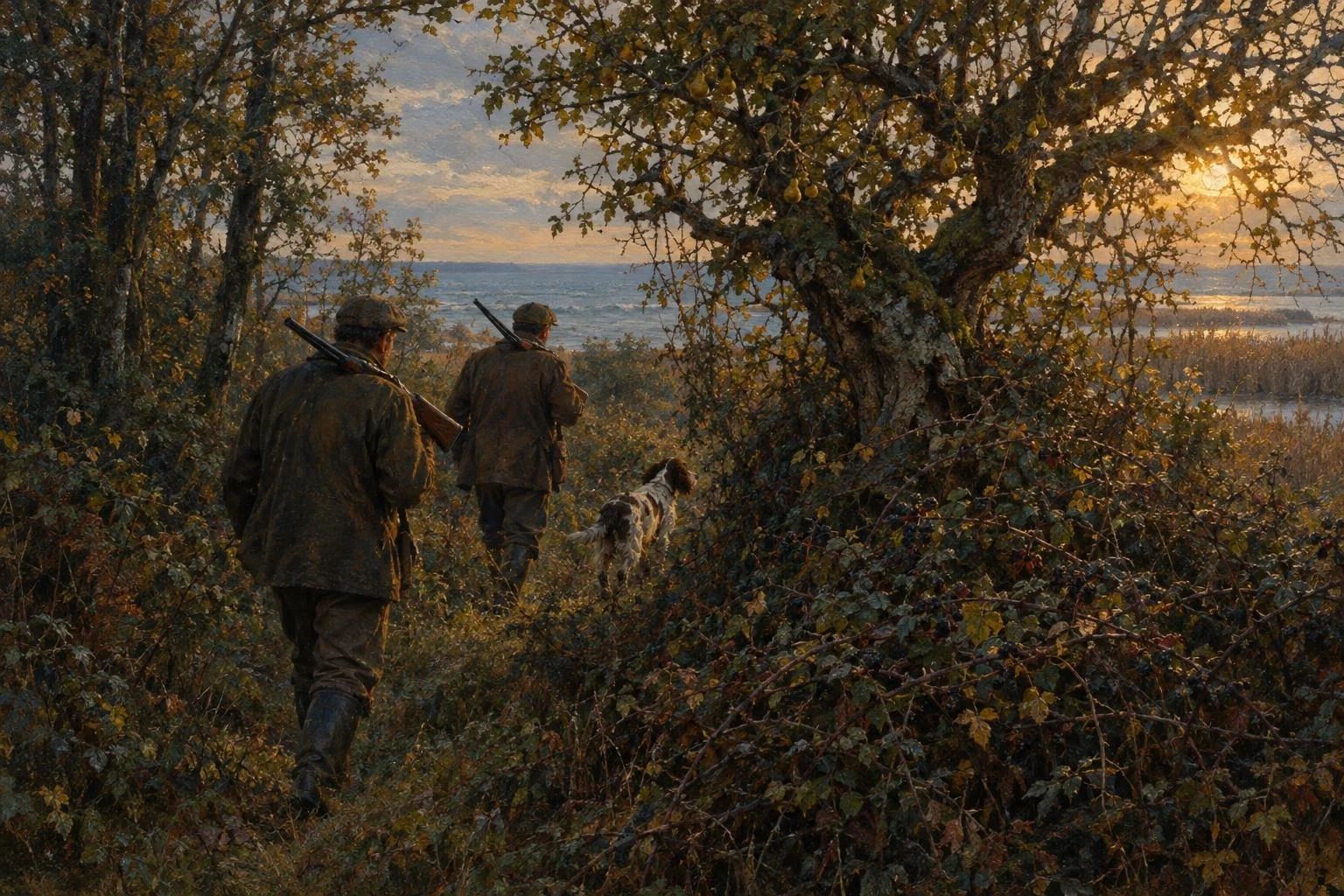
We stopped the car and got out. Evening had just begun to approach with light steps. Through the branches of the trees, the sun hid and reappeared, like a coquettish girl. It had lost its heat. Only its blinding beauty remained. Further on, behind the trees, you could hear the rhythm of the waves knocking on the shore, an old score between them that went on for eternity. The waves would sometimes curse and run away angry, and sometimes return repentant to kiss the cheeks of the shore. The Bay of Patok, which I had not seen for a full eighteen years, had changed a lot. I saw that the trees had grown, their branches like open arms. Even though it was early November, they wore their green suits on their shoulders, faded here and there, like a garment washed many times but still beautiful.
Gjergji watched me, lost in the kingdom of the forest, and said nothing. He opened the door of the cage where the dog was kept. The animal did not wait to be called; it jumped out, shook itself as if to loosen its bones, and began to leap and frolic. It was a bird-hunting breed, with large ears, a small red nose, and sweet, silken eyes, like the eyes of a child.
“The reserve hasn’t been privatized yet,” Gjergji told me. “The incubators and the birds that used to cross right in front of your feet have long been forgotten.”
The dog dashed forward, sniffing at the bushes. It stuck its head into the tufts of rushes, which looked like unkempt heads with their tips sticking straight up like hedgehog spines. Wild ducks make their nests and lay their eggs in them. Pheasants stay further from the shore, deep in the forest.
The dog began to bark and search. Gjergji and I, with our shotguns on our shoulders, followed its barking, which acted as a guide and made us trail behind. I don’t know why, but at that moment the dog seemed to be racing to wake my youthful memories from their sleep. It spoke to them in its own language, but they were either in the deep sleep of oblivion or had migrated to another paradise.
“This way!” I said to Gjergji, pointing to a narrow path covered by a clump of brambles.
He smiled and replied:
“That path is closed. Time has done its work. The trees and shrubs have grown. Still, I’m glad you haven’t forgotten it.”
The path grew narrower and narrower, and a little further on it was covered in grass. The old tracks, like capital letters, reached a certain point and could no longer be read.
“This way, this way!” I repeated. “A little deeper in, there’s a pear tree!”
“Yes,” he interrupted me, “there is! It has grown now; it isn’t the girl you once knew. Its branches conquer the spaces. Its bark”
has thickened; it has become a mother. The birds eat its fruit. The autumn wind slaps it and gives them as a gift to the hedgehogs. No one takes care of it; all around it is covered by brambles, like wicked, gossiping women who do everything they can every day to suffocate it.
Gjergji had understood from my very first request that this evening would not be for hunting. It would be a return to the past. Near the chirping, near the sun that had already sat upon the surface of the water, like a fussy child wanting to bathe. Following me carefully, he lay in wait, not for the prey that might appear at any moment, but for my movements. They were slow, because my eyes wanted to devour everything around me. I now resembled not a hunter, but a passionate curator of memories wanting to open an exhibition. That of the soul, which had been locked with the key of oblivion eighteen years ago. My memories were startled by the dog’s barking, which sounded somewhat distant to me.
In a small clearing that appeared before us, resembling a little stage, a beautiful beak appeared, a breast as reddish as a sunset, and then a pheasant with a long, multicolored tail.
Gjergji took the shotgun off his shoulders.
“Don’t!” I caught him by the hand.
He looked at me without speaking. A faint smile touched his lips. The cold evening breeze wove through his eyelashes, but he did not move.
“Let’s just watch it for a bit. I haven’t seen one in years.”
I told him that in the big cities of Europe, such moments only appear in movies and zoos.
“You’re punishing us,” he whispered to me. “We’ll look for it further on, but…”
“It doesn’t matter!”
I had never liked hunting. My childhood friend knew this too.
The pheasant had come out completely. The barking had moved away, coming muffled beneath the rustle of the waves and the light wind that wove through the palms of the leaves. The bird stood on guard. Frightened, expecting danger from all sides. It looked to me like a distant, lost memory that had just come out to meet me. It moved its head slightly like a radar, to catch all the waves of danger. Meanwhile, the evening breeze ruffled its feathered clothes, unfurling a treasure trove of colors and variety. My chest filled with metaphors. At that moment, if I had had paper and a pencil, I would have filled a whole meadow of figures with letters. They went in and out of me, like this rustling, like this evening.
“They are always frightened, distracted, because they are hunted. The old mania hunters have for them has made them always be on high alert. But why did you get emotional? You poets are soft, brother. Your soul is a musical instrument for light symphonies, not for Beethoven’s Ninth Symphony.”
Gjergji knew me well. He had not approved of my migration for a nest outside Albania, even eighteen years ago.
“You are not a migratory bird,” he used to tell me back then. “You are like the blackbird, but you don’t want to understand it. You are like the owl; you don’t see the day, but you don’t see the future either.”
My father would laugh at the time, while my mother filled our raki glasses, as if wanting to burn away the pain on the day of my departure.
The pheasant watched us with a strange calmness. It seemed as if it were reading our thoughts and nodding its head in greeting. It hid behind a bush, like the beautiful girls of the runway behind the wings of the stage. Its multicolored tail was its final farewell.
We went deeper, pushing aside the branches, which looked like hands wanting to embrace us. The leaves, with their green lips, whistled melodies, turning the reserve into a natural symphonic stage. The harmony of its instruments was perfect. Only the conductor was missing. Then we came out into a meadow. In its corner stood a large mulberry tree.
“Does this mulberry tree remind you of anything?” Gjergji smiled at my bewilderment. “Do you see these wires and these twigs? Remember? You put them there…”
Strangely, the bed I had made in its arms had moved higher up.
The tree had grown, carrying my memories on its shoulders too. The wires I had once tied through the branches had completely taken it over, becoming one with it. Above the bed of twigs, the trunks and dry branches looked surprisingly like a bed. I climbed up and touched them with my hand. The dry branches felt to me like the bones of a dead man. They had lost everything—strength, vitality—but within their dead silence they hid what I could not easily erase from my memory. A guitar that played in the echo of the mulberry branches and vanished into the abyss of memories.
“I’ve missed it for so many years, damn it,” I told my friend, not sure if I was speaking to him or to myself. “I’ve slept in luxury hotels, but this will remain the royal bed of my dreams.”
Gjergji was silent. Today he had removed the buckshot of teasing from his shotgun of humor. It seemed he wanted to let me enjoy this evening as much as possible. A little further away, the blades of dry grass were swaying. They looked like antennas wanting to send us a message. Gjergji and I cast a glance. From there emerged a tortoise with its shell in the shape of a chessboard. It walked calmly, paying no mind to our presence. It looked like a moving bunker.
“They say they live a long time,” I said.
“It’s true! They don’t rack their shells too much, like we do,” he replied, tapping his head with his finger. “They are content with what they have, with what fate gave them. In truth, we who ask for more, live less.”
Suddenly, a wind started up. The treetops roared, as if in a rebellious manifestation. Mount Vela was covered in clouds, like wicked thoughts. The Krujë mountain range as well. From where we were, the Cape of Rodon looked like a giant ship anchored on the shores of the Ishëm estuary, its bow facing west.
Gjergji said to me:
“In less than an hour we’ll have rain, storm, and wind. Do you hear the trees? Their calls are loud conversations and a clear expression of what is to come. It’s getting dark. Let’s go! Let’s go! A quick escape saves the day.”
Like a blinding motif, a flash of lightning appeared in the distance. Frightened, the dog leaned against Gjergji’s legs. It seemed as if it were begging us to hurry.
It too had sensed the weather turning.
“Let it fall! Let a cold rain fall furiously, with large drops, to wake me from this melancholy I’ve carried with me for years.”
The sky was entirely conquered by clouds. A thick darkness reigned everywhere. It seemed as if someone had thrown the cloak of oblivion over the trees, the nests, the daydreams. I felt Gjergji’s hand on my arm.
“Let’s go. If you want, we can come back another day.”
I was afraid of another day. It felt like it would happen after another eighteen years.
We could no longer see anything ahead. We only heard the voice of the wind calling and the rushing flow of water. To the left, the sea still rocked the waves in its lap. We walked along a narrow path. The weather had suddenly turned cold, as if with the stroke of a sword. The branches whipped our burning faces. Before we quite realized it, we emerged from the forest and were walking through an open area. We could feel the crunch of dry grass breaking beneath our steps. Gjergji turned on the flashlight.
“We walk straight until we find a path and get up to Gurëz.”
He had barely finished his sentence when the gods unleashed the lightning. After it, a torrential rain, like the unbridled desires of deities, poured down on us. Nothing but the gurgle of the downpour. The spot where a patch of sky had been visible just moments before, like a map in a captain’s cabin, closed up too.
“You’ve committed a sin!” laughed Gjergji, who was standing close to me. “Everything is paid for here.”
I don’t know why this late autumn both pleased and frightened me at the same time. Little by little, the rain was seeping into my body, and I began to feel cold. I realized we were walking through water. Gjergji cast the beam of the flashlight all around. We were on a large island, flooded on all sides by water.
“I can’t get my bearings on where we are!” Gjergji said.
I detected signs of fear and uncertainty in his voice. I couldn’t see his face. I only heard the pouring rain striking his back.
“I think we’ve come out at the mouth of the Mat!” he continued. The roar of the currents drowned out his voice.
“I didn’t hear you!” I called out to him, struggling to breathe.
“We are surrounded by water. We have the high tide from the sea, and from above the rushing current of the Mat, which is swollen from the rain.”
Anxiety gripped me too, and panic set in. We didn’t know which way to turn. Meanwhile, the water level began to rise and was approaching our knees. The dog whined softly, as if asking for help. The water reached up to its waist.
“What now?” I asked him, not even understanding what was happening myself.
“Every cloud has a silver lining,” he tried to calm me down.
“And every silver lining has a cloud,” I added, making a joke. In truth, I was terrified. I had never happened to be in danger in my entire life.
The situation was getting worse and worse. We turned to the right, but
we quickly turned back, because the water was deeper the way we were going. To go back the way we came again… we couldn’t make sense of anything anymore. Gjergji, sensing the danger more acutely, took the shotgun off his shoulders and fired it. A few small sparks appeared, illuminating
the surrounding area a little, accompanied by the characteristic sound of the gunshot. He repeated it once more. In my ears, this shot sounded like a call. “Hey! People! We are in danger! Help! Help!” After the shot, only the sound of the water and the wind could be heard. We listened for an answer, but nothing. Our call for help had fallen on deaf ears. Who is the fool that would leave their house in this rain, I thought. However, I said nothing to Gjergji. He loaded the shotgun and fired it again. He desperately wanted to communicate with someone. Its blast was the only means to send our hope of salvation across this sea of water. This time, the shot sounded clearer and somehow longer. At least, that’s how it seemed to me.
It wasn't long before another shot was heard from our left, not too far away. We looked each other in the eye. We stood waiting, flashlights in hand. The minutes felt long to us. From the other side, the shot was heard again.
“He's asking for an answer,” Gjergji told me, and loaded the shotgun again.
The shots followed one another, and after each shot, the blasts were heard more clearly. This showed that this someone, whom I baptized with the name of hope, was getting closer and closer. In the depths
and distance, a beam of light appeared, shimmering over the water. Gjergji didn't wait any longer; he loaded the shotgun and fired it again. The other person saw the light of the call and waved a large flashlight in our direction, to let us know he could see us now. The water was approaching a hand's breadth above our knees. I had taken the dog and was holding it in my arms.
The boat our savior was sailing in had a motor. But in these moments, its help was beyond measure. When we climbed into it, I realized how difficult this night would have been for us.
The unknown boatman merely greeted us and turned the boat in another direction. He was calm; it was clear he knew the area well. We disappeared into the darkness. The beam of the boat's flashlight struck far ahead, where the tall trunks of the trees appeared.
...
When we reached the road, the rain had stopped its earlier fury, though lightning continued to tear through the sky.
“We're going to my house!”
The stranger had a deep and calm voice.
“We have the car near the Zekaj stables,” Gjergji told him. “Thank you! Where can we go in this state?”
“It's nothing!” the other man cut him off, grabbing us by the arms. “We have plenty of clothes. We'll have a glass, then I'll walk you to the car. It's still early.”
His request was simple. From his voice, it was clear he meant it with all his heart. I was starting to like this man, with that baritone voice of his, like a rumble.
“We wouldn't want to refuse,” I replied.
“You don't look like you're from our parts.”
“I'm from Përmet,” I answered, “but I grew up and worked
for years in this area.”
“Then we definitely know each other.”
Meanwhile, we approached the house. Next to the large fireplace, everything was forgotten. The flames licked the walls of the chimney, creating strange figures, like the ones told of in ancient fairy tales. Two children came up to us, with a small age difference between them. The girl had a round face, with darting eyes and lips on which a smile itself seemed to have sprouted. The boy was tall for his age, with curly hair that covered his ears, calm and gentle, like a navigable lake.
“Do you have children?” our host asked me.
Gjergji laughed.
The other man didn't understand, but he laughed too.
“He is unmarried. He's been an emigrant for years. A family is a nest that isn't easily built in our times.”
“Regardless, a man emigrates to better himself, not to lose what he already has,” the master of the house said. “I emigrated to Switzerland for two years too. Here I am, I came back, set up a chicken farm in Tale since I have my lands there, got married, started a family, and I am at peace. I know why and for whom I work. My wife is a teacher, she'll be here soon, she teaches the village children. The demands have grown.”
Meanwhile, the door opened.
“This, gentlemen, is my wife. Now I give you my word, we will eat and drink well. The raki will surpass the downpour falling outside, and the chicken farm will have blood up to its knees.”
I saw her shadow beside me and stood up. She held out her hand to me. The light of the lamp faded for me. I locked eyes with her gaze and got lost in a sea of sadness and longing all at once.
Lightning bolts struck the numb hemisphere of my brain. The water of my thoughts came to me muddy, and it felt as if it would drown me. Yes, yes, this time it was hard to escape.
“Shake her hand,” her husband woke me from my daze.
Her outstretched hand seemed large, heavy to me. It felt as if a bridge were appearing before me. A bridge I had carried on my shoulders for years, along the roads of the world. And here, suddenly, I was finding it again, in this house, with this man, who had perhaps even saved our lives.
“Good evening!” I replied to her lifeless smile. She had frozen, like a flower turned to ice by the snow.
Gjergji enlivened the suspended atmosphere.
“Forgive us, we didn't want to intrude, but your husband...”
Then he told her the story, hiding nothing. The pear tree, the mulberry tree, and other memories. She sat there as always, calm, though her lower lip was trembling and her eyes were losing their shine. A cloud of mist, laden with tears, was floating in the expanse of her eyes.
“Excuse me!” she said. “We also need to cook.”
In truth, she found an excuse to leave. She was betraying
herself, and this was not good, neither for us, nor for her husband and the children.
The table was set quickly. Gjeto, the master of the house, urged us to drink. And indeed, I had a mad desire to drink. I wanted the strength of the raki to burn away that fire that had consumed me. My tongue was already getting thick. My half-drunken thoughts had taken flight. I truly sought those hands, those eyes, but I never expected to have them so close. In my hostess of those moments. I had lived in dreams with their presence for so many years and found happiness. Now those eyes were drowning me, melting me away once and for all. And I had them right in front of me...
I looked at her and couldn't get enough of her blossoming. With her thick, black hair falling over her shoulders. With her silent lips, the gurgle of her voice that had already dried up without realizing it. With her white cheekbones and her clean throat, where a gold chain slid down the valley of her chest, where my pearls were hidden. The pillow of dreams where I had once rested my head and my hopes. And yet, they were in front of me and I couldn't speak to them, touch them, or whisper even a single word to them. Even though I desired it like a madman.
She saw that I was lost in my gaze upon her, and to calm the situation, she addressed me:
“Why did you go out to the seashore this evening?”
“To hunt ducks, pheasants, blackbirds.”
I spoke to her and looked her in the eye, as if asking her for an answer as ancient as life itself. For a debt she owed me, or I owed her, and which had to be settled.
“Why, over there where you've been in Europe, are there none of those, that you come and look for them here?”
“No, there aren't! Over there, the locals hunt them. For us, it's difficult.”
“The hunting season is over now,” she said, while her eyelashes trembled and she was struggling to breathe. Only we were speaking, and only we understood.
“The hunting was an excuse. In truth, we came to meet our memories,” Gjergji intervened, to avoid the dangerous course of this conversation.
“Memories are birds that cannot be killed,” she insisted. “If you don't hold on to them, they wander off and leave only the shadow of the past. A person must be strong, not forget them, but also not weave hopes for a sun that has set.”
The evening went on long. The exhaustion, the drink, and the thoughts put us into a troubled sleep filled with dreams. The next day was clear, the sky had opened up. In fact, since yesterday, a furious downpour had fallen in my soul.
Gjeto and his wife had come out to the door to see us off.
She looked tired. I realized she hadn't slept all night, just like me. We shook hands, we looked into each other's eyes. They said a lot.
The road was washed clean. The storm already belonged to the past. We said our goodbyes and left. Our hosts, holding hands, made their way back into the house.
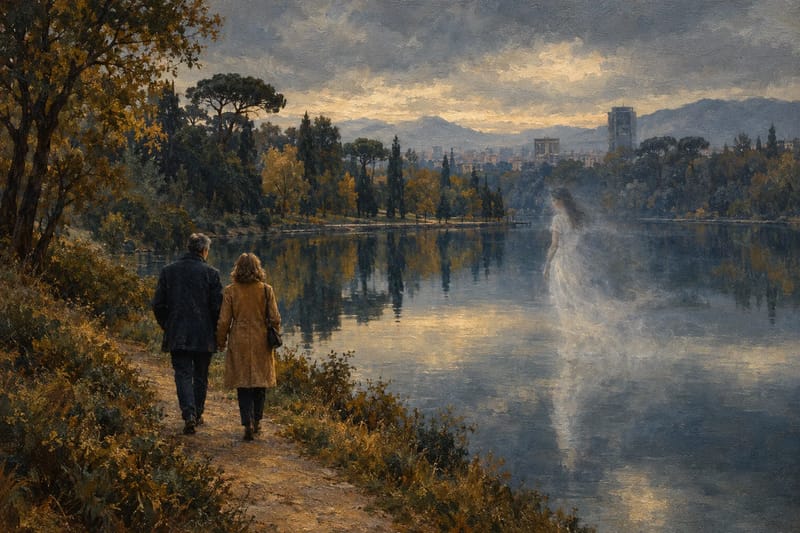
I saw my blackbird of the past when she turned her head one more time, as if she wanted to film for the last time in her memory the wanderer of a lost love.