A Story
Sokrati picked up the TV remote and turned it off. For days, morning and night, he had heard nothing but noise about the passing of an anti-corruption law. He forcefully pulled the door of the apartment building where he had lived for twenty-five years, because the rest of it was carved into his brain and he could not forget it even if he wanted to. The weather outside looked fine, but inside him thick clouds of thoughts churned and clashed; here and there a rumble of thunder or a lightning bolt of thought could be heard, and then he would fall back into silence. Into a false silence, because at every hour of the day he seemed distracted and on edge.
He crossed the Lana river with a measured step and came out on the Shallvare side, a name he himself did not know how this neighborhood had acquired. This had been his route even when he went to high school and later to university. He buttoned his shirt up tight, then his windbreaker, and pulled up the hood hanging down his back. Cars of all kinds and qualities passed by on the street, but he only cast them a glance and kept his eyes on the road ahead. Ah, he thought, this law of corruption and injustices, which is never going to pass. He combed his long beard with his fingers, and the hair that kept him from seeing, realizing that his eyebrows had grown long too, just as the rope of injustice grew longer in the times he lived in.
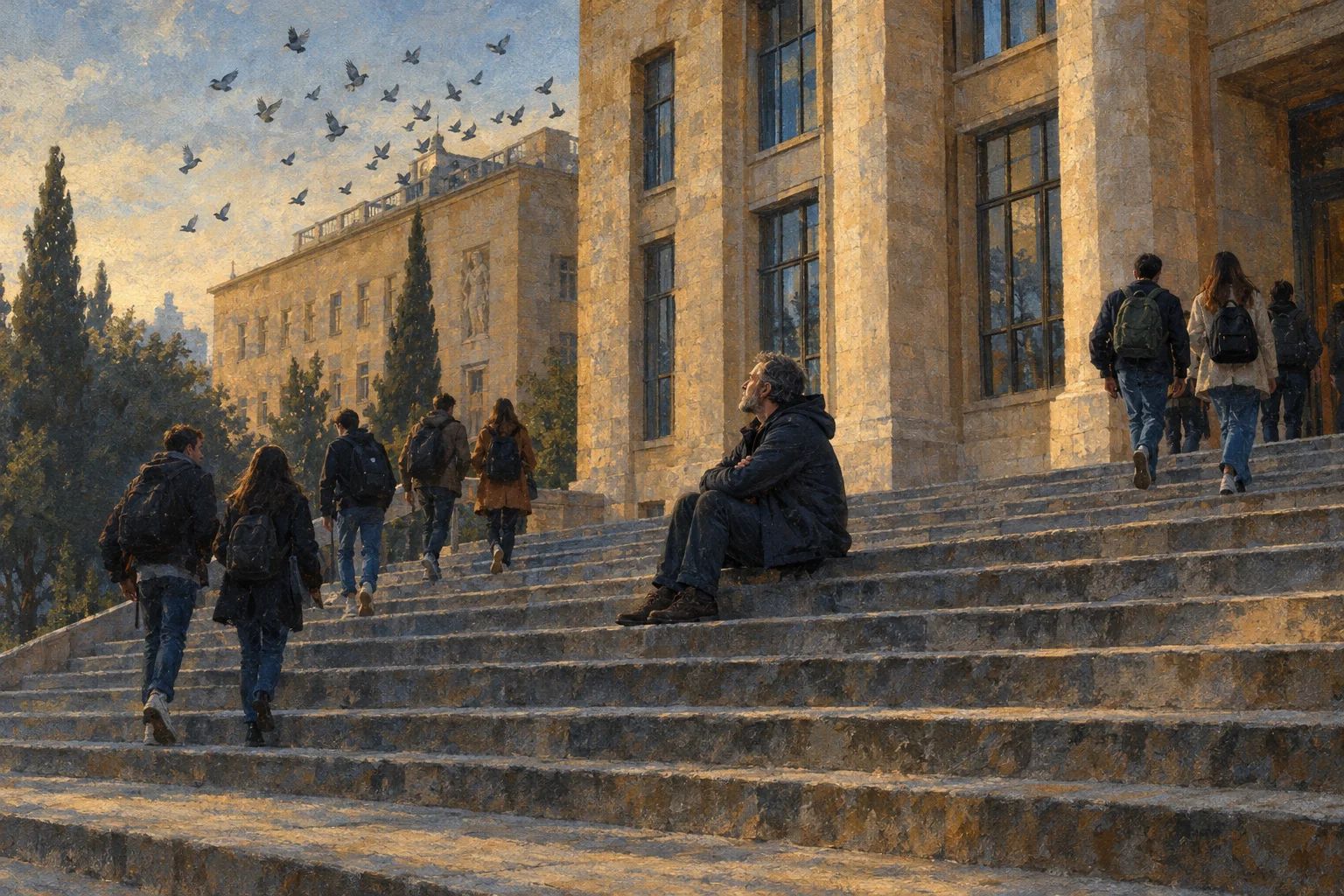
He always went to the grand steps of the university at the same time in the morning, well before the students, professors, or deans went inside. He sat in the middle of the steps as always and waited; some greeted him and some passed by without speaking. Many of the students and professors were surprised to see this fifty-five-year-old man here, whose hair had begun to turn white and whose beard had taken on the look of a philosopher. To everyone’s astonishment, some took him for a madman, or a man with an obsession, who sat on these steps every morning, because no one understood or knew or saw him begging for anything. He only had his two hands crossed in front of him, his gaze cast upward, as if searching for something with his eyes in the open or closed windows of the university. Above the great terrace of the university, a large flock of pigeons sometimes cut through the air and climbed high into the sky, sometimes swooped down and played with the tree branches swaying in the wind. Sokrati thought, he only thought, and lost his gaze sometimes deep in the windows, sometimes down the street, where the students came in groups or alone. Opposite was the Higher Institute of Arts, from which the sounds of music could be heard, as well as the signs or banners that the painting students put up from time to time.
Sokrati stayed there at the same time, in the same place, and after those going inside had passed by, he would get up a bit sluggishly and take the road back, or the road to where he had worked in recent years.
This morning he looked gloomier, older, quieter. The students, who were already used to him, greeted him and went inside. Sokrati sometimes smiled, sometimes took the clouds of the sky with his lips and brought them down over his forehead. For most of them, he plucked a rose of a smile from his lips, because smiles were rare in his life, and nodded his head in greeting. This ritual had created a silent monument among the students, of a silent man whom they always saw in the same place, at the same time, but without understanding the values, the purpose, and the reason of this human monument. For some time, Sokrati had become a puzzle to be solved among the university students. Most saw him as a myth, some as a madman, and many others as a beggar who begged for nothing. The students, drawn together in groups, discussed this mystical figure who perhaps spoke something in his own language that no one understood. This caught the eye of the Dean’s Office too. Hence that Tuesday, when there was only a week left until the approval or rejection of the law against corruption and injustices. This morning the students had not gone inside but had filled the steps, and in their midst stood the man with his strange appearance, silent, calm, and wordless.
The university professor and its dean, Mrs. Fitore Diploma—in fact, the surname Diploma had stuck to her thirty-five years ago when she had received her university degree with honors and had permanently remained an external professor at the time, then a lecturer, and now for many years the dean of this university’s law department. Her real surname was Pula, and after marriage, Skifteri, although she had nothing in common with a falcon, but rather more with a fox, because she had a furtive gaze, an unsteady and laconic look. When Fitore saw the group of students and their discussions on the steps, climbing up in her high heels, with her pitch-black hair and a latest-fashion dress, she shifted her folder to her left hand and called out to the students. But they did not move; they only looked with curiosity at the man standing silently in their midst.
Seeing that the students were not moving, and that they were looking at the strange man of late, she went up to him and spoke. She spoke to him in an unusual tone, not the way she spoke every day from afar, but sharp and harsh.
“Good morning, sir!”
The other man cast his gaze at her full legs and moved his eyes up past her knees and thighs, to her somewhat thickened waist, her ample chest, and her shoulders rounded by age.
“Good morning, Madam Dean!”
“To you I am not a dean, and my name is not Dean, but Fitore.”
“I understand,” the other man said, his head still bowed. “This name was given to you by those who brought you into the world, who apparently knew the path of victories you would reap in life.”
“Every person has their victories in life, sir. I have mine, and it is not up to you to speak of them, because my deeds, my career, and the vote of the people who elected me to protect their interests speak for them every day.”
For several election cycles, Fitore had also been a member of parliament in Albania.
“I am glad for your successes, madam.” Sokrati stood with his head bowed, his long hair covering his forehead and eyes. “Early on I read and paid for your beauty and wisdom.”
“We are not here for words and debates, sir. I ask you not to stay in this place anymore, otherwise I will call the police to come and take you away.”
“I am not surprised by that, Mrs. Fitore, because the victories in your life are built on the foundations of the police!”
The MP was infuriated, but she restrained herself.
“Please get up and leave, otherwise we will remove you by force.” The conversation was becoming public; the students, driven by curiosity, drew even closer. The dean felt uncomfortable. “Go away, sir, what are you looking for here?”
“I am looking for my degree, madam!”
“Your degree? Which degree? If you are looking for a degree, you don’t look for it on the steps, but inside the dean’s office, in the files and archives of the university.”
“Excuse me, madam,” Sokrati shifted in his place, but did not get up. “Are you going to vote for the law on corruption and the injustices that have been done and are being done in this nation?”
The dean was outraged:
“Here I am a dean, sir, I am not an MP. If you have anything to ask in that regard, then come to my office where I am an MP elected by the masses. Here I am chosen by my personal abilities as a lecturer and Dean of this university.”
A falcon swooped down over the university terrace, frightening the pigeons as it dove at them; the trees began to rustle loudly, and thick clouds seemed to descend, covering the green wings of the spring foliage around the university. The pigeons crashed through the branches, and many of them flew right down to the steps and near their feet. The students cried out in unison; the place echoed and filled the sky. The predatory falcon was startled and fled, but as it flew away, it crashed into the glass of the large second-floor window. Into the madam dean’s window, and from the impact, it plummeted to the ground; the glass shattered, and shards of glass pierced its body. The mass of students gasped. Sokrati took the opportunity and stood up:
“The falcon crashed into your office window and received its punishment, Madam Dean.”
Fitore liked this comparison.
“Sir, both figuratively and from a state perspective, we are chosen to uphold the law. The falcon was a predator, and their end is known.”
Sokrati stood up completely, pulled back his hood, grabbed the dean by both hands, and, after brushing back the hair falling over his eyes with his hand, spoke to her in a voice so loud it seemed the university itself and the entire universe around them were listening.
When the dean looked him in the eye, she trembled all over, and the large folder with the students’ names fell from her hand.
“Fitore, it’s me,” Sokrati cried out, “it’s me! I am the one who kissed and caressed your body, the one who taught you both in bed and at the university what life was like, what path you should follow in life, and not the one you took and made.”
Fitore pulled her hands away and covered her ears so as not to hear, but Sokrati’s cry was a roar, a lightning bolt that sent its thunder across the sky of justice in front of the university steps.
“You are here thanks to my degree, madam. You, together with the Sigurimi operative of the time, whom your deputy minister father had commissioned, presented the defense of my degree at the university. I did not know this, and five days later I presented myself with the same thesis, with that thesis you stole from my bedroom, and I was called a thief of your thesis. The operative, with your action, your word, your treachery, and your testimony, put me in prison for eight years.”
Fitore grabbed him by the hands and screamed:
“Enough, enough, Sokrati!” She saw the waves of hatred in his eyes. She could no longer control herself; her hair was disheveled, the stones of her fortress of beauty and pride had crumbled, and she looked like a castle that had fallen into enemy hands after a long, bloody, and destructive battle.
He looked deep into her eyes and spoke to her in that voice of his, which was not unfamiliar to her:
“On your body, in your eyes, I read the days of my joys with my lips, Fitore. In your chest I had my court of justice and faith. In the depths of your soul I sought happiness, but I found my ruin.”
A profound silence had fallen over the university steps; the scene now had only two actors, and hundreds of spectators watching it, but who had been left open-mouthed and mute by the tragedy playing out. A strong wind caught the large banner with a painting hanging on the wall of the Higher Institute of Arts and dropped it to the ground, then dragged it forcefully down the street as if to show that not everything can withstand time. The wind shook the branches of the trees around the university, which resembled a grand symphony with Beethovenian notes torn from the Ninth Symphony, “the Revolution.”
The dean put her hand over his mouth and screamed at him:
“Stop, please stop!”
“I will stop,” he shouted, “but the waves of my soul and the breath I keep locked inside cannot stop. Tell me, will you vote for the law against corruption and for national judicial equality?” He shook her hard. At that moment, he saw the dean sway two or three times and collapse unconscious to the ground. The students saw her snap from the lightning bolt of justice in his words, like the branch of a tree, but no one approached to give her first aid. Sokrati dialed the emergency numbers on his phone and held her head. He spoke to her slowly and tenderly:
“I loved you, Fitore, I loved you as the most precious thing in life. Tell me, will you vote for the law for justice and against corruption?” But she did not answer; her silence was a double-edged sword. When she woke up, we did not know, would she be with the past or with the future!