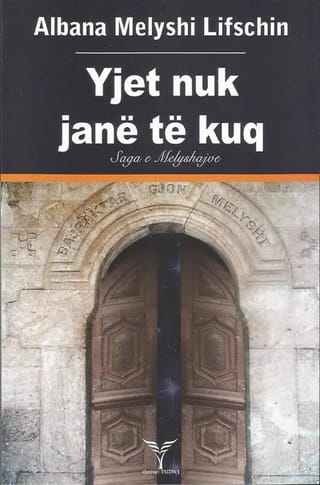
The book “Stars Are Not Red” by Albana Melyshi-Lifschin
A woman, a journalist, placed at the center of a book, who writes the saga of a great house of bajraktars over which time and politics have cast heavy mists. This intellectual woman comes all the way from America. She has thought long and hard about her far from easy undertaking: to clear the mists and clarify the light and shadows over one of the most renowned families and greatest, most noble houses of
Mirditë, that of the bajraktars of Kthellë, bearing the much-discussed name: the Melyshajs. The undertaking is complicated for another reason too:
The bajraktars of the house of Melyshaj were men who spoke and wrote their history with a rifle. Meanwhile the author, one of the descendants of this great house, is a woman and will speak with her pen. And to be believable, she must be completely impartial, unswayed by emotion, and weigh her words as befitted the men of a great house. Almost like calling upon a woman to unravel events governed by the Kanun…
To do this as best she can, the author makes the journey from America to set foot on those lands and territories that became an amphitheater for heroic events and battles that elevated the name of the house of Melyshaj, but also for tragic events that cast mists and dark shadows and brought down the towers of the bajraktars. In her difficult mission, Albana somewhat reminds us of the travels of the scholar and journalist Edith Durham, at the time she was writing the book “Twenty Years of Balkan Tangle”. This comparison grows even stronger when we recall that Albana was on a mission during the war in Kosovo and has also written a book about Kosovar children. But let us return to the Saga of the Melyshajs, which we now hold in our hands. I will not dwell on the book’s plot, because I would like the reader to discover it for themselves and enjoy it just as I have. I want to offer a few thoughts as a reader. I was impressed from the start by the simple way the author has chosen to bring the complicated history of a great family into the light of day. The author draws the reader along with her, making them part of those searches to uncover the truth.
She is not an investigator from a detective novel, but a storyteller who knows how to meet the right people, who, with what they recount, piece by piece complete the mosaic that makes the saga of the Melyshajs whole and bright.
Time and politics had confronted Albanian public opinion with a family split into two parts:
One, made up of reactionaries, traitors, and enemies of the people, interned and imprisoned along with their entire families. With Nikollë Melyshi as its main representative. The other, emerging from this very same family of traitors, but centered on a mysterious figure who, after bearing the stigma of a traitor and a fugitive in the reactionary
bands, suddenly receives the title of Hero of the People, seven years after a suspicious murder that remained so even 60 years later. And this was Pal Melyshi, Nikollë’s son. A family where, according to communist ideology, one side had to be a mortal enemy to the other. And, as irony would have
it, this ideological confrontation remains even today, after 23 years of democracy, but inverted: now it is the Hero of the People who is considered to have a bad biography. Surrealities that happen only in a country like Albania, where ideologies continue to rule over logic and historical facts. When you reach the end of the book, you realize with what mastery, simplicity, and wisdom the author has managed to definitively clarify that the Melyshi family was one, integral, of a deeply patriotic mold, with a single ideal: the true freedom of Albania. Even though on two parallel tracks, Nikollë Melyshi and Pal Melyshi share one ideal: the freedom of
Albania. It is this ideal that forms the backbone of this great family, which has rebuilt the towers of the Melyshaj bajraktars even when they were burned down by the Turks, the collaborationists, or the communists.
Albana has achieved this by letting the numerous characters speak, without falling herself into the trap of her own personal comments and
opinions. Like a good conductor, she has known how to let each one speak with their own sound and voice until the harmonious completion of that soundtrack which makes up the true saga of the Melyshajs.
The wisdom of the house of Melyshaj has been naturally inherited down to its descendant, the author of the
book. While reading, I was struck in two paragraphs by the calmness of Nikollë Melyshi. The first is when he finds out his son has become a communist. He tells the others to leave the boy to his own business, because he knows what he is doing. And when he finds out that his son was killed, while being a “fugitive” in the ranks of the reactionary bands, he immediately understands that this was a dirty game by the communists with far-reaching goals. In the second instance, when Nikollë Melyshi manages to get a visa to return from America to die in his own country, and the Albanian state tells him a mistake has been made and he must go back, he replies: “Alright, alright, mistakes happen too.” Even from afar he knows the ferocity of the communist regime, and even though he has come with a visa as an American citizen and enjoys the protection of that state, he leaves without a word, so as not to bring harm to those who now belonged to the family of a hero, who was still his son. The hero’s father is driven out of his own land once again, and this was the execution by firing squad they could never carry out with weapons. But he had lived in America and was accustomed to true American democracy, so he knew how to behave like a gentleman even in the face of an “execution” like this.
And, since we are on the subject of the Melyshajs’ wisdom, let us also pause at the final paragraph of the book. The heroine who has taken us by the hand through all the events, who is the author, works in a law firm in New York and helps many of those seeking political asylum. Especially Albanians. One day, a young man from Albania shows up there, seeking to win political asylum by using as an important document the film “Operazioni Zjarri” which is dedicated to Pal Melyshi. He inverts the content and says that the film is dedicated to his grandfather, Prengë Dodë Gjin Keçi, who killed the communist Pal Melyshi. The journalist does not say a word; she sees with pain that the fact that the film is dedicated to her
uncle, the Hero of the People, Pal Melyshi, has indeed been erased from the tape. On the contrary, with the calmness of her grandfather, she takes the tape to translate it for the lawyer and helps the grandson of her uncle’s killer get political asylum.
Because she too has lived in America for more than 20 years, because she has gained from the open mentality and democracy of the Americans, because she hates the class struggle she once suffered on her own back, because she is a descendant of the Melyshajs.
And only a descendant with such a mentality could clear the mist and gift us the
bright saga of the Melyshajs.